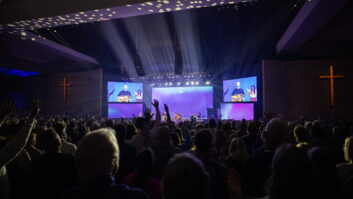
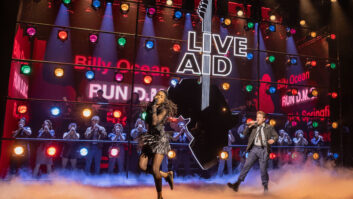
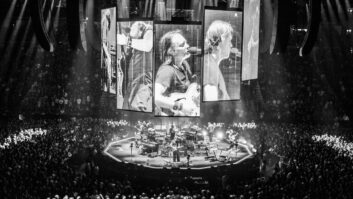
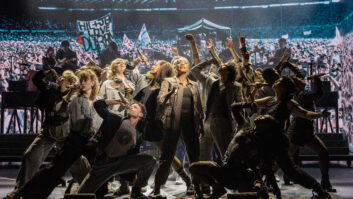
The term live events covers a lot of ground, encompassing concerts of all musical genres, corporate productions such as company presentations and product launches, live theatre – both musicals and plays – plus the opening ceremonies for major occasions like the Olympics. Sport is now coming under this umbrella, with pre-match and half-time shows utilising the kind of sophisticated sound and visual systems previously regarded as the preserve of the rock concert.
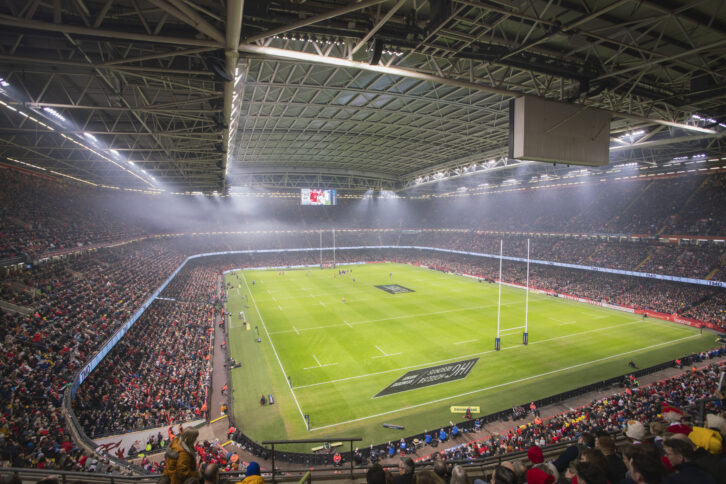
This latter trend has given rise to the multi-purpose stadium, with football clubs in building new stadiums that– while still designed for the core purpose of hosting matches and featuring the requisite public address (PA) and voice alarm (VA) systems – are often equipped with a touring/concert level sound rig. The aim – sometimes with the addition of large-scale video screens – is to bring in touring bands in the off season. A recent example is Everton football club’s new Hill Dickinson Stadium in Liverpool, which has incorporated high-end NEXO GEO M line arrays. Their power did not escape the attention of BBC Radio 5 Live pundit – and former Everton player – Pat Nevin, who said during coverage of the team’s first Premier League game in August: “They’re rock concert speakers. They’re not normal speakers.”
FRONT & CENTRE
Jonjo Glynn, head of event production services at d&b Solutions, observes that for audio, intelligibility and consistency remains critical, while, on the visual side, “LED technology has overtaken projection” for many productions. “Finer pixel pitches are making LED viable even in mid-sized spaces,” he says. “We’re also seeing selective but smart use of augmented reality [AR], XR [extended reality] and holographic displays. Not as gimmicks but as storytelling tools.”
As Rob Fowler, director of business development at Brompton Technology, explains, even in live events, where there might not always be pre-recorded material, real-time graphics can become more relevant through the increasing use of interactive elements. “Virtual production and related areas have really driven growth in tools like real-time graphics engines,” he says. “The push from other industries has advanced these technologies and live events benefit from that. Streaming has also created opportunities, with relatively small amounts of screen technology used to create larger extended sets. You see this in broadcast and live sports events, where small stages can be made to look much bigger. These technologies definitely have made an impact on live shows.”
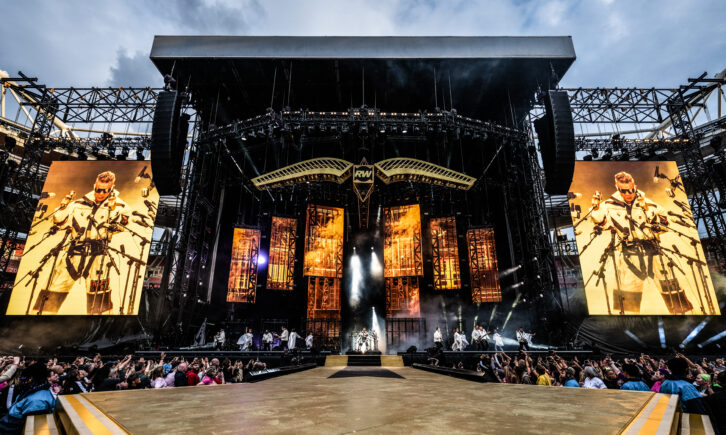
The creative potential of video technology for live events is a major consideration, but so too are practical aspects, including versatility and financial viability. Luke Marler-Hausen, co-territory head for UK rental and staging at Leyard Europe, comments that the market has changed quite significantly to allow for events in all seasons. “For stadium tours there is the realisation that you don’t need to have a pixel pitch [which determines image sharpness and optimal viewing distance] much lower than 5mm, because there’s no benefit to the audience, plus it increases Capex and risk of damage,” he says. “The demand is 5 to 6mm, up to 10mm for doing backdrops. But there is also a desire to move to 3.9mm, which gives the ability to be a dual-season system. It can be used for sports events, concerts and cinema in summer and when the weather turns bad, the same screen can be turned around and used for indoor events. This gives a better return on investment and avoids over-reliance on one income stream.”
Fellow LED screen manufacturer Absen also supplies displays for stadium concert tours but is seeing a growing demand from indoor venues, including theatres. “I think theatre is a very interesting application and since last year we have had a big growth in that area,” says Emma Liu, general manager for AbsenLive. “In the past, people went to see quite traditional shows and a lot of musical events. But now there is a trend for using different technology, like LED displays, which is giving a lot of new life to shows.”
EVOLVING EXPECTATIONS
This is part of what Yann Verhellen, strategic marketing manager at Barco, calls a trend towards “next level experiences”. In stadium and arena production, audiences not only expect more but are increasingly jaded. “Visitors, fans or spectators have seen it all, either by themselves or on Instagram and TikTok. It’s getting harder to impress and attract crowds. New and emerging technologies all contribute to the overall fashion for enhancing immersion. Direct view (dv) LED displays have taken centre stage in many applications, from traditional flat backdrops and IMAGs [image magnification] to the creative digital signage applications by design agency d’strict.”
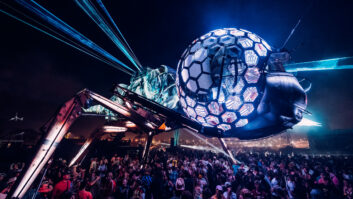
Verhellen also believes holographic displays are catching on, while there is increasing use of transparent LED screens, as seen as part of DJ Eric Prydz’s Holosphere 2.0 venue in Ibiza this year, and projection technology, such as Barco’s 1600 4K projector, which is part of an exhibition at the Matadero Madrid cultural centre. “Projection mapping is still a growing market,” he adds. “Software innovation, together with ever lighter and brighter projectors, is making workflows easier, so more companies are finding their way to mapping projects. We don’t see a material movement in the use of AR/VR in events or venues but we do see many applications of interactive technologies in immersive spaces and exhibitions.”
Video may be Barco’s primary focus but, according to Verhellen, customers often say their biggest headache is audio. This is due to problems with reverberation, speech intelligibility and reflective surfaces that plague many stadiums and arenas, particularly older ones. Rich Soper at NEXO agrees, saying some spaces can be “incredibly harsh” acoustically. “We have strict standards to work to in terms of intelligibility and it can be a challenge when faced with an older venue that was built before those standards existed,” he says.
“Back then, sometimes not much thought was given to acoustic response that could have a very long reverberation time. These days the main challenge is finding a compromise between all the different disciplines involved. Although new stadiums are built with far higher levels of attention to acoustic response and the potential for amplified entertainment, the function, capacity, cost and aesthetics can all take priority at times, which leaves us struggling to achieve what is required when the architect doesn’t want speakers hung from certain areas, the venue owner doesn’t want them to be seen, or we can’t put any in particular areas due to structural issues.”
Antonio Ferrari, director of RCF’s engineering support group, says the attention to audio quality and performance today is “ever greater” for live events, particularly in multipurpose stadiums and arenas, which already have to operate according to standards laid down by football governing bodies FIFA and UEFA, as well as technical guidelines, including EN 50849 and EVAC-EN54 for emergency announcements and fire alarm/detection systems respectively.
GENERAL TRENDS
As for general trends in AV technology in live events, Ferrari highlights the need for increased control over coverage. To achieve this, RCF, like other leading brands, has produced cardioid cabinets that “focus all the energy solely on the frontal emission, increasing intelligibility and minimising bleed on stage, walls and ceilings”. Alongside these, Ferrari sees modular line arrays suitable for articulated deployments as necessary for even distribution. “We are seeing a clear rise in venues requesting a single infrastructure that can accommodate sports, entertainment and corporate events,” he says. “Our rule is: design to the most demanding application, then scale down.”
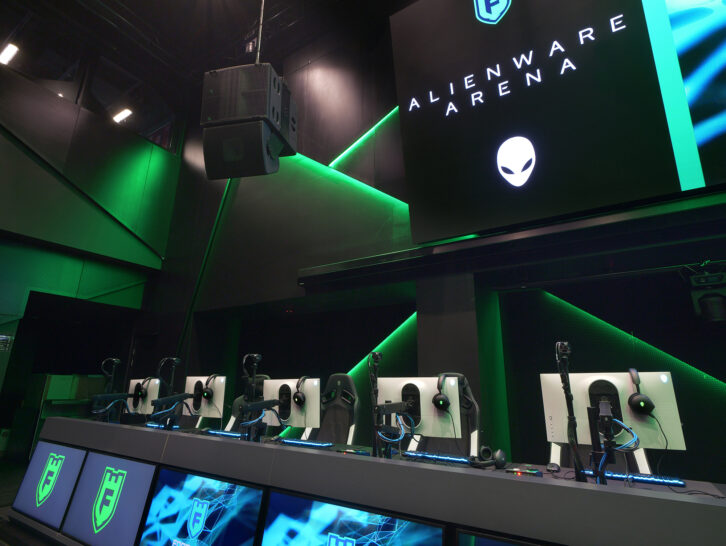
Ferrari adds that many multi-purpose and hybrid venues today are looking for standardised Audio over IP/AV over IP (AoIP/AVoIP) infrastructures, which allow for the scaling of installations to match event requirements, fully remote monitoring and beam-steering or immersive audio options. Austin Freshwater, managing director of console manufacturer DiGiCo, says immersive/spatial audio continues to be a hot topic. The company has worked with major PA brands to integrate suitable workflows into its consoles. “There is the realisation that the equipment being specified and installed in venues must be at the top end of the market to help attract the business the operators are after,” he says.
A key element is the microphone, particularly wireless devices. These have enabled the free-moving stage shows, unencumbered by cables and wires, that audiences expect today. Musical theatre set the standard for this in the late 80s and into the 90s; rock concerts have also taken this route, primarily for lead singers and instruments, although David Byrne’s American Utopia shows took the concept to an extreme with the entire band on wireless systems and no fixed equipment on stage. Corporate events have also seen the benefits and potential of this technology, with a presenter not only being able to work hands-free but roam through the auditorium and interact with the audience.
DEMANDING COMPLEXITY
“Productions are more demanding than ever and not getting any less so,” says Matt Forgey, market development manager at Shure. “Shows are getting more complex and advanced, especially in our world of audio and RF,” he comments. “There are also new regulations, especially from the FCC [Federal Communications Commission] in the US. What’s also interesting is that, previously, the different markets were segmented and well-established. There were instrument microphones for one segment and other types for conferencing. Over the last five to ten years we’ve seen a blending of all those verticals.”
This, explains Forgey, includes new conference facilities being built that include live performance spaces as well as meeting areas. “It’s not just an arena or a theatre, it’s an entertainment complex that maybe has a sports venue and is also a conference centre. There’s more integration between the RF and conferencing worlds than there was before. General corporate sessions now often have a live performer and events are just getting bigger. What there is now is a merging of corporate and touring and it’s an interesting challenge to fulfil those needs.”
The major obstacle to using wireless mics is spectrum, with more productions jostling with each other for usable frequences. “There’s a move into any spectrum that is legal and available to use,” Forgey says. “We have less spectrum available than ever and are sharing it with more people. Because of that we’re all about spectral efficiency, with technologies like WMAS [Wireless Multi-Channel Audio Systems, which was designed specifically for live events] in our new ADPSM wireless monitor system, which allows you to fit more channels in less [bandwidth] space.”
Like other AV technology manufacturers, Shure is producing systems with a “digital-first audio transport mentality”, using AoIP protocols and standards including Dante and AES67, as well as MADI and more general IP formats such as SMPTE ST 2110, while others are also looking at AVB Milan.

“Networking is absolutely a major consideration now because it’s what makes modern AV systems work as one,” observes Kathryn Taub, senior product marketing manager at Audinate, developer of Dante. “Every project starts with the network design because that determines how audio, video and control will connect, scale and stay in sync. Without that foundation, you can’t deliver the level of coordination people expect today.”
DEMANDING COMPLEXITY
Although everything today is predominantly in the digital domain, there are still differences and incompatibilities between the different networking and media transport systems. “Interoperability is one of the toughest parts,” agrees Taub. “Dante takes a multi-vendor approach, so products from different manufacturers can operate together on the same network. That extends to broader IP-based media protocols, including compatibility with ST 2110, which is gaining popularity in live video production. The need for flexibility in stadiums that might be hosting sports one day and a concert or a corporate event on another is driving the move toward fully networked infrastructures with audio, video, lighting and control all running on the same backbone so the space can be reconfigured quickly.”
This makes the installation and integration of all different technical components a critical factor, especially for multi-purpose operation. “Technology that enables this flexibility is crucial,” concurs Sarah Gellas, communications director of installation and hire company RG Jones Sound and Light. “Solutions like DirectOut’s PRODIGY range of processors, matrices and converters allow us to manage complex signal routing and interoperability. Shure’s Axient digital microphone systems and the latest in-ear monitors deliver stable RF performance and reliability in the most demanding environments.”
Megan Zeller, senior director of business development of Peerless-AV, comments that “AV technology continues to redefine the live event experience”, from stadiums and arenas to theatres and multi-purpose venues hosting concerts, corporate presentations and other live performances. Zeller highlights dvLED as being central to venue design today, with screens being deployed beyond the central pitch or stage. “Press rooms, partner suites, fan engagement zones, training facilities and even player tunnels are incorporating LED to elevate both operational efficiency and the overall visitor experience,” she says. “And choosing the right mounting infrastructure also plays a critical role in enabling convenient maintenance, long-term performance and flexibility to adapt to evolving technology needs.”
TECH SPOTLIGHT
The realisation that the ancillary areas of a venue are just as important as the central performance space, and support the live events being staged there even though they are not directly part of them, has put the spotlight on technology that previously had been associated with other applications. “Digital signage plays a bigger role than people often realise,” says Jonjo Glynn at d&b Solutions. “Beyond branding, it’s about dynamic wayfinding, live data integration and safety messaging. This is all part of shaping the audience journey from arrival to departure. Smart signage systems are now integrated into the wider venue network rather than existing as standalone elements. They also allow spaces to be transformed from daytime data to content display.”
Leyard Europe’s Luke Marler-Hausen acknowledges that digital signage plays an important role once people are in the venue lobby or on the concourse, but adds that other video systems are key to raising the profile of venues today. “Operators now look to do more with creative LEDs, like pucks, bars and other lighting fixtures, as well as generic video effects over the stadium or arena,” he believes. “Then there are the ribbon and perimeter screens, which are part of revenue generation. It’s all about selling the venue.”
The live event itself – whether it is a concert, play or football match – is, of course, the main attraction but venues of all types are no longer just about the performance or playing space, they are a place to come, eat and drink, generally get in the mood and then see the show or game. Which makes live events even more of an event.