Live sound should not be easy to ignore. It delivers the core of a musical concert but audiences – and even ardent fans – often focus more on an artist’s performance and the overall staging, only really considering the audio if it is particularly good. Or particularly bad. This emphasis on the visual aspects of a show was obvious at many trade exhibitions during the 1980s and into the 90s. While audio companies would have to keep levels down, their lighting and stage effects counterparts seemingly had the freedom to dazzle visitors and squirt smoke into the aisles.
AUDIO EVOLUTION
Encouragingly, this year’s ISE showed that those days were very much in the past with its dedicated Audio Zone and Sound Experience areas, the latter being home to demo rooms featuring the leading live sound manufacturers. The stated aim of the Audio Zone was to highlight “the increasing levels of interoperability, which has made systems more affordable, controllable and flexible”, alongside signal processing, transport, 3D spatial audio and “cutting edge of loudspeaker design”.
Indeed, the continuing development of integrated systems was reflected in a Futuresource Consulting report published prior to ISE, showing that while the professional loudspeaker market continued to grow, particularly where high-end productions were concerned, “simple box replacement” was no longer the priority. Instead, solution-led specifications were now leading the way, with loudspeakers being part of a greater whole alongside DSP, amplification, monitoring and control systems. This approach is reflected across the market, with manufacturers such as Adamson Systems Engineering developing systems that operate as part of wider, integrated audio environments, whether for touring productions, festivals or installed performance spaces.
Futuresource also found that top-end touring remains the primary market but is now followed closely by large installed estates in leisure and commerce. In both cases, a major element of systems and installations is an integrated audio ecosystem, instead of traditional, individual hardware devices.
Due to the high level of investment involved, venue operators are not looking for high-quality sound performance alone but also the ability to adapt spaces for different productions, changing the system configuration quickly and easily. This requirement is as financially and commercially motivated as it is based on any technological imperative. As Peter Hunt, founder and managing director of acoustics, AV, IT and theatre consultancy Hewshott, observes, when a developer or public body spends millions on a building, they do not want it to sit idle.
MULTI-PURPOSE VENUES
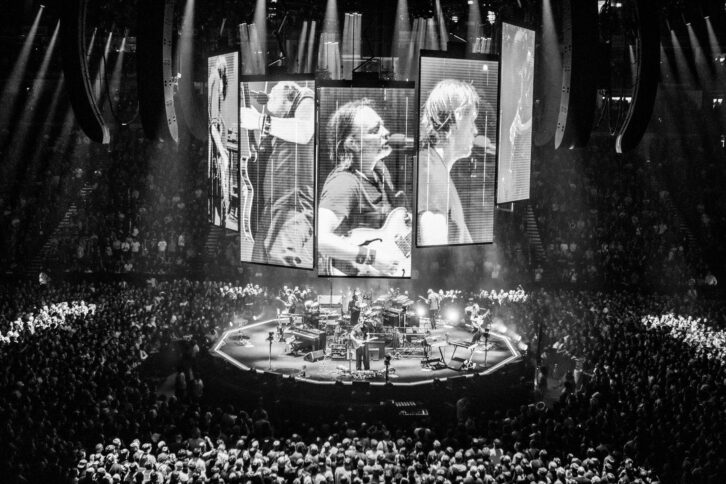
Hunt explains that buildings need to have a multi-purpose element to them: “Even something as grand as a concert hall needs to work five, six or seven days a week, not just sit there ready for when a symphony orchestra happens to turn up.” Hewshott has branches in India, Singapore, the UK and the US, with its Australian office in the Perth suburb of Subiaco more focused on live sound and venue production. From an acoustics design and sound system specification perspective, Hunt comments that the aim today is to give everyone in the audience, no matter where they sit, the same experience.
Artists now tour with a sound system to deliver all this but it can still be difficult in regions outside North America and Europe, where the cost of transporting a rig is high, if not prohibitive. Consequently, touring acts are increasingly relying on either hiring systems from local suppliers or using in-house rigs at venues.
This second option is now more viable as more stadiums, concert halls and arenas install gear that is essentially what bands would have on the road. AV systems integrators are now moving into this burgeoning area, including Diversified, which previously concentrated on classrooms, corporate offices, houses of worship and broadcast facilities.
SYSTEM CONFIDENCE
Last year Diversified launched a performance division, headed up by director of strategic accounts for performance spaces, Aaron Beck, who has a background in live sound that includes Broadway musicals and six years as head of audio for the Cirque du Soleil Entertainment Group. From this perspective, Beck confirms that touring engineers are now feeling a little safer using a house system than in the past because the quality of installations has reached a higher level.
But overall Beck sees infrastructures and the way audio is transported nowadays as having drastically changed, which has called for different approaches technically and operationally. “It’s a balancing act because AVoIP requires a higher level technician,” he says. “As integrators we see it more in the small to mid-sized venue where there’s still a lot of copper and analogue infrastructure being put in because it’s a little easier to operate a venue. But larger venues with a higher level technical team might be able to utilise a network-based audio system.”
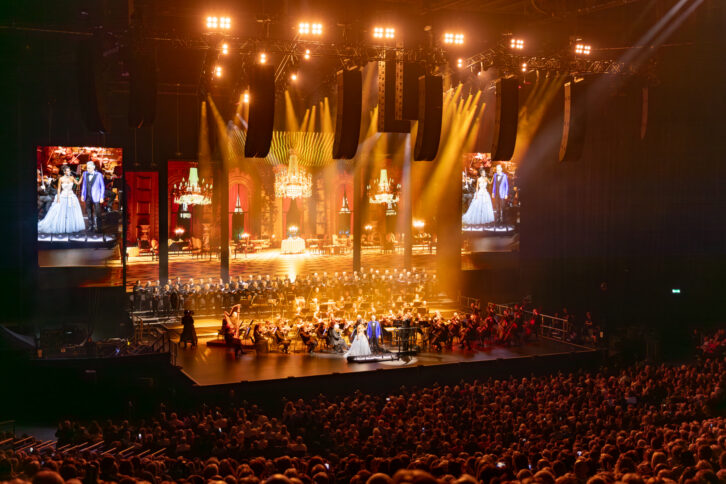
Talking to integrators, hire companies and sound engineers over the last few years, it has become clear that those running or designing systems today have to be IT technician and audio engineer in equal measures, if not more biased towards the former. Hire companies are an important part of this transition.
Bryan Grant, non-executive director of Britannia Row (part of the Clair Global group), says IT integration is an integral part of any large production and highlights the need to train technicians in both touring and fixed installations. When it comes to where investment in technology is being directed, Grant says this depends on the specific market. He adds that international tours and, increasingly, major installations tend to focus on a relatively small number of brands for both loudspeakers and control.
Live sound engineers, both front-of-house (FOH) and monitors, have seen a substantial amount of change in technology and how it is used for live performance. The shift towards IT-based working is just the most recent, following on from the adoption of digital consoles and the almost all-conquering march of line arrays. How people are spending their money and on what has varied in recent years.
Independent sound engineer and tour manager Tim Boardman observes that 12 to 18 months ago he would have said investment was going into consoles and RF equipment due to the rise of control-only hire companies. “Over the last year or so we’re seeing a lot of these either absorbed into the larger companies or having to invest in loudspeakers and amps,” he says. “Several engineers I have spoken to point to artists and engineers owning their own consoles, which has definitely led certain people to pivot how they look at investment.”
INNOVATIVE TECH
When it comes to innovative technology making it into the real world, Boardman cites the Sennheiser Spectera bidirectional, wideband digital wireless system, which he tested on arena tours last year. “It was great to see them make it from testing out into the wild,” he says. “One I’d like to see more of but seems to be rare is the L-Acoustics L-ISA immersive system.” L-Acoustics was at the forefront of the line array boom during the mid to-late 1990s, which substantially changed the way live sound systems were designed and specified. But while the line array has played a key role in the evolution of the large-scale stage productions that are now expected from leading artists, systems that preceded it helped create the template for what we see now.
Two of the most spectacular touring shows of the early 90s were U2’s Zoo TV Tour, which was among the first to utilise two stages along with video screens for interactive content, and Pink Floyd’s Division Bell Tour, captured on the Pulse release, which continued the band’s established approach to large-scale staging. Zoo TV Tour’s sound system was based on Clair S4 all-in-one four-way boxes, plus the then new P4 trapezoidal cabinet, while the Division Bell Tour featured Turbosound’s Flashlight multi-box point source rig. Today, line arrays dominate the productions that are the 21st-century equivalents
of those trailblazers.
CAPITAL EXPENSE
In keeping with the Futuresource report’s findings, L-Acoustics’ director of product management, Scott Sugden, views the sound system as the big capital expense for most productions. While that initial investment is high, there is the financial consolation that loudspeakers generally have a long lifespan.
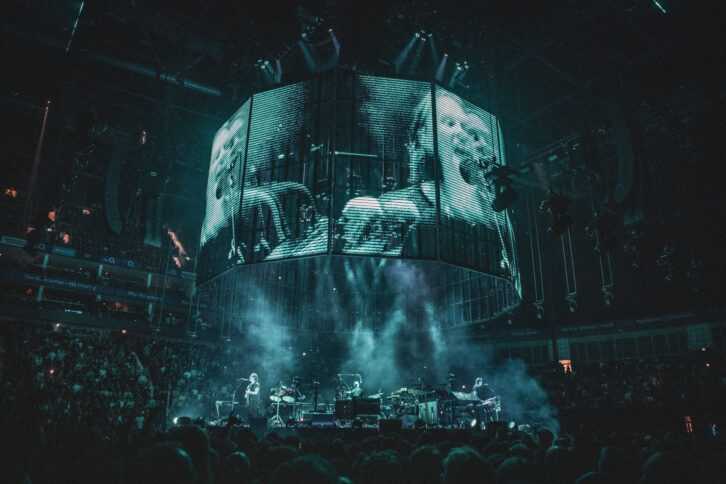
“The K1 has been out since 2008 but in that time the predominant mixing desk has probably changed five or six times,” he says. Sugden adds that a music genre often dictates what technology is used, with EDM (electronic dance music) festivals usually not requiring a big mixing desk with lots of inputs but still needing a large, powerful sound system. This has helped reinforce the position of large-format line array platform solutions, particularly in vibrant festival environments where scale, consistency and coverage are critical.
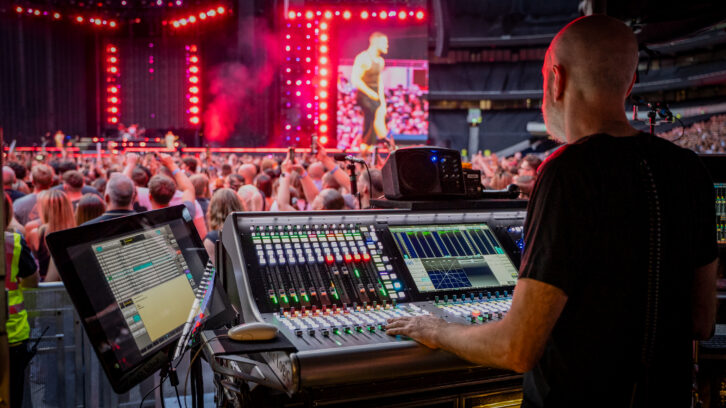
For other musical styles and productions, the console remains a creative and technical focal point, through which the FOH engineer both recreates the feel of the original recording and produces a mix that pulls the audience in. But, as networks and infrastructures grow, consoles are moving beyond that single, albeit important, function to become the central hub for networking and routing the multitudinous signals now necessary to run a show.
“While the underlying technology is critical, the goal is always to let that act as a foundation, enabling the creative aspects of audio to remain the primary focus for the engineer mixing and operating the console,” says Tom Knowles, director of product management at Solid State Logic (SSL). He adds that different options are still necessary, including MADI and Audio-over-IP (AoIP), usually in the form of Dante and AES67 for highly flexible routing.
IMMERSIVE AUDIO
The next big thing in live sound, which is mainly still the preserve of flagship tours and installations such as The Sphere, is spatial or immersive audio. This has been a longer time coming than many who are now familiar with Dolby Atmos might think. Back in the early 70s Pink Floyd used quadrophonic systems to surround their audiences with sound. But this was a more conceptualised use of the technology, which not only recreated the soundscapes of The Dark Side of the Moon but brought the songs to life in a more intimate way.
There is a degree of that in the way systems such as L-Acoustics’ L-ISA, d&b Soundscape and Atmos are being used but the overall aim is to create an immersive experience in the venue that ties to the stage performance and video content. Peter Hunt at Hewshott agrees that immersive audio can be compelling but how successful it is for productions depends on skilled system design, programming and operation, which calls for experienced crew. Diversified’s Aaron Beck is seeing mid to large venues investing in this technology and views AI-assisted mixing technologies as a means to dramatically reduce set-up time.
While L-Acoustics is doing, in the words of Scott Sugden, more projects than ever with spatial sound through its L-ISA system, Brit Row’s Bryan Grant says it is expensive in terms of equipment and personnel, particularly for touring, and does not suit all genres of music. Tim Boardman is more optimistic, saying there is definitely space for it, with more purpose-built venues for individual shows – such as ABBA Voyage, which features L-ISA – being created.
SYSTEM EVOLUTION
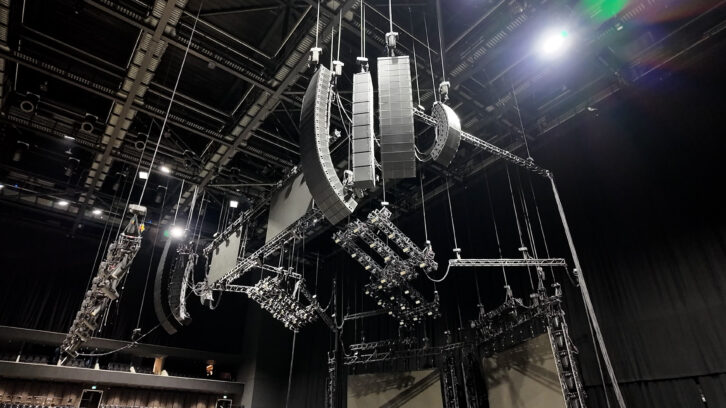
For productions that either cannot afford immersive or don’t feel it is right for them, the line array continues to be the go-to system, although point source has had something of a revival for smaller shows and venues. There is the feeling that now sound systems have reached a level of consistency where quality is concerned, the whole technology sector might be at risk of levelling out, which could lead to a decline. Line arrays continue to develop, with manufacturers producing smaller and more efficient versions with improved hanging options. Companies such as Adamson have focused on high-output, tour-ready line array platforms designed for scalability and precise coverage, reflecting the continued demand for systems that can adapt to different venue sizes and performance requirements, particularly across large-scale touring productions and festival environments.
Spatial audio promises much and designers and engineers are taking advantage of that , which may inspire more uptake in the future. SSL’s Tom Knowles says: “How the technology is accessed and experienced is fundamentally more important than the technology itself”, with good design and thoughtful development as necessary to the creation of new systems as the hardware and software.
The live sound touring and performance market has made a stunning comeback in the years following the pandemic. While there are still concerns about a shortage of experienced engineers and technicians, the sector appears vibrant, which should attract new talent, and it’s hard to believe that its evolution won’t continue.
You can subscribe to Installation magazine for free here and the daily newsletter here.