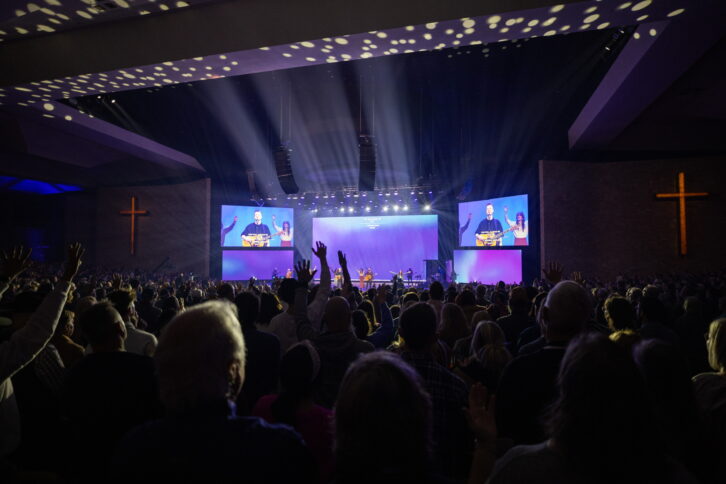
For many years, technology in houses of worship was largely associated with delivering intelligible speech and high-quality music reinforcement to congregations gathered inside a single building. Today, that remit has expanded dramatically, as the convergence of pro AV and broadcast disciplines reshapes what a worship space can be. Increasingly, churches are expected to create professional-quality content for audiences watching online, support hybrid forms of worship and engage communities that may never physically attend a service.
The result is a significant evolution in the way worship spaces are being designed. Audio remains the foundation of most installations, but video production, lighting, networking and broadcast infrastructure are playing an increasingly central role. Broadcast workflows and, increasingly, virtual production techniques are beginning to influence both permanent installations and live event production, offering new creative possibilities while making content creation more flexible and cost-effective.
 GOING LIVE
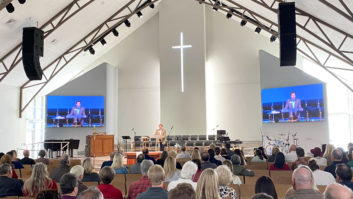
The pandemic accelerated livestreaming across every denomination, but many organisations have continued investing long after restrictions ended. What began as a necessity has become an established communications strategy, with weekly services now complemented by podcasts, Bible studies, conferences, concerts and social media content. Large US ministries such as Elevation Church, Life.Church and Church of the Highlands now produce content for audiences numbering in the hundreds of thousands, while many smaller churches have adopted production standards that would once have been associated only with regional television broadcasters.
That shift has brought broadcast disciplines into environments traditionally served by pro AV. Camera shading, colour management, graphics, replay systems and remote production are no longer confined to television studios. Many larger houses of worship now operate production facilities comparable to regional broadcasters, supported by IP networking, software-defined workflows and increasingly sophisticated control rooms.
The convergence between AV and broadcast is particularly evident in signal transport. SMPTE ST 2110, NDI and other IP-based workflows are allowing video, audio and control data to move more freely throughout increasingly complex facilities while reducing dependence on fixed point-to-point infrastructure. At the same time, software-based production tools are lowering barriers to entry for smaller organisations that previously lacked the resources for traditional broadcast equipment.
NEW ENVIRONMENTS
Virtual production represents the next stage in that evolution. Rather than relying solely on physical stage sets or conventional projection backdrops, churches are beginning to explore LED volumes, extended reality (XR) environments and real-time graphics powered by game engines.
Although adoption remains relatively limited outside North America’s largest ministries, early adopters such as Transformation Church in Oklahoma and James River Church in Missouri have demonstrated how LED volumes and virtual environments can support sermons, worship, conferences and online productions without the need for extensive physical scenery. A single stage can become multiple environments, reducing setup times while increasing creative flexibility and allowing production teams to repurpose spaces throughout the week.
Importantly, virtual production is not simply about visual spectacle. For many organisations, the objective is to communicate more effectively with online audiences while making better use of production resources. Facilities that once sat largely idle between weekend services are increasingly being used to produce training materials, interviews, youth programming, podcasts and community content, extending the value of technology investments well beyond the Sunday service.
Audio nevertheless remains at the heart of most houses of worship projects. Speech intelligibility, musical excellence and volunteer-friendly operation continue to shape technology decisions, with networked audio, digital mixing, wireless microphone systems and loudspeaker optimisation often representing the largest areas of investment. Manufacturers including L-Acoustics, d&b audiotechnik, DiGiCo, Allen & Heath, Yamaha and Shure continue to invest heavily in the worship market, reflecting the sector’s ongoing importance to the professional audio industry. Virtual production therefore complements, rather than replaces, the core disciplines that have long defined worship technology.
As churches continue to balance in-person worship with digital engagement, the distinction between pro AV and broadcast is likely to become increasingly blurred. Whether through IP networking, software-defined production or virtual environments, the common objective remains the same: creating flexible technology platforms capable of supporting meaningful communication across multiple audiences and multiple channels.
For integrators, that evolution reflects a broader shift towards designing worship spaces as integrated production environments, where audio, video, lighting and broadcast workflows are planned together from the outset to serve both the congregation in the room and the communities connecting from elsewhere.
You can subscribe to Installation magazine for free here and the daily newsletter here.