From festivals and concert venues to museums and corporate meeting rooms, the boundaries between lighting, audio and video are dissolving. Immersive environments are driving a fundamental shift in how these three disciplines are designed and deployed – and the industry is reorganising itself to keep up.
Lanz Short, global director of solution design at Disguise, puts it like this: “You don’t want people to go, ‘that was amazing lighting,’ or ‘that was amazing video’. You want them to say, ‘that was a really immersive environment.’ And to do that, you need everything to be acting as one.”
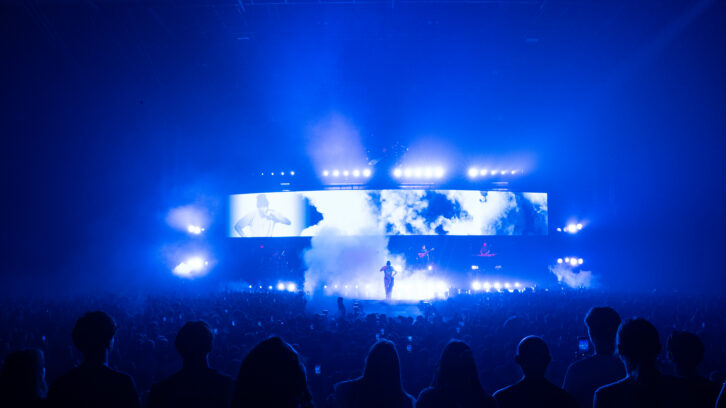
It is a sentiment that captures where the industry finds itself in 2026. AVL is not a new acronym, but Short acknowledges that while he has not commonly heard it used, it reflects how production is now evolving. The three disciplines have long coexisted in live production environments, but lighting in particular was often treated separately within pro AV, more closely associated with touring shows, theatre and entertainment than with integrated system design. For much of the industry’s history, a lighting designer and an AV integrator might work on the same project without ever meaningfully collaborating. That separation, he says, is now breaking down.
The shift is being driven by a combination of technological and experiential factors. LED technology has blurred the boundary between lighting fixtures and display surfaces, while media servers and show-control platforms are increasingly capable of managing lighting, video and audio within shared software environments. At the same time, IP-based networking and protocols, such as Art-Net and sACN, are bringing lighting infrastructure onto the same data networks that already underpin AVoIP and AV control.
But an even deeper driver of the trend is experiential, as audiences in museums, themed attractions, concert venues and brand activations are demanding more unified sensory narratives. As a result, the industry is having to reorganise itself to deliver them.
Alexis Reymond, CSO at Naostage, frames the shift in more conceptual terms, describing it as a structural change in how experiences are designed. “Storytelling is no longer linear or siloed – it has become systemic and interactive,” he says. “Lighting, audio and video can no longer operate as independent layers. They are part of a living ecosystem.”
Reymond describes this as a Storyplex — an environment in which every medium contributes simultaneously to meaning and perception, and in which the boundaries between disciplines dissolve in service of a shared creative vision. In practical terms, it is a design methodology that requires all three disciplines to be considered together from the outset, rather than integrated after the fact. For vendors and manufacturers, it represents a significant product challenge. Tools, platforms and fixtures increasingly need to speak to all three disciplines simultaneously rather than serving a single domain. For Reymond, the convergence of AVL is not simply a technical development but a fundamental shift in how experiences are conceived and authored.
TECHNICAL RELATIONSHIPS
At the centre of this convergence sits the media server, although as Short points out, that term is increasingly inadequate for what these platforms now do. Short explains the technical relationship between video and lighting control that makes media servers such a natural home for both: “Using the word media server is a little bit of an old phrase – we are doing
so much more than just serving media. We are controlling the lights, playing audio, doing the video. One pixel is essentially one light: you’ve got the intensity, and then you’ve got RGB. And with a media server you’ve got millions of pixels, so when people use a media server to control lights, you can actually control thousands of universes of parameters – way more than with a lighting desk. At Disguise we’re also interfacing with AI systems, real-time rendering engines and live data inputs.”
Wouter Verlinden, product manager for creative LED, lighting and control at Martin Professional, frames the broader AVL shift in terms of fixture design as well as control. Martin’s P3 system controller allows fixtures and video surfaces to be addressed and mapped within a unified visual framework, treating the entire installation as a single canvas regardless of whether individual elements are luminaires or display surfaces.
A permanent exterior installation at a private Los Angeles residence, delivered by integrator Kinetic Lighting, put this into practice across 5,000 Martin Exterior Dot-1 Pro fixtures. Using P3, Kinetic mapped every fixture into a single control environment, giving the client access to more than 400 individual programmes blending lighting movement, colour and video-inspired content.
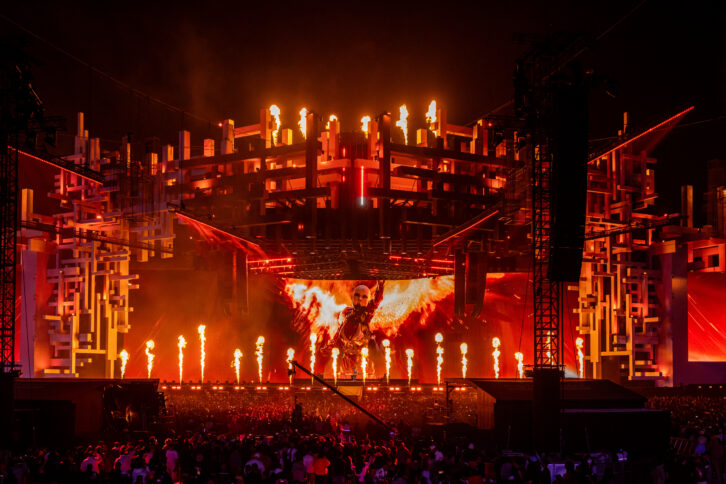
That meant the client could select entirely different lighting and video looks across the landscape from a single interface, with content flowing seamlessly across fixtures without requiring individual programming per zone. Verlinden says: “Modern luminaires are designed to operate across multiple roles – key light, effects and ambient – making them inherently more adaptable within broader AVL systems. This flexibility supports system-wide coordination rather than siloed design, allowing lighting to function as part of a larger storytelling platform.”
IP BACKBONE
Several contributors feel the move to shared IP infrastructure is one of the most significant enablers of AVL convergence, though it is also one of the least visible. Lighting control has historically relied on DMX over dedicated five-pin cabling, a world apart from the IP networks carrying audio and video in modern installations. Short says: “In the past, lighting desks were sending out DMX down a five-pin cable. Now it has to be IP – using Art-Net or streaming ACN to control them. That’s the only way.”
Verlinden sees shared IP infrastructure as doing far more than simplifying cabling. Lighting systems can now operate on the same networks as audio and video, which simplifies system design and enables more scalable, unified solutions. “It removes the need for dedicated lighting-specific cabling to be built into a venue, allowing lighting to be deployed more flexibly within existing AV infrastructure,” he says.
Joel Mulpeter, senior director, product marketing, Crestron, makes a similar point from a corporate AV perspective. IP networks are becoming the backbone of lighting as they are for nearly everything else in modern facilities, including AV. “If all of an organisation’s video and audio traffic is being handled by the network, there’s no reason that lighting should be any different. It’s an approach that streamlines everything, from cabling to system management,” he says.
Helping to accelerate integration further is GDTF – General Device Type Format – an emerging standard for describing lighting fixture personalities in a consistent, interoperable way. Short explains that a personality defines how a control system talks to a fixture. Channel one might be intensity, channels two, three and four RGB, followed by pan, tilt and a range of additional parameters.
Historically every manufacturer, desk and media server had its own way of encoding that information, creating friction whenever a fixture needed to work across platforms. GDTF establishes a shared format and crucially carries additional data, including a 3D model of the fixture for use in visualisation software.
For integrators, the practical benefit is significant: less custom personality work per project, faster deployment and more reliable behaviour when fixtures move between platforms or productions. Short says: “With this new format, it’s easier to transfer data between systems. Working at Disguise, we can export the GDTF format, and any lighting desk that supports GDTF can bring it in.”
EARLY COLLABORATION
Verlinden points to the Royal Opera House in London as an example of what early cross-discipline collaboration enables. “Productions often return to repertory after long periods, and lighting systems must recreate looks accurately while integrating with evolving staging and broadcast needs. Earlier collaboration between disciplines means better, quicker results in the long run,” he says.
Joel Mulpeter sees more collaboration than ever before, but he is blunt about how far the industry still has to go. The best results are obtained when lighting designers, integrators and creative technologists such as interior designers are all at the table at the outset of any project, but it is not yet as pervasive a practice as he would wish. “Buildings go up in phases, so decisions are made in phases,” he says. “The more those phases are in sync, the better the outcome’s going to be. But someone deciding on lighting when there’s no concrete poured anywhere or no plans finalised can be making a decision that impacts results further down the line if it’s not done with everyone in the same room at the same time.”
Those initial talks can have long-term consequences. When lighting is integrated into the broader AVL platform from the design phase, it influences network architecture, bandwidth planning and system infrastructure decisions that are difficult to revisit later. Protocol mismatches in particular can derail integration at a late stage. Mulpeter says: “If you can’t talk to the lighting system because it’s on a different network or uses a protocol that’s not supported, that’s a challenge that needs to be ironed out early, so all of your networked solutions can harmoniously talk to one another.”
IMMERSION IMPERATIVE
Not every project demands full convergence. The right architecture still depends on what the lighting is actually doing. Short says: “If you’re going to deal with moving lights, I’d stick with separate lighting control for that. If the lights aren’t moving and it’s just a static light changing colour, I’d move it onto a media server.”
The immersion imperative is also reaching into spaces not immediately associated with experiential design. As cameras proliferate in meeting rooms and hybrid working drives demand for broadcast-quality results, lighting in corporate environments is becoming a technical consideration rather than an aesthetic one. Mulpeter adds: “Cameras can do great things with white balance and other functions, but they can’t work miracles. For those attending a meeting in person, long sessions in poorly lit spaces can be extremely fatiguing. The right lighting becomes important to help people stay engaged.”
SHIFTING CONVERSATIONS
What is clear, across live events, permanent installations and corporate environments alike, is that the conversation has shifted. Lighting is no longer the discipline that gets added after the video and audio systems are designed. In the most ambitious installations – and increasingly in everyday ones – it needs to be part of the conversation from the start.
In our second article, coming soon, Installation will explore the operational realities of AVL integration in depth. We will consider the workflow challenges, the role of AI-driven show control, real-time rendering, and the question of whether the lighting desk as a distinct tool has a long-term future in an increasingly unified AVL world.
You can subscribe to Installation magazine for free here and the daily newsletter here.