The first half of this decade reminded us that the quicker we can adapt, the better off we are. AV over IP (AVoIP) systems aim to speed up this adaptability, making it easier for those charged with managing the technology to respond as their organisations expand, contract and evolve.
For Marcus Bengtsson, CTO at Original Syndicate, a communications infrastructure design and integration firm, systems designers should consider implementing an AVoIP backbone in every installation they oversee. He argued that it offers greater flexibility and scalability and, in many cases, costs less than technology that runs over copper cables.

However, this isn’t a blanket argument. There are projects for which AVoIP may not be the best solution, not because of the technology itself, but because of the people charged with managing it.
“Traditional baseband video is relatively simple to understand: It’s very easy to troubleshoot, it’s very easy to install, and you know very easily when something is wrong,” said Bengtsson. “The answer to whether AV over IP is a bad idea or a good idea is probably more down to what people in the organisation will own the system long-term. Do they have the capabilities of actually troubleshooting or fixing a network that needs to be designed [for] AV over IP?”
Seth Warner, US sales manager at PlexusAV, identifies auditoriums, classrooms, command and control centres, divisible spaces, enterprise campuses, houses of worship, training facilities and any other environments in which sources and displays don’t reside in a single room as ideal candidates for AVoIP. He said the possibilities become more interesting when AV is considered part of the system infrastructure.
“Once AV becomes part of the network architecture, the system is no longer limited by fixed matrix switch sizes or rigid cable paths,” added Warner. Instead, sources can be shared and spaces reconfigured much more easily when necessary. “A system can grow without tearing apart the original design.”
Like Bengtsson, Warner acknowledged that AVoIP isn’t always the best choice, particularly for single-source, single-display spaces that don’t require remote management and aren’t expected to expand.
“The mistake is assuming every AV problem needs a networked AV solution,” he said. “Sometimes the smart design is the simplest design.”
However, Warner added that companies often miscalculate how quickly their needs will change or whether they will eventually need to repurpose spaces or extend their capacity.
Networks and segregation
Some applications require sources to move between spaces rather than remain permanent fixtures in a particular room. An AVoIP infrastructure makes this easier to manage, according to Joe da Silva, vice-president of marketing at Extron.
“Regardless of the venue, configuring multiple CATx drops and network ports in a video VLAN enables simple reconfiguration of sources, encoders, decoders, displays, and spaces,” said da Silva.
For example, encoders and scaling decoders can be installed on mobile carts, with or without dedicated sources and displays, and connected to any RJ45 port on the AV network. He noted that the AES67 protocol enables AV professionals to achieve accurate, more efficient control and routing to amplifiers, DSPs and speakers. The system can also be configured for ease of use.
While there may be a tendency to make infrastructure as fast as possible to allow for future expansion, adopting the most powerful technology isn’t always the wisest approach, according to Bengtsson. More powerful infrastructure may be more affordable, but installation complexity remains significant – and the solution may be overkill.
With network speeds ranging from 1G and 10G to 25G and potentially 100G, AV designers and integrators should instead ask what a system needs to do and what level of audio and video quality is sufficient. The challenge is translating these requirements into terms the end customer can understand.

“The challenge lies in quantifying quality in a sense that a person who isn’t necessarily equipped or skilled to do these things themselves has something to relate to,” added Bengtsson.
Brandon White, director of product development at Vanco International, explained that 10G systems are usually specified for larger installations or applications requiring low latency, higher resolutions, higher frame rates or greater signal quality. However, switches, cabling and general infrastructure tend to cost more.
“A 1G system is usually more cost effective and can be a very strong fit for many commercial AV applications,” said White. “Latency on 1G systems has also improved over time, with some solutions now offering very low latency compared to earlier generations.”
One of the first decisions AV designers, integrators and their clients must make is whether to put AV assets on a converged AV/IT network or keep them separate. Leveraging an existing converged network can save time and reduce capital and operational expenditure, da Silva noted, but not all codecs perform well in a converged environment.
He encouraged AV professionals to select purpose-built solutions, such as Extron’s PURE3 codec, which was specifically designed for AVoIP systems.
At Original Syndicate, Bengtsson advises segregating AV from IT, even if doing so increases costs. He said this provides a clear division of responsibilities: the AV team oversees the AV communications network, while IT oversees its own network, regardless of whether personnel are employed internally or outsourced.
“If you can afford it, it’s always going to be beneficial from a performance point of view, from a long-term maintenance point of view and from an ownership point of view,” he added.
Scalability considerations
Symetrix CEO Mark Graham argues that defining scalability cannot be reduced to counting endpoints. A truly scalable system can be expanded without major redesigns, performance compromises, more complex management requirements or prohibitive costs.
While scaling capacity may make it easier to plan for the future, particularly on large projects, organisations risk paying for capacity they don’t use and locking themselves into an inflexible environment. Incremental scaling, by contrast, is more adaptable to change and better suited to phased deployments.
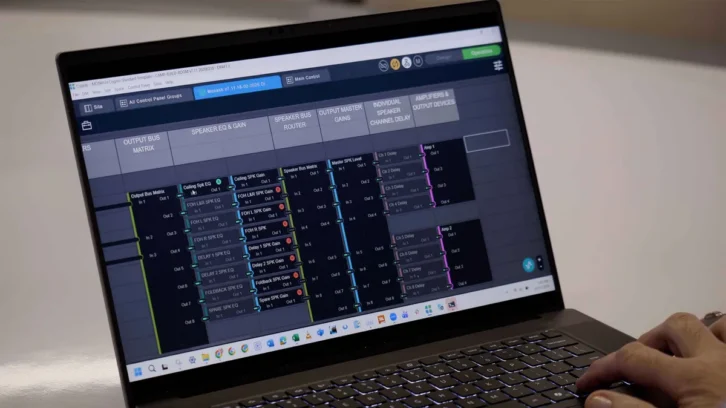
Symetrix’s Cognio platform is designed to support phased project deployments.
“It allows systems to start with what is needed today and expand intelligently over time as requirements become clearer,” said Graham. “For AV professionals, that matters because most customers cannot define their ultimate system size on day one.”

While scalability should be considered for almost every project, Graham points out that AVoIP platforms should be equally “graceful” in their ability to scale up and down. He considers this particularly important in IT-centric environments that use centralised, all-in-one solutions and room kits rather than more bespoke architectures.
“A system that’s truly scalable and incremental is going to completely remove the legacy boundary conditions that have kept those systems out of [these spaces] because they were just too expensive and complex to complete with a room kit,” added Graham. “You can come in and more specifically address customer needs very cost effectively and deliver higher performance.”
At PlexusAV, Warner acknowledged that software-driven AV can significantly improve scalability when properly designed, provided the system remains open.
“If the software layer is closed, overly proprietary, difficult to integrate, or dependent on one manufacturer’s ecosystem, then scalability becomes conditional,” he said.
While this may not matter initially, it can complicate matters for customers who want to make adjustments later.
“[A software-driven system] should make the customer’s infrastructure more useful, more transparent, and more adaptable,” added Warner. “The best software layer is not just a control surface; it is a bridge between AV, IT, operations, and future applications.”
Changing the matrix switching mindset
Designing for AVoIP requires AV professionals accustomed to traditional matrix switchers to think differently. While conventional systems may be built around a fixed number of inputs and outputs, AVoIP can remove these constraints. Extron’s NAV System is an example of this approach, according to da Silva.
“Even with modular matrix products, you build the inputs and outputs in groups, up to the physical limitation of the matrix frame,” said da Silva. “While these modular matrix configurations afford flexibility and higher bandwidth for switching uncompressed video signals, the trade-off is understanding the maximum number of inputs and outputs a system might need over its lifetime.
“AV over IP system design trades this design mentality for one where you can add any number of inputs or outputs to a system by adding encoders or decoders,” he added. “You can even scale your network switch infrastructure if you need more ports over time, delivering virtually unlimited scalability and range.”
This feature first appeared in Systems Contractor News, Installation‘s B2B sister publication.
You can subscribe to Installation magazine for free here and the daily newsletter here.