It is now a little over ten years since the Video Services Forum (VSF) published the TR-03 and TR-04 technical recommendations. Although the seismic nature of these developments may not have been entirely clear at the time, TR-03 (‘Technical Recommendation for Transport of Uncompressed Elementary Stream Media Over IP’) and TR-4 (‘Utilisation of ST-2022-6 Media Flows within a VSF TR-03 Environment’) are profoundly impacting networked media in broadcast, as well as pro AV.
In no small part, that’s because of their subsequent incorporation into the SMPTE ST 2110 suite of standards published by the Society of Motion Picture and Television Engineers (SMPTE). Whilst the IP media revolution was already well underway prior to their availability, it’s not hyperbole to claim that ST 2110 had a galvanising effect in terms of migration away from legacy connectivity formats. By providing a point of unification for leading work from other organisations – the NMOS discovery, registration and control services for IP networks developed by the Advanced Media Workflow Association (AMWA) being a prime example – it was possible to show that migration did not need to be an overly daunting prospect, and that with careful planning and implementation end users could benefit from the flexibility and scalability afforded by IP.
BROADCAST ADOPTION
Given SMPTE’s own focus on broadcast, it’s not surprising that it was in this industry that adoption was initially most pronounced. Cameras and vision mixers were among the critical items of equipment that first gained IP connectivity, and in a fairly short period of time it was not uncommon for broadcasters to be creating IP workflows – even if, in the early years, it was rare for facilities to fully discard SDI, the main legacy video format, in favour of an ‘all-IP’ solution. As of 2026, however, it would now be pretty rare for a new-build or refurbishment project to not include IP elements – and, in fact, many are now designed from the ground-up to be comprehensively IP-based.
Albeit a little more slowly, the same pattern has gradually emerged in pro AV. Beginning with environments where the appeal of high-quality networked media was immediately apparent – such as conferencing, higher education and medical applications – ST 2110 has become the bedrock of many IP-based installations. More recently, its progress in AV has been further fuelled by the emergence of Internet Protocol Media Experience (IPMX), a set of standards that builds on ST 2110 with a number of additional features geared towards the specific requirements of pro AV users and integrators.
In this article we take a look back on the last decade of progress, including a consideration of whether ST 2110 has fulfilled its original objectives; why the standards suite has had such a major impact where some previous initiatives did not; and how the scope and adoption of the standards might develop in the years ahead.
In terms of identifying one individual to provide an overview of ST 2110’s trajectory over the past decade, you would be hard-pressed to find anyone with more insight than John Mailhot. As well as being systems architect for IP convergence at Imagine Communications, and chair of the Technical Work Group at AIMS (Alliance for IP Media Solutions), he is the long-serving editor of ST 2110 standards. He notes the similarity of ST 2110 to TR-03, in particular, but says that it was more precisely written and enhanced to cover a wider variety of video formats and use cases. These include alternative samplings, colour spaces and transfer characteristics. Mailhot: “The SMPTE process resulted in a clear family of standards that has stood the test of interoperability worldwide for almost 10 years.”
The introduction of large-scale interoperability testing, via the JT-NM programme, is also perceived to have helped build end-user confidence and understanding about IP as a whole. Jake Dodson, executive director product management at Riedel Communications, suggests that ST 2110 has succeeded because it solved the interoperability that so many customers desired. The JT-NM tested collaboration guaranteed interoperability across multiple competing vendors which opened the way for large-scale adoption, he believes. “Prior to 2110 customers had to decide which vendors’ IP approach they would have to choose with the knowledge that they risked being locked into a supplier’s specific ecosystem. 2110 allowed them to choose best-in-class products in various product verticals, knowing a common network layer could be used,” he says.

MARKET TRACTION
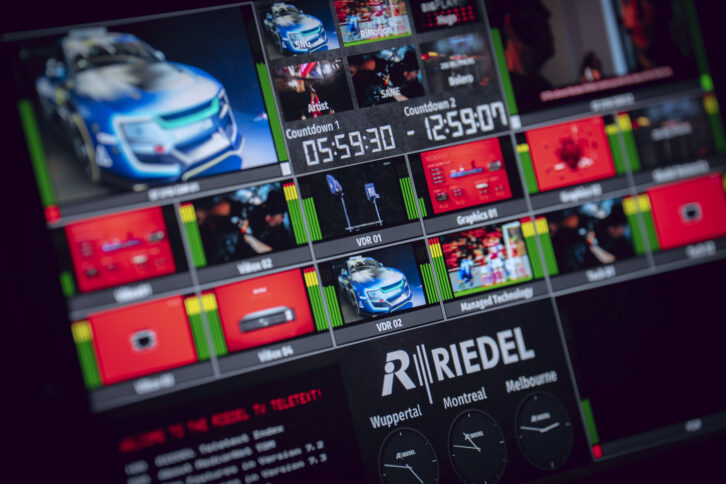
Accordingly, Riedel has closely aligned with ST 2110 and related developments, beginning with AES67 in 2016 and then evolving through TR-03, TR-04 and beyond. Today, all of its major product families – including intercom, audio, video and wireless – have support for 2110, with many thousands of systems deployed around the world.
In addition, it does seem as if it was a case of the right technology at the right time. Joe Davenport, director business development – hyperconverged solutions at Ross Video, confirms: “Timing also played a major role. ST 2110 arrived as network infrastructure matured, with spine-leaf architectures and 100Gb+ switching becoming common, and PTP established as a reliable timing method added to system reliability. Just as important, it enabled gradual adoption – avoiding a rip-and-replace approach, which is critical for budget-conscious customers.”
There is a general consensus that ST 2110 is now the foundation for many larger projects where high-resolution/quality video workflows, such as those involving UHD/4K, are a necessity. Therefore, it is not surprising that broadcast studios and venues that deliver live sports video have proven to be particularly fecund territory, although they are by no means the only areas where the SMPTE standards suite has achieved traction.
According to Mailhot, ST 2110 has become the basis of design for most medium-sized and larger facilities worldwide, especially those that aspire to do High Dynamic Range (HDR) and UHD/4K workflows. “While hard numbers for the whole industry are difficult to estimate, at Imagine we’ve shipped well over 200,000 channels of ST 2110-capable encapsulation since the publication of the standard.”
Application-wise, sports venues – where 1080P, UHD and HDR are being deployed as part of fan engagement efforts – have turned out to be a major marketplace for ST 2110 streams. The need for format-flexibility among the assorted users and rights holders involved in sporting applications is well-suited to the deployment of ST 2110, notes Mailhot.
The rise of IPMX has been another critical factor in the longer-term pro AV success story. It was in 2017 that initial conversations took place about presenting a set of open standards and specifications geared towards the pro AV market, enabling the carriage of compressed and uncompressed video, audio and data over IP networks. In 2022, Andrew Starks – board member & marketing workgroup chair at AIMS and director of product management at Macnica Americas – told Installation that “at first the conversation was more about seeing whether we could essentially take ST 2110 as it was and translate it to pro AV”. It was quickly determined that additional features were required if the standards were to reach the greatest possible audience.
Hence the development of IPMX, which is based on the SMPTE ST 2110 suite of standards and related AMWA NMOS specifications used in the broadcast industry, but adds specific capabilities for pro AV workflows. These include HDMI support, digital copy protection with HDCP (High-bandwidth Digital Content Protection), NMOS discovery and registration, I/O management, enhanced audio channel mapping, and compressed media using the JPEG XS video coding system.
IPMX’s core capabilities, meanwhile, include the ability to transport and control compressed and uncompressed video and audio, such as 4Kp60 with 4:4:4 colour, over standard 1G networks and with very low latency. It is ready for 8K (or higher) resolutions and can support 10G, 25G, 40G and 100G networks. As such, it has already made its mark on pro AV applications where video quality is an absolute priority, including conference centres, corporate facilities, stadiums and medical centres. The growing adoption of IPMX is also influencing product development across the wider pro AV sector, with manufacturers including Atlona reflecting the growing emphasis on IP-based media distribution and interoperability.
Rob Moodey, manager – strategic partnerships at Matrox Video, says: “Technologies like IPMX are extending the principles of ST 2110 into adjacent markets, and the ability to operate across both ecosystems is increasingly important. Our approach has been to support that convergence – not just by aligning with the standards, but by making sure our solutions fit naturally into mixed, evolving infrastructures that will maximise ROI.”
HYBRIDISATION TRENDS
But whilst ST 2110 and now IPMX have spearheaded the growth of IP in broadcast and pro AV, it’s important to note that there is also a simultaneous trend towards hybridisation at present. There are likely to be multiple factors at play here, including a very understandable reluctance to invest too heavily given the general economic uncertainty (and, in broadcast, considerations such as the dramatic decline and fragmentation of advertising revenue). It’s also probable that companies are at different stages of the replace & renewal cycle, meaning that they have equipment with plenty of life left in it.
Davenport notes that adoption levels have varied by region. In addition, while some customers have chosen to move to all-2110 facilities, many deployments remain hybrid, with substantial baseband infrastructure still in service alongside other IP-based approaches like NDI, SRT and JPEG-XS. Plenty of facilities, he says, still rely heavily on SDI and plan to for the foreseeable future, often introducing IP in targeted ways to complement existing signal flows rather than replace them outright. Ultimately, the approach comes down to size and scale requirements for the system as well as budget considerations.
“I think we’ll continue to see growing adoption of IP-based production, with hybrid approaches remaining the norm for most use cases” says Davenport, adding that “across both broadcast and pro AV, customers will benefit from the scalability and flexibility that IP enables”, and noting that Ross offers a complete suite of ST 2110-enabled production tools.
With regards to digital video, Moodey points out that SDI’s continued evolution to A 270 Mbps link associated with SD content at the end of the 1970s was superseded by increased bandwidth of 1.5 Gbps, then 3 Gbps, 6 Gbps and 12 Gbps.Moreover, it is an ongoing story according to Moodey.
“SDI hasn’t stopped evolving either – try putting 24G-SDI into your favourite search engine,” he says. “That one is already standardised by SMPTE – ST 2083. (If you really want to scare yourself, try searching for 48G-SDI!) So those who think SDI is an unchanging technology point of reference need to realise that the landscape around them is moving. The longer they stay put, the bigger the step will need to be when they decide to move.”
As to the more general future of IP, it’s arguable that there are still issues that need to be addressed, not least with regard to the alignment of, and integration with, what might be termed more ‘traditional’ IT infrastructures. According to Dodson, IP network performance is there but at the cost of complexity and specialised IT support. “This is a general problem we as vendors need to solve. We see growth in live production, sports, broadcast and corporate applications, but if the IT complexity can be solved there are many more possibilities,” he says.
FUTURE ADOPTION
In the meantime, it’s evident that vendors across both broadcast and pro AV are more than willing to address ST 2110 product requirements and ensure that customers have access to the solutions they need – and at the price levels they require. As the examples throughout this article demonstrate, support for standards-based IP media infrastructures continues to broaden, reinforcing ST 2110’s position as the foundation for increasingly flexible and interoperable workflows. “NAB26 featured an exceptional number of new product announcements supporting SMPTE ST 2110,” concludes Mailhot. “Vendors at every position on the value spectrum have embraced ST 2110 as the forward-looking solution for building scalable solutions to meet modern media infrastructure requirements. I expect that the ST 2110 standard will be in widespread use for many years to come.”
You can subscribe to Installation magazine for free here and the daily newsletter here.