Much has been made in recent years – and within these pages – of the growing convergence between broadcast and pro AV technologies. And with the latest edition of IBC taking place in Amsterdam a couple of weeks after this issue of Installation went to press, it feels like a timely moment to assess the actual extent of this convergence, the specific spaces in which it has progressed most rapidly, and the aspects where we can expect to see more movement in the near-future.
Across the many organisations approached for this article, there has been a remarkable consensus around the extent to which the adoption of IP protocols and networking infrastructures has fuelled the convergence, as well as the increasing amount of shared ground over display, production and audio technologies.
ACCELERATED MATURITY
Sean Wargo, VP of market intelligence at pro AV trade association AVIXA, indicates that the convergence has shifted into a decisive new phase: “The convergence between broadcast and AV has moved from a conceptual trend to a tangible reality. At AVIXA, we’re seeing a growing number of integrators and solution providers operating across both domains, driven by shared technologies and evolving content delivery expectations.”
Inevitably, some areas have evolved more rapidly. “While some segments, like live events and corporate communications, have fully embraced this convergence, others are still navigating the cultural and operational shifts required. Overall, I’d say we’re in a phase of accelerated maturity, where the lines between traditional broadcast and AV are increasingly blurred.”
Among vendors and service providers, there is general agreement that the adoption in both markets of the same range of networking standards/technologies – such as NDI, SMPTE ST 2110 and, increasingly, IPMX – has been a primary enabler of convergence. Suzana Brady is SVP worldwide sales and marketing for Cobalt Digital, which now supports ST 2110 and IPMX in its product range, with IPMX essentially building on ST 2110 with more AV-specific features.

“The shift toward IP has gained momentum as organisations across both broadcast and pro AV look to do more with less, reduce complexity, lower costs, and enhance scalability,” she says. “End-user expectations are the same – high-quality video, low latency, and real-time control – whether in corporate communications, live events, education or sports production. Additionally, the desire for open standards, vendor interoperability and simplified deployment is making IP-based systems, and particularly IPMX, highly attractive to both AV and broadcast markets.”
IP-BASED SHIFT
Catherine Koutsaris, product marketing manager at Matrox Video, also highlights the importance of the shift towards IP-based systems, but asserts that the migration is unfolding differently across industries, with broadcast leaning towards ST 2110 and NDI, while AV has been dominated by fragmented proprietary solutions. “This has created new technical challenges but also substantial opportunities,” she says, “supported by the emergence and growing adoption of open standards like IPMX, which is designed to bridge the gap with features such as synchronised and non-synchronised media support, expanded media options beyond ST 2110-20, -22, and -30 including HEVC (for example), digital rights management (DRM), privacy encryption, and USB compatible across different equipment types and different brands.”
Koutsaris adds that Matrox’s own range includes the ConvertIP devices that support both ST 2110 and IPMX, “enabling seamless media format translation across asset classes and maintaining signals fully in IP without requiring SDI to HDMI.”
Ryohei Iwasaki, managing director of IDK Europe, is also engaged with bridging the gap between broadcast and pro AV networking needs. There is a growing “crossover – however, the needs are still not matching exactly.” What he describes as “unmatched needs and technologically, especially for the pro AV side” has led IDK to provide “bridging concept” products. “The next one we may consider will be ST 2110 bridging,” he says. “But the hurdle is still high [and I feel that there will be a trend towards] utilising the strong points of different technologies and migrating those into one system.”
Matt Morgan, regional sales manager, corporate – South at Ross Video, connects the convergence of connectivity technologies with the increased expectations of AV customers, by way of reference to the company’s Hyperconverged production platform: “We continue to add support for more transport types like NDI, SRT and other IP-based protocols to meet changing market demands. NDI, for example, was once a low-cost solution for AV teams connecting cameras to Zoom or Teams. Today, it is natively supported across our Hyperconverged platform, reflecting how AV environments now expect the quality and flexibility in a broadcast AV solution.”
HYBRID MEDIA ENVIRONMENTS
Aside from the issue of IP networks and related infrastructure, it is evident that the convergence is also being driven in no small part by shared production and control requirements across markets and verticals.
Jamie Adkin, vice president of sales EMEA at Adder Technology, says: “Broadcasters are moving to more flexible technologies that achieve their high production quality threshold, and AV environments are rapidly raising their standards to achieve that same production quality. [Meanwhile] the expectation levels of the viewer continue to rise, no matter whether they are watching a professional sport, or participating in a hybrid corporate all-hands meeting. [In our case] the needs of our customers in television broadcast, live sports events, corporate communications, and house of worship now largely overlap. They are all seeking flexible, scalable, and efficient KVM technologies that deliver high quality of live production.”
Koutsaris notes: “Beyond infrastructure, other key drivers include the growing demand for hybrid media environments, including live production requirements across corporate, education and government settings. These trends are further supported by the development of IP-to-IP gateways, software-based workflows and cross-industry collaboration through organisations such as the Video Services Forum (VSF), Alliance for IP Media Solutions (AIMS), Advanced Media Workflow Association (AMWA), SMPTE, and more.”
BROADCAST GRADE
Darren Gosney, product specialist manager at Blackmagic Design, highlights the trend of AV customers seeking ‘broadcast-grade’ systems. “AV teams are increasingly adopting workflows that were once the sole domain of broadcasters,” he says. “The demand for higher production value in AV spaces, such as corporate events, education, live concerts and stadia installations, has accelerated this trend. The need to simultaneously serve both in-person and virtual audiences has highlighted the benefits of a broadcast-grade infrastructure, from built-in encoding to streaming.”
For example, it may be that production teams in broadcast and AV segments, such as corporate, need to “extract as much value as possible from a single event” – resulting in “multiple deliverables” ranging from immediate livestreams to social media clips. Hence the popularity of Blackmagic Cloud-based workflows, notes Gosney, which can “facilitate these requirements through remote production and post-production working hand in hand. It means editors can begin working on the digital deliverables while the event is still happening, allowing for faster turnaround. It is also more sustainable since crew members can collaborate remotely from anywhere in the world.”
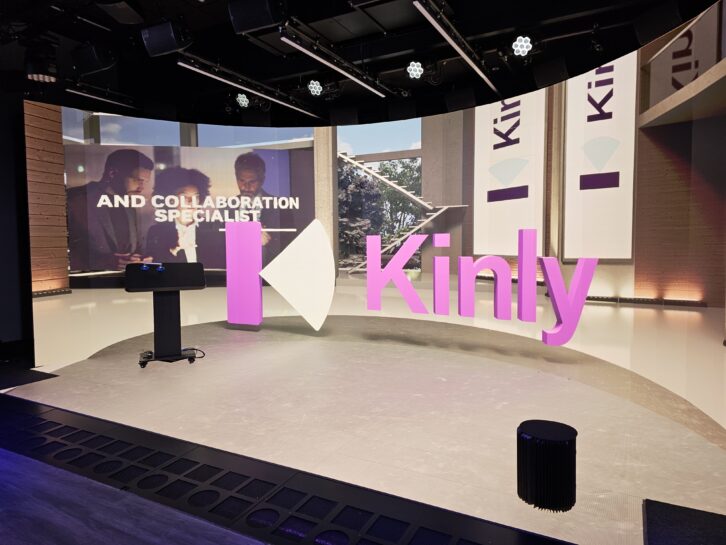
Matthew Quade, CEO of TSL, points to the trajectory of the company’s own control ecosystem as an example of the broadcast/AV convergence: “Originally developed for broadcast master control rooms and OB environments, over the past decade we’ve increasingly supported deployments in AV contexts such as financial institutions, education and performance venues. A recent example is for the Czech Philharmonic, where our control platform bridges multiple AV and broadcast systems to deliver seamless live production capabilities to the orchestra’s global audience.”
HYBRID CONTROL
The need for hybrid control capabilities is also becoming more universal. Hence, says Quade, “we’re developing closer integrations between AV platforms such as Q-SYS and broadcast devices, for example Grass Valley routers. This kind of hybrid control is becoming essential in multi-discipline environments, allowing users to operate everything from an intuitive, frictionless interface, regardless of protocol or manufacturer.”
Meanwhile, whilst there has been a lot of attention given to standards-driven video advances, there is also plenty of convergence evident in the use of audio across broadcast and AV – not least in the growing need for flexibility of deployment and remote management capability.
Bill Oakley – Shure associate director, global product management, pro audio – remarks: “The industry is seeing both traditional and digital-first players raising the bar to engage audiences in new ways. At the same time, Shure’s upcoming array microphone technology for broadcast is arriving at just the right moment, enabling audio teams to match the creativity and flexibility seen on the video side and integrate seamlessly into these advanced production environments.” Enabling control, adjustment and monitoring over IP, the technology “supports both broadcast and AV applications, enabling creative teams to adapt quickly without needing extensive on-site intervention.”
GREATER SYNERGY
A range of predictions were offered when our interviewees were asked to nominate the areas in which they expect convergence to accelerate in the next few years. For example, it’s expected that – with the technologies involved becoming increasingly universal – there will be a more fluid deployment of personnel between the two ‘worlds’.
Notes Quade: “We’re seeing a convergence in terms of talent. AV engineers are increasingly familiar with IP-based media workflows, and they expect tools that are fast to deploy, easy to integrate into existing workflows, and vendor-neutral. Again, this shift prioritises flexibility and user experience over legacy complexity.”
According to Wargo – who notes that AVIXA is supporting the convergence through several initiatives, including the expansion of its research to include insights on “adjacent markets” like broadcast and streaming – “AI is poised to be a major unifier. From automated camera tracking and real-time transcription to content personalisation and predictive analytics, AI is streamlining workflows that were once siloed between AV and broadcast. It’s enabling smaller teams to produce high-quality content at scale, which is especially valuable in corporate, education and live event settings.”
He adds that AI is also “helping bridge the gap between production and audience engagement, offering insights that inform both content creation and delivery. As these tools become more accessible, we’ll see even greater synergy between the creative and technical sides of both industries.”
For Blackmagic Design, Gosney also envisages further advances that will boost content production, regardless of market. “With the needs of both markets converging, offering unified workflows with features such as built-in recording, remote operation, and scalable network infrastructure is now expected. Therefore, building systems that provide a high production experience and output, while ensuring our solutions can integrate into wider ecosystems, is essential.”
Visitors to IBC this month will doubtless see a large number of products described as being capable of supporting broadcast and pro AV environments. But as we have seen in this article, it’s arguable that we are still in the relatively early days of a seismic shift that will ultimately bring colossal benefits to end-users across the two industries.
To read the new edition of Installation, click here.