It’s easily more than five years now since ‘convergence’ became a hot industry topic in broadcast and AV. With the adoption of IP-based networking as perhaps the greatest single enabler, the distinction between the two sectors has become increasingly nebulous. As well as standardisation of technologies benefiting customers, it’s also brought new opportunities for vendors and integrators, who can slip between the sectors with growing ease.
So the starting point for this article is that convergence is now generally accepted as being well underway, with the result that the focus is shifting to questions about the precise nature of the alignment. Such questions include ‘which broadcast disciplines are proving most relevant to pro AV?’, ‘what will IBC tell us about the convergence?’, and ‘which aspects of broadcast are so not applicable to pro AV?’.
Along the way we’ll explore issues such as IP, software-defined workflows, orchestration, monitoring, redundancy and monitoring. Where once such capabilities were typically associated mainly with demanding live productions for sports and news, they are now more commonplace in AV as customers frequently strive for broadcast-quality infrastructure and output.
Interviews with a broad selection of vendors confirm the validity of this article’s central contention: that convergence is now a given, and that instead the emphasis has shifted onto the practicalities of implementation.
Joyce Bente, president/CEO Americas at Riedel Communications, confirms: “I believe we have largely moved beyond talking about convergence as something that is still going to happen. It is already happening. The more relevant discussion now is how quickly different markets are adopting the same technologies and operational expectations.”
She adds that although different audiences may be being served, the boundaries between them are increasingly hard to define. For instance, corporate events are streamed worldwide; sports venues have huge content requirements; and universities, HoWs and entertainment venues are delivering programming to broadcast-level requirements.
SOLUTIONS INVESTMENT
Inevitably, this alignment has wrought change for integrators and AV operators, who – notes AJA Video Systems technical director Andy Bellamy – are “investing in solutions that support higher resolution, higher frame rate, and HDR workflows; and in many cases, IP, virtual, and remote production. It’s fair to say that broadcast practices and technologies aren’t just shaping AV; they’re redefining it.”
Grégoire Deminière, business development manager, live production, at Blackmagic Design indicates that the greater adoption of mature standards in broadcast has been an important influence on the AV convergence. “The main advantages are image quality, interoperability and cost,” he says. “For example, broadcast cameras can produce a clean, high-quality image that’s now expected in corporate communications, live events and other AV applications, while established standards such as SDI provide robust signal transport. At the same time, these cameras, switchers and other live production equipment have become more affordable, opening up broadcast practices to a far wider range of users and integrators.”
As well as the actual reality of the convergence, there is also a great deal of consensus around the specific areas in which alignment is most advanced. These run the gamut from video production standardisation to IP networking and LED walls, with standards that originated in the broadcast world at organisations such as SMPTE and AIMS serving as valuable catalysts.
In the case of video production, Niki Whittle, principal product manager for Viz Engine and Virtual Studio at Vizrt, says that “ultimately, it’s the same challenge facing both industries. The demand of the eyeball economy which suggests that storytelling is the key communication tool now, applies not just for broadcast, but also for town halls, house of worships, immersive theatres, events or museums. Comparable video content quality is expected now”.
She also feels that the broadcast world is gaining knowledge from the AV industry in terms of the need for simplicity and building workflows and operations around more simple productions and the ability to work with smaller teams. “So I think we’re learning from each other and we are pretty much merged.”
WIDELY ADOPTED
With IP, the standards suite SMPTE ST 2110 – which specifies the carriage, synchronisation and description of separate video, audio and data over IP managed networks – has been widely adopted in broadcast since the first elements started to be published in 2017. Recognising its robustness and relative ease of deployment, it did not take long for interest to materialise from pro AV. Accordingly, there has since been a development called IPMX, which is founded on ST 2110 but adds additional features pertinent to AV, such as support for asynchronous sources and HDCP content protection.
Meanwhile, as AV systems become larger and more interconnected, there is also a need for many networking-related capabilities long familiar in broadcast circles. Examples here include centralised monitoring, system redundancy, and orchestration – the last-named term for the automatic provisioning, coordination and management of IP networks, devices and, increasingly, cloud-based resources as well.
CENTRAL MANAGEMENT
With growing complexity, notes Bente, customers require an ecosystem that can be monitored, managed and reconfigured centrally. “Broadcast has a long history of designing systems around operational continuity – understanding signal paths, identifying problems quickly, and maintaining service if a component or connection fails. Those disciplines are becoming increasingly important in AV.”
The shift away from dedicated or bespoke hardware to a much firmer emphasis on software and off-the-shelf hardware is nothing new in AV. However, the terminology around it has changed and now, as in broadcast, the use of ‘software-defined workflows’ is becoming commonplace, and no wonder, as it reflects the desire of customers for platforms that evolve – with relatively minor impact on their part – through updates of application, license and software.
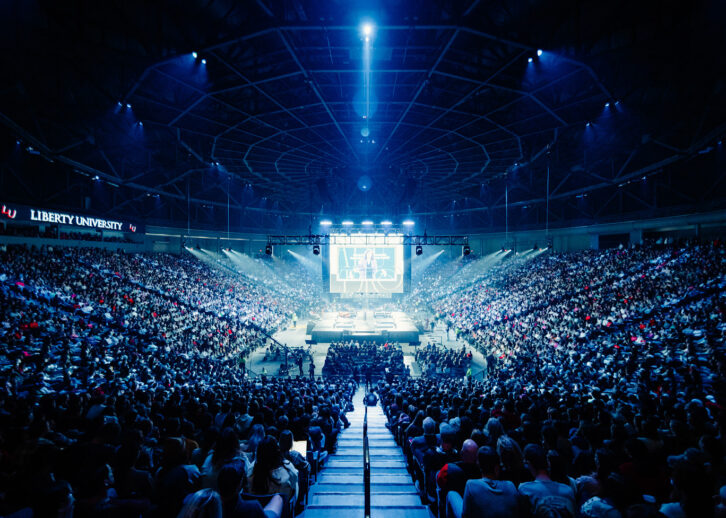
Distributed or remote production – which in the broadcast world translates to applications such as outside broadcast, where money and resources are saved by doing more back at the broadcast centre and sending few people into the field – is another area of alignment. Bente offers a couple of examples: “Teams no longer need to be in the same room, or even the same location, to communicate, control systems and produce content. North Point Ministries [in the US], for example, uses a hybrid TDM/IP Riedel infrastructure to connect eight campuses, allowing it to support both independent and combined productions. Liberty University uses an Artist ecosystem for campus-wide communications supporting sports, entertainment, and convocations. These are broadcast disciplines being applied to broader AV requirements.”
Elsewhere, underlining the increased expectations around visual content and reproduction in many AV environments, there is also alignment in the use of high-end visual technologies such as LED walls. “High-resolution LED screens, once strictly developed for high-end film and TV production, are now commonly used in pro AV for auditoriums, control rooms, and large-format commercial displays,” says Guilhem Krier, head of new business and market development (EMEA) for Broadcast & Pro AV at Panasonic Connect Europe.
Finally, virtual production – albeit still in something of a nascent state in pro AV – is also destined to become more commonplace as solutions are simplified and entry-prices decrease. It’s likely well-resourced corporations who will be among the early adopters here.
Francesco Scartozzi, vice-president of sales and business development at Matrox Video, says: “Virtual production sets can be used for making movies and series. But in the corporate world they can be done to provide virtual factory tours or to provide exciting effects for corporate presentations.”
DEPARTURE POINTS?
In exploring the aspects of alignment, it also seems entirely logical to question those areas where points of departure remain. But in conducting interviews for this article, it became increasingly clear that it’s more a question of implementation rather than strict differences. For instance, it may be that the AV project is simply of a scale where full-scale broadcast-level monitoring and orchestration is not needed.
“Perhaps it is not what, but ‘how’,” says Krier. “AV users want the full power of broadcast technology but adapted to their context. That means streamlined interfaces, multi-purpose environments, whereas the budget is not the same as broadcast-scale investments.”
Then there are the differences between individual AV environments that have long existed, and may not shift any time soon. Bellamy notes: “Determining the broadcast technologies that best integrate into AV environments depends on the venue architecture. Since the AV market encompasses distinct environments – ranging from concert and performance venues to enterprises, universities, convention centres, sporting arenas, museums and theme parks – broadcast technology requirements vary and are tailored to each install.”
For instance, whilst a sports venue may well now deliver 4K HDR video to in-venue displays, a university might find HD to be entirely sufficient – at least for the foreseeable future. So in short, there will continue to be variations in the extent to which different areas of AV are in tandem with the cutting-edge of broadcast.
Redundancy is another consideration where the requirements could be quite marked between AV environments. Deminière says: “Rather than there being broadcast technologies that do not belong in AV, it is more about applying the right level of complexity to the application. Multiple layers of redundancy may be essential for a broadcaster operating 24/7, but a smaller meeting room or presentation space is unlikely to require the same level of resilience. The key is to understand the operational requirements of each project and design the system accordingly.”
Norbert Paquet, head of live production solutions at Sony Europe, echoes these sentiments. “In mission-critical live broadcast, we typically build in full network-level backup paths, because the cost of failure is so high,” he says. “That level of engineering rigour is usually overkill for most AV deployments, where losing one camera out of eight is often redundancy enough. It’s not that these broadcast workflows don’t belong in AV, it’s that AV rarely needs them at full broadcast intensity.”
IBC EXPECTATIONS
There is a general feeling that this year’s IBC will be especially insightful in terms of defining the future beyond convergence. In particular, it is thought there will be more real-world case study examples and products that reflect combined thinking drawn originally from the worlds of broadcast and AV. There is also a feeling that such specific terms will continue to hold less sway.
Bellamy predicts that the discussion on convergence at IBC will pivot from theory to practice, with a focus on leveraging rapidly evolving broadcast technologies to solve real-world market challenges. “More installers and integrators will highlight successful remote and virtual production and ST 2110 deployments, offering insight into key learnings and best practices,” he says. “And as more of these environments move toward higher end multi-camera production setups, colour management will also move to the forefront of the conversation.”
Paquet: “Broadcasters have exactly the same need as everyone else – to reach wider audiences through streaming and online platforms. Niche content production needs to be efficient with its costs, and as a result we’ll see several methods that have become familiar in pro AV arriving at IBC – similar to how broadcast tools have been finding their way to ISE.”
And Whittle believes that ISE will be less about people “thinking is it AV or broadcast”, and instead what solutions are going to fit best for them. “So they’re going to be looking for flexibility, reliability, and obviously more software solutions over hardware.”
WORKFLOW CONTEXT
It’s safe to assert that AI will be a big part of the conversation at IBC, but it may be most useful where it can be seen in a workflow and/or business context. “AI will receive considerable attention, but the most meaningful developments will be how AI, automation, and software can simplify operations, support smaller production teams, and make sophisticated capabilities accessible to more users,” opines Bente. “We will also see greater crossover among broadcast, AV, cloud and IT technologies. The important question will be whether a product integrates easily, scales efficiently, and delivers the reliability required for live operation — not where it originated.”
Looking further into the future beyond convergence, there is an expectation that broadcast level/grade reliability and functionality will continue to become more habitual in AV – especially those applications where it helps drive revenue and engagement. Remote management and distributed production will also grow as operators – for instance in the education and corporate worlds – seek flexibility and cost reduction.
“The lines between traditional AV infrastructure, unified corporate communications, and broadcast equipment will continue to blur,” reckons Scartozzi. “Each of these core asset groups can now use the same open standards for media and transport, and this has big implications for campus management and the increased flexibility in cross-pollinating core tech.”
It’s also important to remember that the definition of a broadcaster has already changed, according to as Paquet. “A CEO livestreaming quarterly results to a global workforce is, in effect, a broadcaster now. I expect that shift to keep evolving.”
But as much as it’s a matter of tech, the next phase of convergence is also one of humans and their shifting roles and responsibilities. “As corporates professionalise their content, we’re starting to see it reshape careers, with titles like internal comms producer, even cinematographer, appearing on LinkedIn job ads,” adds Paquet. “The creator economy’s skills in audience engagement and visual storytelling are increasingly being brought in-house too. So this isn’t just a story about tech converging – it’s about the people and skills evolving with it.”
Perhaps that is ultimately where convergence leads: to a point where the distinction matters less than the outcome, and the question is simply which technology, workflow or skill is right for the job.
You can subscribe to Installation magazine for free here and the daily newsletter here.