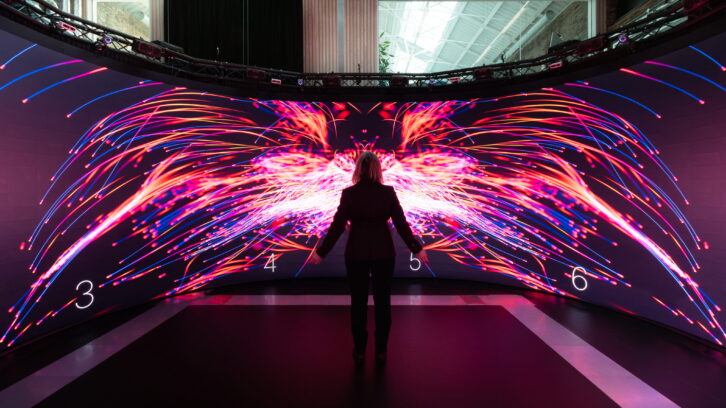
ClearLED’s 360° immersive LED display forms the visual core of the Reality Emulator, a room-sized environment at the Bristol Digital Futures Institute (BDFI), University of Bristol. The project was carried out by Mechdyne, an immersive visualisation specialist, and is designed to let researchers step inside complex datasets, simulations and virtual worlds.
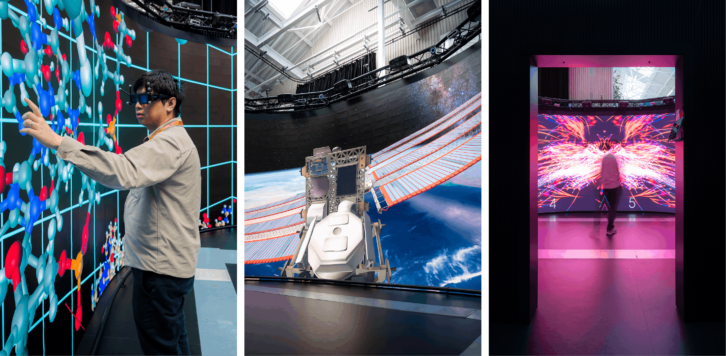 The 31m-pixel curved wall is made up of 1,562 ClearLED Ribbon Series Indoor modules. The company says the modules bend and flex to form a continuous curve that follows the shape of the space, giving a display with no visible edges, flat planes or seams while maintaining pixel-perfect alignment and structural integrity. The 1.2mm pixel pitch also made the project’s egg-shaped geometry possible, which the company says could not have been achieved with standard direct-view LED panels.
 Mechdyne defined the wider system architecture, while ClearLED specified the display technology needed to meet the project’s performance requirements. The cabinet geometry, structural engineering, image processing and immersive visuals were considered together from the outset.
Since completion, the Reality Emulator has become part of the University of Bristol’s digital research facility. It is used regularly for activities including research around game-engine technology and AI, where experiences can respond dynamically rather than follow a fixed, pre-programmed outcome.
Gus Hadaya, president and CEO of ClearLED, said: “When you’re sitting in the middle of the room, you have to be immersed in the environment; the screen has to disappear. When I walked into the finished space, it felt real. This technology allows you to be transported anywhere you want in the world and will allow scientists to go beyond what they can imagine.”
You can subscribe to Installation magazine for free here and the daily newsletter here.