Integrated Systems Europe heads back to Fira de Barcelona in early February with a clear message: convergence is no longer an emerging theme, but the organising principle for how the systems integration industry now works. AV, broadcast, IT and creative production are colliding in workflows, budgets and buying decisions – and ISE 2026 is being shaped to reflect that.
The benchmark is ISE 2025, up until now the biggest edition in the show’s history. Last year’s event hosted 1,605 exhibitors across 92,000sqm, drew 85,351 unique attendees from 168 countries and generated 185,700 total visits. Daily numbers peaked at 59,038 on Wednesday, with particularly strong growth from the DACH region. “Every year I’m more excited about ISE than the previous year,” enthused ISE managing director Mike Blackman in an exclusive interview for Installation magazine. “But we can’t get complacent. CeBIT was once the biggest computer show in the world – and then it disappeared. Our job is to stay relevant by listening to the market and evolving with it.”
CLEAR EVOLUTION
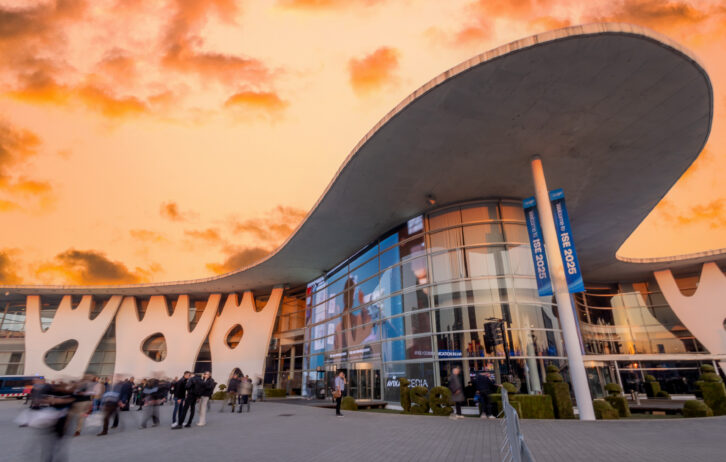
That evolution is clearly visible in the 2026 floorplan. The show will occupy its largest-ever footprint of almost 82,000sqm of exhibitor space across eight halls and seven expanded Technology Zones, with several zones now extending into the East Access area. In total, 1,709 exhibitors are confirmed, among them 323 newcomers, as organisers push the Fira close to full capacity. With the long-awaited Hall Zero expansion delayed until 2028, the emphasis is on optimising the existing site to support increasingly integrated demands from AV, broadcast and creative stakeholders.
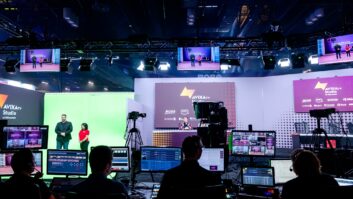
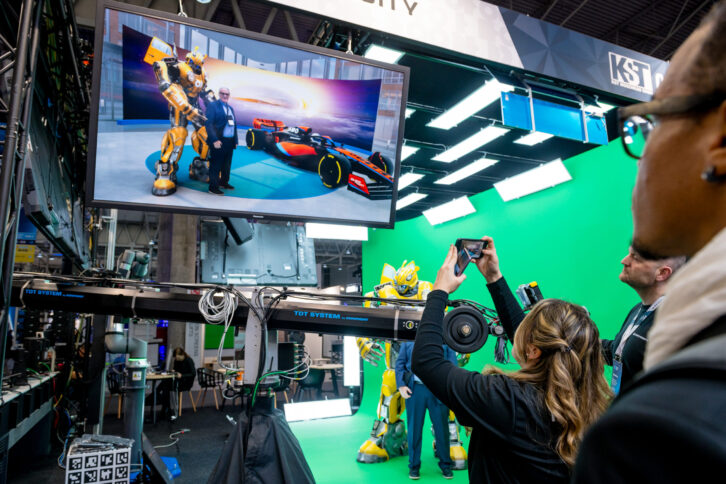
For ISE, convergence is especially obvious in the overlaps between broadcast and AV. The dedicated broadcast area introduced in 2025 – with its Esports Arena, Robotics and Drone Arena, Discovery Zone and live AVIXA TV Studio – returns in expanded form, while Hall 4 (the show’s second-largest) now devotes roughly half its space to broadcast-related solutions. “It’s not that the broadcast business is coming to us,” Blackman notes. “The broadcast business is changing. They’re using more and more AV products and solutions.”
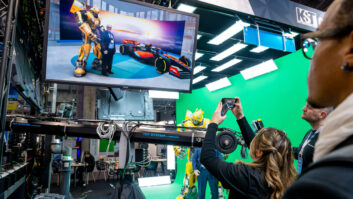
He points to virtual production as the clearest example. Legacy broadcasters built vast 3,000sqm studios for a single show; virtual stages built around LED volumes, real-time rendering engines and compact cameras now deliver a different programme every hour if required. “The initial investment is higher, but the long-term savings and flexibility are tremendous,” he says, adding that corporate TV, agency content and in-house production are also booming as smaller 4K and 8K cameras, LED, tracking and control systems become more accessible.
SPARKS FLYING
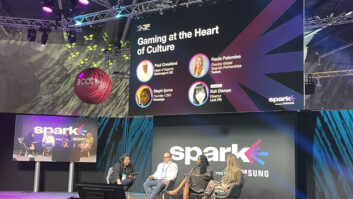
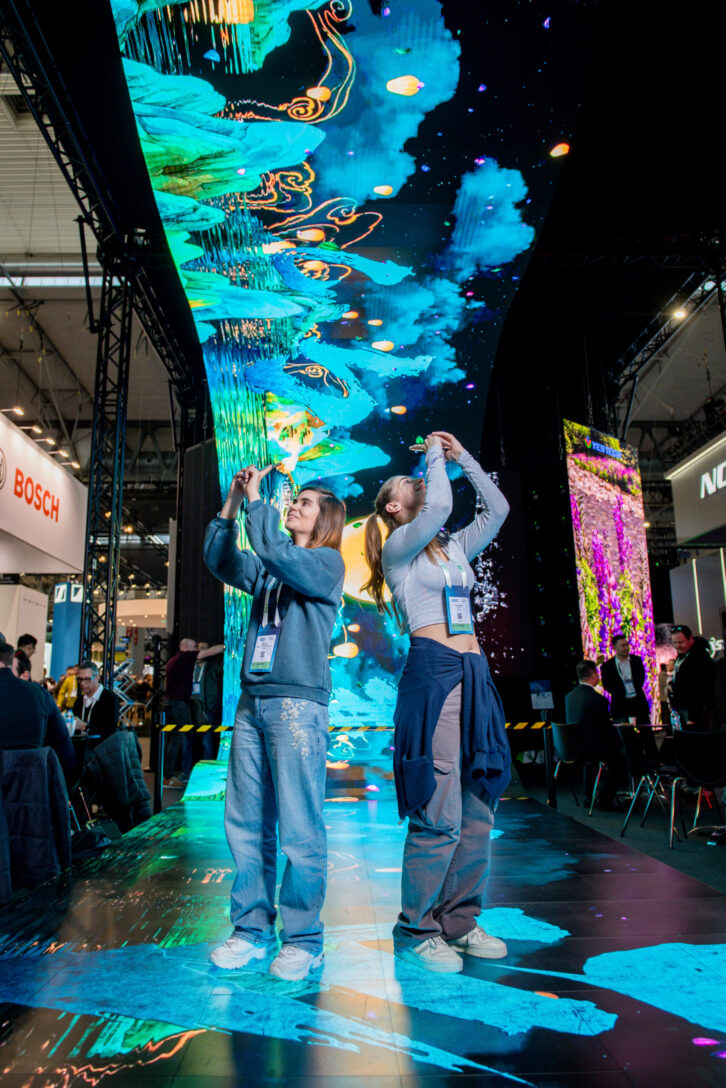
Creative production sits at the heart of Spark, a new cross-vertical initiative for 2026. Centred on a 1,000sqm arena, Spark brings together media, gaming, live events, experiential marketing and design studios around shared workflows: real-time graphics, virtual production, LED environments and immersive audio. It is designed as a collaborative platform for an audience that increasingly straddles broadcast, AV and creative technology.
Futuresource Consulting identified convergence as one of ISE 2025’s defining themes, alongside AI and commercially viable smart spaces – and those trends are set to accelerate. More than 1,709 exhibitors have committed to ISE 2026, including 323 first-timers, with many showcasing software-centric platforms rather than standalone hardware. “You’re going to see more and more software-based solutions,” Blackman says. “AI will be one of the biggest shift changes in our industry.”
AI takes a more prominent place in the 2026 programme. Sol Rashidi, former chief data and AI officer at Sony Music, Merck, Estée Lauder and Amazon, will deliver a keynote on scalable AI deployment, governance and cybersecurity – a topic pitched as much to IT leaders as AV specialists. Organisers expect a strong focus on how AI and data unify monitoring, automation and optimisation across hybrid infrastructures, from smart buildings to virtual studios and collaboration spaces.
SECURITY PRESSURES
Cybersecurity, another shared pressure point, becomes a formal part of the agenda via the first ISE CyberSecurity Summit on Thursday February 5. With AV now deeply embedded in critical environments – from control rooms and broadcast operations to healthcare and higher education – security posture is increasingly a baseline procurement requirement rather than a value-add. The summit aims to connect AV, IT and OT stakeholders around shared frameworks for risk management, compliance and incident response.
 Education also features prominently. The EdTech Congress Barcelona moves fully alongside the main show, running February 4-5 at the Palau de Congressos and focusing on AI in “future-ready classrooms”. A 120sqm Connected Classroom powered by Logitech offers a live testbed for hybrid teaching, remote participation and analytics-driven learning environments, supporting ISE’s ambition to position Barcelona as a European hub for edtech dialogue and innovation.
Audio gets a dedicated upgrade with the launch of High-End Listening Suites in the refurbished CC2. These controlled rooms allow visitors to experience premium systems in comparative conditions, underlining how residential hi-fi, studio monitoring, home cinema and immersive experience design are converging around shared expectations for precision, immersion and repeatability. For manufacturers, the suites offer a more realistic context than the show floor for demonstrating nuanced differences in loudspeakers, amplification and room-correction technologies.
Innovation Park returns with a larger footprint in Congress Square, expanding to 130 exhibition pods. The area now hosts startups, first-time exhibitors and returning innovators, supported by an enhanced Pitching Stage, an enlarged Matchmaking Area and a dedicated Investor Forum. In effect, it serves as ISE’s deal-flow hub: a place where early-stage ideas meet established manufacturers, distributors and capital. The ISE Hackathon, launched in 2025 with 60 students tackling sustainability, innovation and cybersecurity briefs, also returns with a wider remit, contributing to the show’s talent pipeline across AV, broadcast and IT.
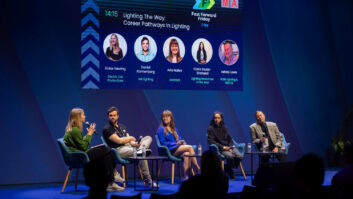
Meanwhile, the Track Sessions introduced in 2025 continue to mature, with curated content on AI, audio, cybersecurity, retail and sustainability, alongside vertical Summits focused on smart buildings, digital signage, workplace, control rooms, broadcast and education. AVIXA’s Xchange Live and CEDIA’s workshops once again bring expanded programming on certification, immersive audio design, wellbeing and business development. Blackman notes that the attendee base has broadened significantly since 2004: “We started as a systems integrator show. Now we’re seeing more and more corporate end users who want to understand why AV makes a difference to their business.”
Outside the halls, ISE’s Barcelona activations are becoming part of the brand. Projection mapping on Casa Batlló has already showcased work by artists such as Refik Anadol, Sofia Crespo and Davide Quayola; for 2026, organisers are planning further large-scale public pieces, alongside an evening drone show in front of the venue that combines hundreds of drones, large-format LED and live performance. For Blackman, these events are as much about community as spectacle. “We come into a city and create chaos with traffic and logistics, yet half the people affected have nothing to do with the show,” he says. “These activations are our way of giving something back – showing the softer, creative side of AV and offering it as a gift to the citizens.”
LONGER VIEW
The long view is never far from Blackman’s mind. The first ISE in 2004, staged in Geneva, hosted just 120 exhibitors and 3,500 attendees. For 2026, organisers are planning for in excess of 90,000 visitors, with 60 percent still coming from across Europe but a growing proportion from Asia, North America, Latin America and India. Early-year timing has helped: while consumer displays debut at CES, many manufacturers now reserve their professional product launches for ISE, driving senior executive attendance and shaping annual sales cycles.
“If 2025 was about resurgence, 2026 is about alignment,” Blackman concludes. “Broadcast AV and live events are among the fastest-growing sectors of the show, software and AI are moving to the foreground, and our role is to bring all of those conversations together in one place. We plan on a five- to ten-year horizon. Convergence isn’t a slogan for one edition; it’s the direction our community is heading.”
ACCELERATED CONVERGENCE
As AV-broadcast-IT convergence accelerates, smart spaces become operational assets and AI moves deeper into workflows, ISE 2026 is positioning itself as the annual meeting point for an industry no longer defined by traditional boundaries. With expanded zones, 1,700-plus exhibitors and a programme designed around a much broader ecosystem, the familiar challenge for visitors remains: four days may not be enough. But for those navigating the next wave of integrated experiences, Barcelona in February is where many of the year’s most important conversations will begin.