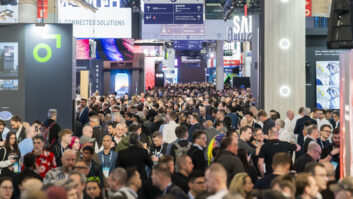
Computex has never been a pure pro AV show. But as AI processing migrates from the cloud to the edge, and as the line between IT infrastructure and AV integration continues to blur, Taiwan’s biggest tech trade event has become a barometer for where enterprise display, collaboration, and signage technology is heading. This year’s theme – “AI Together” – reflects hardware that is converging around on-device intelligence, with implications for how pro AV systems are designed, deployed, and managed.
Installation was invited to Taiwan by BenQ, so the company’s booth was understandably front and centre during our visit – reflected in this initial report, live from the show floor.
ON-DEVICE PROCESSING
A consistent thread running through BenQ’s range of products was that AI processing is now happening on the devices themselves rather than in the cloud – a trend with implications for enterprise AV in particular. A good example is the CP05, BenQ’s latest corporate interactive display, available in 55in and 75in sizes, and on prominent display at the Computex booth.
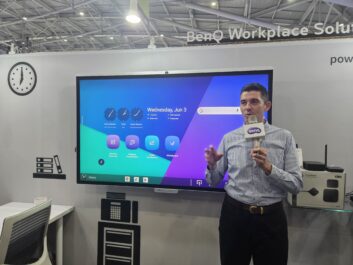
Many of the CP05’s features are handled entirely on device, as a dedicated 10 TOPS neural processing unit processes the AI-powered tasks such as transcription, handwriting recognition, gesture control and camera framing. In practice, this means that the SummarAI meeting assistant – the AI-powered meeting transcription and summarisation tool developed by BenQ and built directly into corporate interactive displays – records and summarises discussions without routing audio to an external server, and the 50-megapixel wide-angle camera frames participants intelligently without needing a cloud connection. These are powerful selling points in enterprise environments where IT security teams are increasingly concerned about what data migrates outside the building.
BenQ believes the CP05’s colour accuracy credentials – Pantone Validated, SkinTone Validated, 95 percent DCI-P3 – will also extend the solution’s appeal beyond the boardroom into creative and medical applications. The 55in model also supports portrait orientation, which the company hopes will open up signage and kiosk use cases alongside its primary meeting room role.
EDUCATION TOOLS
Also showcased at the BenQ booth was the RP05 education display, which carries the same NPU architecture into the classroom, and is available in 65in, 75in, and 86in configurations. BenQ’s AI software suite for education boasts a range of tools – Lasso Search lets teachers circle anything on screen to pull up related content instantly; Ask AI surfaces answers and explanations without leaving the lesson; EZMath converts handwritten equations into clean, editable output; and Circle to Artify turns drawings into more polished illustrated artwork.
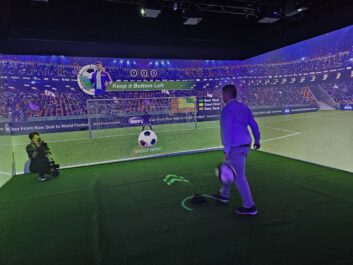
One of the most prominent displays at the BenQ booth was the LH860ST, a 1080p short throw laser projector aimed squarely at the sports and golf simulator market. With a 0.5:1 throw ratio and 5,000 ANSI lumens, it’s built for floor-mounted or ceiling-mounted use in compact simulation spaces. It’s most associated with simulations of playing golf, but BenQ showcased its flexibility by having it running a football penalty kick simulation.
AI SPARKS
More broadly at Computex 2026, the most powerful impression was that serious local AI computing power is becoming standard equipment rather than a premium feature for enterprises. The best example of this is perhaps the NVIDIA RTX Spark platform – the most publicised tech announcement at this year’s show – which is featured across ASUS’s ProArt creator line. The architecture combines a Blackwell RTX GPU with a 20-core Grace CPU and up to 128GB of unified memory, delivering up to 1 petaflop of AI performance in a form factor that fits into a laptop or compact desktop.
For pro AV professionals, the relevance of the RTX Spark platform is less about the creative workstation use case that ASUS was busy marketing, and more about its long-term implications for office infrastructure. When that level of computing power is available in a box that sits under a desk or in a small rack, it might not be necessary to send AV processing workloads to the cloud. Tasks like real-time transcription, automated camera framing or room occupancy analytics previously demanded expensive dedicated hardware and reliable high-bandwidth internet connections, but arguably that won’t be the case any more.
E-PAPER FIRSTS
E-paper also provided one of the more forward-looking product stories that Installation saw on its tour of the Computex booths, with E Ink and chip partner Airoha Technology jointly debuting what they claim is the world’s first 4.2in Ripple ESL – an Electronic Shelf Label format that uses a wave-like animation effect to smooth out the screen transitions that have traditionally made e-paper feel too slow for dynamic signage applications. Airoha’s AB161x Bluetooth chip series, built to the BT SIG 5.4 standard, handles the wireless side.
The reality is that E-paper has been a compelling idea for a few years, but, in practice, its performance has not always matched the manufacturers’ claims. A real barrier to retail and hospitality deployments has often been flickers on page turns, especially when the content changes frequently. E Ink says the Ripple approach is an attempt to resolve those issues.
SIGNAGE SOLUTIONS
Meanwhile, in the world of enterprise signage, Installation was also impressed with CAYIN Technology’s presentation of its full enterprise signage portfolio to an international audience. The range spans three deployment tiers – the Robustie Solution for high-reliability, multi-site installations running industrial-grade hardware; the Flexie Solution for organisations that want full control over their own infrastructure and data; and an E-Paper Solution that speaks directly to the sustainability angle now appearing in more enterprise procurement conversations.
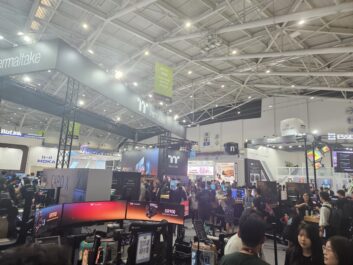
Clearly, the Computex show is no ISE, or InfoComm as it doesn’t boast room after room of pro AV specific product launches. But it is likely that much of the underlying technology on show, including on-device AI, low-power display formats and converged AV-IT infrastructure, are likely to shape the products that pro AV integrators are specifying over the next couple of years.
Computex 2026 is taking place June 2 to June 5 at the Taipei Nangang Exhibition Center, in Taipai, Taiwan.