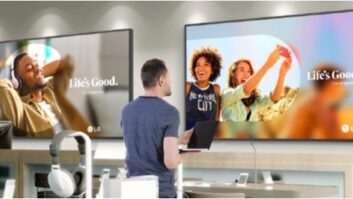
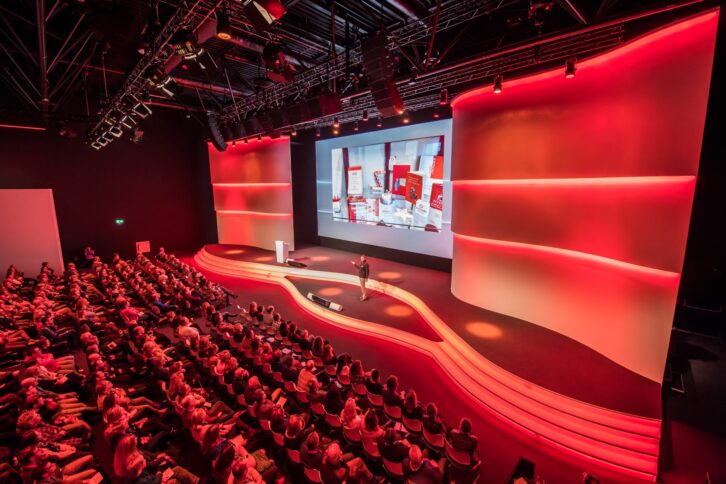
Hotels are much more multi-functional than they used to be, and AV is playing a huge role in this. Previously, as well as bedrooms, many boasted a bar and maybe even a restaurant – perhaps serving dinner as well as breakfast. There may even have been a function room for hosting wedding parties, gala dinners, awards ceremonies and conferences, with basic AV kit provided including a projector and screen, a PA system and lighting.
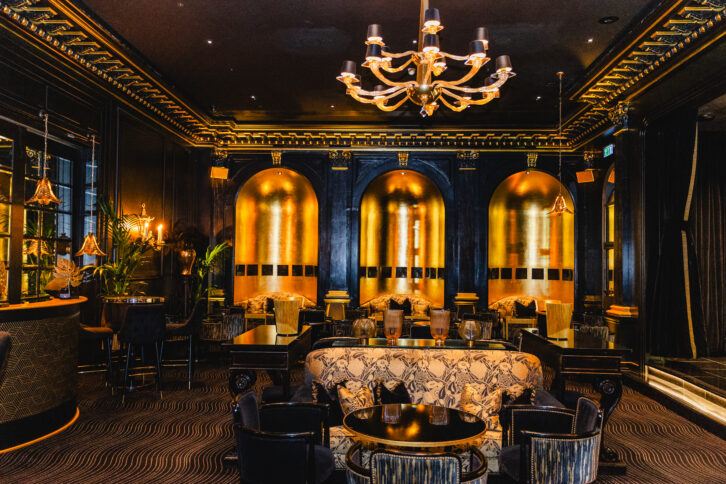
Today, many hotels accommodate several restaurants offering different types of cuisine, shops, a spa and gym plus full function facilities, including meeting rooms, work areas and a cinema or entertainment venue. All of these are now likely to have fully integrated sound, video, lighting, projection and LED screens based on IT and IP networks with the option for automated control by non-technical staff.
This is also true for other venues that come under the increasingly broad umbrella of hospitality, including casinos, restaurants, private members clubs and fitness centres. All provide a service, or, increasingly, an ‘experience’. But, behind that, they are businesses in a competitive market looking to make money and set themselves apart from the competition.
“Most venues these days cannot simply rely on one revenue stream,” says Richard McLean, commercial manager of d&b audiotechnik UK, adding that the multi-purpose approach isn’t necessarily a new trend in hospitality: “Larger hotels have always combined entertainment with corporate events. Destination hotels offer anything from fine dining and spas to concerts and conferences.” With venues now scheduling a wedding one day and a corporate event the next followed by a yoga retreat, McLean stresses that flexible AV equipment is a key requirement, with loudspeaker systems embedded into a hotel’s IT infrastructure.
PRIORITISING RELIABILITY
Because of this multi-purpose, sometimes simultaneous usage, reliability, as Rainer Stiehl, vice president of marketing for Europe at Extron, points out, is a priority for hospitality operators. This is understandable because a reliable system saves time and money on maintenance and repairs. Another consideration is ease of use, with many systems now operated by the house staff – or even the guests – although engineers are still part of the equation. “They want to make sure it’s easy to maintain and operate for their end users, whether that’s their technicians or their customers, depending how they’re setting up the environment,” Stiehl says. “Different hospitality groups have different ways of setting up their base and how they want things to be positioned.”
The way many hotel chains and other hospitality businesses are positioning themselves is to cater for as many events and pastimes within the same premises. “One of the biggest changes we are seeing is spaces that were once designed as standalone presentation environments are now expected to support hybrid participation,” comments Joe Andrulis, executive vice president of corporate development for Biamp. “Spaces that previously required only microphones, loudspeakers and a projector must now seamlessly support conferencing platforms, high-quality audio capture, video distribution and remote collaboration. The result is a growing convergence of technologies that were once managed separately.”
ACTIVITY CONVERGENCE
The integration of audio, video, lighting and unified communication (UC) systems has been enabled by the convergence of AV with IT through IP networking, which has allowed a convergence of activities to be staged within a single venue. Shawn Watts, vice president, Americas at Bose Professional, says AVoIP has played a “monumental role” in unifying audio, video and control data on to a single standardised network.
Another factor driving multi-functionality across premise-wide networks is the slightly clumsily named new sub-sector, ‘bleisure’. Watts says Bose is seeing “immense growth” for “highly adaptable hybrid environments” that allow business travellers to mix work with leisure. “A lobby that serves as a quiet, professional business area with gentle background audio during the morning must be able to seamlessly transform into a vibrant entertainment or performance space by nightfall,” he explains, adding that “atmosphere is everything”, which calls for scalable systems with intuitive controls and automated settings to switch between applications.
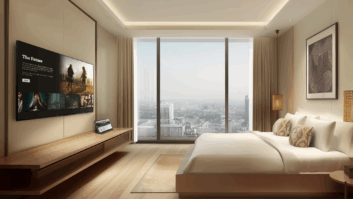
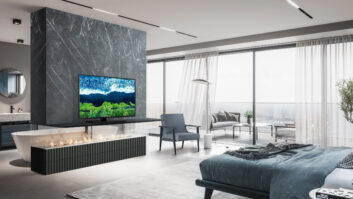
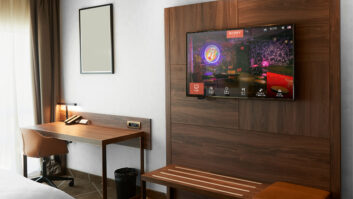
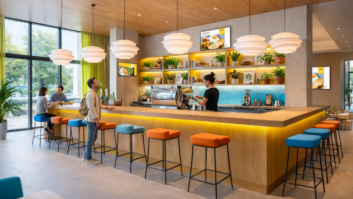
AVoIP and IT backbones are now standardised in hotels not only for entertainment and UC systems but also for in-room facilities. As Richard Jonker, vice president of commercial business development at NETGEAR AV, outlines, a new business hotel of typically 1000 rooms will have a TV screen in each room, which will be IPTV and no longer connected by traditional coax cable. Instead, Jonker observes, everything is streamed and a form of AVoIP, as are the feeds for digital signage providing wayfinding. “That’s not static anymore,” he says. “It’s intelligent because digital signage can change language. If it sees four people with phones from, for example, Saudi Arabia, it will show Arabic. And in the bar, where there used to be a remote for each of the, say, ten TVs, now there are monitors with an AVoIP decoder behind them with everything done in software.”
In-room TVs and screens in the bar are expected in any hotel these days. But most guests and visitors would probably put Wi-Fi at the top of their list for vital technology. Today Wi-Fi is available for free in most, if not all, hotels, but many travellers will remember with a shudder when they had to pay hourly or for a whole day to get connected, if the hotel had Wi-Fi at all.
“There’s been a huge shift where not only are hotels saying, ‘We’re giving you free Wi-Fi’, the expectation among guests is that it will be free,” says James Harrison, founder and managing director of network integrator and IT consultancy Connected Hospitality. He confirms that “the majority” of hotel brands have moved away from being merely “bed shops” to offering hybrid, multi-purpose facilities. “In the US and the Middle East, hotels have become this meeting place, the centre of attention, with conference spaces and multiple restaurants,” he says. “From the technology side we’re no longer just thinking about servicing the guests but also shorter stay visitors who are coming in just for a drink. As a hotelier, you want to ensure you’re driving revenue out of these guests and the number one thing we do is look at how the guest Wi-Fi and digital signage can be used as advertising space for the hotel’s restaurants and other facilities.”
The evolution of both hospitality venues and the technology for them is now making people working in the sector redefine not just technical terms but also how the spaces within a venue are used. A case in point is ‘hybrid’, which Steve Glancey, digital practice leader at systems integrator Diversified, says no longer means a single room used for two separate things but “a large, complex space” where every environment within it has to both work on its own and also add up to one experience.
“The individual rooms flex, too,” he says. “Nobody can afford a ballroom that only earns its keep for eight hours a day. But with the right approach and enabling technology, a space can serve as a conference room in the morning, a wedding venue that evening and the setting for a streamed launch the next day.” He also observes that AVoIP is central: “Putting video on a standard network instead of a fixed matrix lets you send anything anywhere and change your mind later. For the person running the venue, it’s simple.”
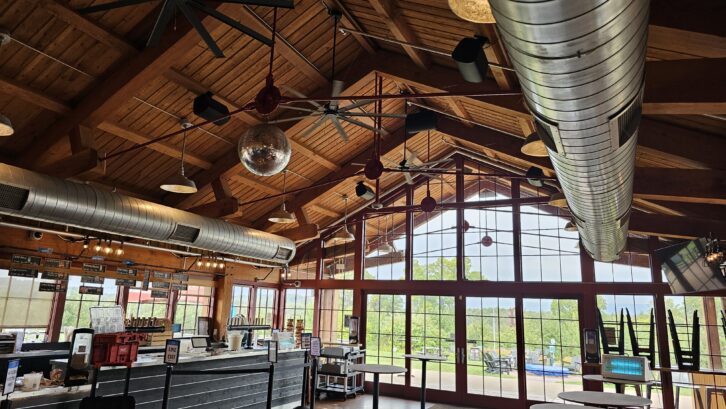
It’s to be expected that the perspectives of people working into the hospitality technology market differ, which may suggest that the moves towards full multi-purpose hotels and venues are still in progress rather than the norm. Chris Godfrey, senior category manager for EMEA at distributor ADI, says the company is not necessarily seeing a universal shift towards fully hybrid venues, but there is increased demand for flexibility within individual spaces. “Customers want venues that can support multiple use cases simultaneously, for example, a wine bar atmosphere in one zone while hosting live music in another,” he says. “This has naturally driven a convergence of AV, lighting and IT infrastructure, even if it’s not always described that way by clients. The priority is creating zoned environments where different experiences can coexist seamlessly without interference.”
FURTHER EXPANSION
As is now established, the traditional businesses that comprise the broad hospitality sector – hotels, bars, restaurants, members clubs and, increasingly, casinos and spas – have been expanding their activities by offering meeting facilities, live event spaces and generally moving into each other’s markets. But, as Sergio Molho, senior partner and co-chief executive of acoustics and AV technology consultancy WSDG, comments, the sector is further expanding to include sports stadiums. Since the start of the 21st century there has been a steady stream of new stadia opening – including those of Arsenal, Manchester City and Tottenham Hotspur in the UK – that look to rent out VIP and function rooms, as well as staging live concerts, on non-match days and in the off-season.
Whatever the setting, background and other environmental noise is now a major consideration to ensure everyone has an enjoyable stay or meal. “If it’s a hotel, the sound isolation, the acoustics of the room and the technology are already shown in [the brochure],” Molho explains. “In restaurants, noise from open tables is one of the elements that gets higher or lower ratings. Acoustics and technology are all over the place, and we work with those parameters and talk the language of architecture.”
WSDG’s work in AV extends to lighting and curtain shading, which can similarly be controlled as part of an overall IT network. Crestron is involved in this area through automating HVAC (Heating, Ventilation, and Air Conditioning) outputs in conjunction with shading controls. “When a system knows a room is vacant, there’s less need for heating or cooling,” comments vice president of hospitality Michelle Guss. “Shading that’s designed to harvest or repel solar gain, depending on climate, season or occupancy, working in tandem with the HVAC, can be a huge saver of both resources and money.”
MANAGEMENT INFRASTRUCTURE
This kind of ancillary control is part of a wider central management infrastructure that many suppliers, including Sennheiser, are seeing being rolled out for hospitality installations. “Instead of one room having a couple of mics and another having a couple, it all comes back to a single processor, be it Q-SYS, Biamp or Crestron,” says Sennheiser technical applications engineer Greg Oden. This integration was announced for the TeamConnect Ceiling M Plus microphone at InfoComm 2026. “It’s less of a third-party integration and more that the controller sees our microphone.”
Shure is also seeing more requirements for integrated management of devices to deliver a consistent experience for different types of events. Market development manager Andrew Francis comments that this is achieved through networked technologies on standard IT infrastructures. “Audio has become increasingly network based, allowing microphones, DSPs and other AV devices to integrate more closely with video platforms, control systems and wider IT networks,” he says. “This makes systems easier to deploy, manage and scale, particularly for venue operators looking to standardise technology across multiple rooms or locations.”
According to Nick Fichte, global business development lead for hospitality, home and yacht at L-Acoustics, the days of audio, video, lighting and IT being separate trades using their own cabling and control are fading. “This is especially in hospitality, where budgets and ceiling space are tight,” he says. “Convergence is being achieved primarily through networking, running everything over standard IP infrastructure – Dante/AES67 for audio, NDI or AVoIP for video and DMX-over-IP or similar for lighting – so it all rides the same backbone and can be managed, scheduled and monitored centrally.”
Hotels are no longer simply places to sleep before heading out to tourist attractions, business meetings or conventions. Increasingly, they have become destinations in their own right, with hotel chains and hospitality venues seeking to offer everything leisure and business travellers might want under one roof. At the heart of this transformation is AV technology, enabled by automation, IT and IP connectivity.
You can subscribe to Installation magazine for free here and the daily newsletter here.