Ken Scaturro, CEO of Kinly, is surely the only senior figure in pro AV to owe his career to a space shuttle disaster. At the age of 21, Scaturro was watching at the Kennedy Space Center on January 28, 1986, when the Challenger rocket exploded right above his head. A computer engineering student, his only ambition had been to put rockets into space. “It changed the whole trajectory of my career because they laid off thousands of engineers and put the space programme on hold for years,” he explains.
Scaturro’s life had been on a single trajectory until that moment. While at school in New Jersey, he had only applied to one college in the entire US, Florida Institute of Technology – so close to the Space Center that many of its graduates ended up working there. Now forced to change direction, he moved into networking and communications, spending five years travelling the globe as a network engineer on infrastructure projects for Lockheed Martin in the mid-1990s.
 It was his technical ability that first opened doors, landing him a role at FORE Systems, a networking pioneer competing with Cisco during the dot-com boom. He joined as a sales engineer, but the company quickly noticed his natural gift for engaging and winning the trust of clients. “They said: ‘You’re pretty good with people – why don’t you become a salesperson?’”
TAKING OFF
Having found his calling, Scaturro’s career took off rapidly. He progressed through sales management into executive roles, riding the dot-com boom before landing at Inktomi – one of the era’s most prominent casualties, acquired by Yahoo for a fraction of its peak value as the bubble burst around 2000.
While he was contemplating the wreckage of the dot-com collapse and his faltering career, a chance meeting with York Wang, founder of Yorktel, opened up a new direction. The company had a strong engineering base but no sales force, and Wang asked Scaturro to help them build one. “They were relying entirely on word of mouth,” he recalls. “They came out to the Washington DC area, where I live, and I mentored them on how to build a global sales team. So my first interaction with them was helping friends develop a go-to-market model for a strong engineering company.”
Scaturro’s strategy proved so effective that Yorktel wanted him on a permanent basis. He joined as senior vice president of global sales and business development in 2002 and the sales strategies he established helped to grow the company to more than $100m in revenue over the next nine years. But by that point, Scaturro felt the pull to build something of his own.
He took a COO role at an IT cybersecurity company in 2012, then founded myVRM, a software platform for managing video and collaboration resources, running it as president until it was acquired by Condeco Software in 2016. When Yorktel reappeared with a highly tempting offer, he knew it was time to return. “They asked me if I wanted to get the band back together,” he says. “And I did – because of the people. So I returned in 2018, but this time as president.”
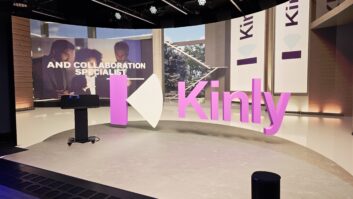
Scaturro remained in the role until 2024 when he became CEO as part of a transition to private equity firm One Equity Partners and the exit of founder York Wang. The new owner wanted to use Yorktel’s managed services platform as the foundation for future acquisitions and the merger with Kinly, completed in late 2025, was key. In March, Yorktel-Kinly opted to move forward under the single unified brand ‘Kinly’, serving over 2,500 clients across 27 offices worldwide in more than 100 countries.
The two companies were largely complementary rather than overlapping, Scaturro believes. “If you created a Venn diagram of where each company operated. Kinly brought boots on the ground systems integration capability across Europe and Asia-Pacific, whereas Yorktel’s strength was in North America and managed services. Think about a global customer who operates in 25 countries and who wants consistency across the board, We can now deliver that.”
Although the companies share a family atmosphere, there were cultural differences to navigate between American and European styles, and they brought in Dr Elizabeth Nelson, whose work focuses on the ‘biology of collaboration’. Her task was to address how different cultural groups read interpersonal cues and how misreadings can create what Scaturro calls “false bearings” between colleagues. “These are nuances that, if not handled properly, can set up barriers,” he says.
“It was enlightening to understand how the Norwegians look at something, and how it differs from the Dutch, and the British. We say things that are natural to us, but can easily be misinterpreted by others. With Americans, it may feel like we’re shooting from the hip, but we’re doing all this analysis in the background and you don’t see that. There’s a perception issue.”
Extensive planning meant that when the clock struck midnight on January 1, 2026 – day one for the new company – all employees understood their roles and the leadership structure. “We started by deciding what the executive team would look like, then worked down through the foundational levels,” Scaturro explains. “We’re building a target operating model for how best to scale this organisation. We expect to achieve the first big step by the end of the year.”
LIFE OUTSIDE
Away from work, Scaturro is a committed family man. He and his wife Jennifer have been married for nearly 30 years and have two sons, both now independent. One has shown an entrepreneurial streak Scaturro admires by launching his own insurance business, while the other possesses Scaturro’s technical ability, operating as a mechanical engineer on data centres. “They’re off my payroll and productive members of society,” he jokes.
The intensity of heading up a 1,700-person global operation requires downtime and the whole family shares two passions that involve escaping into nature – motorcycling and fishing. Over the past 20 years, Scaturro and Jennifer have ridden their bikes through all 50 US states, completing the final one, Alaska, this past Fourth of July. Asked to pick a favourite, Scaturro chooses Yellowstone for the “vast amount of wildlife – the wolves, the bears, the fishing in the lakes, the herds of buffalo – I could go back again and again”.
Riding a motorcycle brings all of his senses to life, but there is the inevitable exposure to the elements. Hotels are booked in advance so that even in heavy rain or high winds, there’s no choice but to reach the next stop, which could be anything from 50 to 300 miles away depending on the terrain. “Anybody who’s ridden enough understands there’s going to be really bad weather. You just go anyway. You’ve got rain gear, and if it gets too wet you pull over and wait it out. You can’t be in too much of a hurry.”
The experience of both riding and fishing, he says, demands total presence, allowing him to forget everything about work and daily life. “You have to be paying attention to the road. And out on the boat fishing, you also have to be in the moment. It allows you to really relax and decompress. Integrating two companies, the mental drain of that means being able to wind down is important to ensure you’re not burning out.”
Scaturro enjoys all types of fishing, anything from catching rainbow trout in a small brook a few feet wide, to wrestling with a giant fish off the coast of Costa Rica, where he has just been on holiday with his wife. “There’s a special thrill in catching a 500lb blue marlin. I had to fight one for a couple of hours. In Costa Rica, it was like an underwater ‘Jurassic Park’. We saw massive sharks and whales and pods of hundreds of dolphins doing back flips and front flips,” he says.
Scaturro lives in Annapolis, Maryland, which is home to the US Naval Academy, although Jennifer likes to joke that in reality he lives on a plane, a train, an automobile, or basically anywhere other than Annapolis. With so much travel, weekends are devoted to the family. As an empty nester, he now is able to travel more often with his wife, something he values highly. “It’s important to have that sanctuary of home life. That’s what allows me to go and do what I do in the business.”
SETTLED MIGRATION
Scaturro has little patience for those still debating AV’s migration to IP. That argument was settled a decade ago, he says. Even so, he still heard discussions at ISE this year about AV moving to IP. “This is already an IP world. Anybody who wants to get into the collaboration space needs to understand IP and that transport mechanism, because everything is built on it. Get your training and education on the IT side, and then move into wherever your passions drive. We can teach them the AV part,” he says.
When asked to name the single biggest shift he expects to see over the next decade, Scaturro resists the obvious answer of artificial intelligence. Even more significant, he argues, is the transition to immersive platforms. “AI is just a component of agentic transformation, which is itself a component of digital transformation, which is ongoing and ongoing,” he opines. “But immersive platforms, the spatial part and the content creation part, are really starting to come together now. The question is whether the business case truly translates into something that makes people more productive and more efficient. I think that experiential pivot is what we’re going to see.”
The Challenger explosion set Scaturro on a path he never planned. Forty years on, he is running a global AV integration business with 1,700 people across 27 offices. The trajectory, it turns out, was never going to be a straight line – and he seems entirely at ease with that.
You can subscribe to Installation magazine for free here and the daily newsletter here.