All AV environments have specific technological requirements but the house of worship (HoW) – of all faiths – is now one of the most technically demanding of all. Live sound production once led the way in the use and development of technology, influencing other sectors, but now the HoW market is equally innovative – if not more so.
This did not happen overnight. Live sound, recording and video equipment has been integral to evangelical church services in the US since the 1960s. Other religions have made use of this technology to lesser or greater degrees to the point where most, if not all HoWs, now have a live sound and ‘broadcast’ installation, which was primarily designed for the benefit of the in-person congregation, with the recording of services often being secondary.
The Covid pandemic made all HoWs rethink how they connected with and served their communities at a time when people could not attend services in person. Streaming over the internet became integral to this. Post-pandemic, the focus has returned to the in-person experience but streaming is now firmly part of the way HoWs work today, with AV technology playing even more of a crucial role for both.
According to Christopher Mullins, head of product marketing at Sony Professional Displays & Solutions, the video and speech/music operations are no longer just supporting what happens in the HoW. “Houses of worship now design their AV infrastructure to serve in-person and online congregations simultaneously, as one unified experience rather than two separate set-ups,” he comments. “This evolution dictates the technology chosen across the whole production chain, from capture through to visual delivery.”
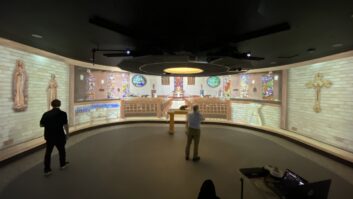
This includes intelligent PTZ cameras with AI auto framing to make for more engaging shots so remote viewers can see everyone at a service. Mullins adds that sanctuaries now need high impact visuals, with non-glare coatings on displays keeping the lyrics and scripture passages shown on screen legible. Scalable dvLED backdrops are also being used as a visual canvas behind altars, also with anti-reflection features.
Big screen and LED technology is routinely used to make services within the church more engaging, while creating an attractive experience for remote congregates. Webster Moyle, technical sales manager for Western US at Brompton Technology, says: “That has changed how systems are designed because displays, cameras, lighting, audio and streaming platforms must work together as one production environment. LED screens must look strong in person while reproducing accurately on camera.”
BEYOND BROADCAST
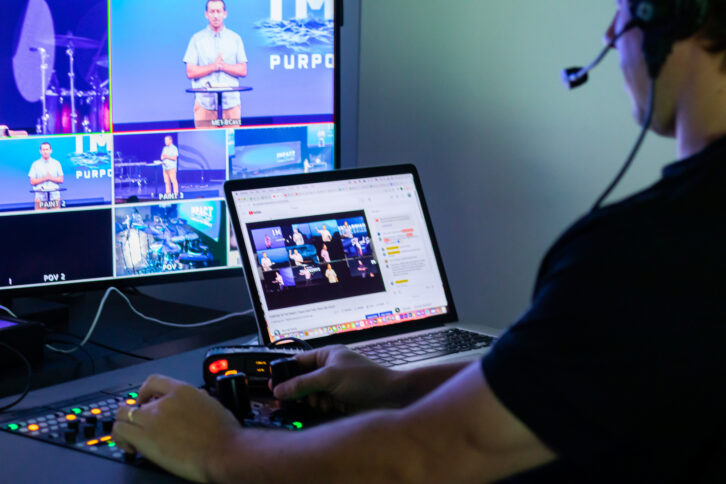
The expansion of the ‘broadcast’ installation at many HoWs gave the opportunity post-Covid to expand coverage into other areas of the church itself while maintaining the streaming and recording services. “The combination set-ups continue today, where a live production is going on inside the HoW, so they can feed monitors inside the church, and also send feeds to what we call ‘the crying room’, for those that have children but still want to view the service,” says Bob Caniglia, director of sales operations for North America at Blackmagic Design. “In addition, it’ll be livestreamed to people at home but also recorded and put on the church website or YouTube channels.”
Even after the lockdowns and quarantines were over, there was a coexistence between in-person and remote, which Samantha Potter, installation and commercial audio manager at Allen & Heath, says is tricky to balance effectively. “Hybrid is the most difficult blending of technology and people,” she says. “It’s really hard to serve both the people there in person and those online really well. Very few HoWs have taken streaming away entirely but I am seeing a recalibration of what is appropriate for a particular HoW or congregation. Instead of live streaming, they’re recording the service and making it available afterwards to those that could not see it live.”
Coming to terms with all this has been a learning experience for those running the technical equipment in HoWs, many of whom are volunteers and not specialists. “Our sound engineers and media team had to retrain on how live streaming works and how to get the best audio and visuals,” says Adrian Reid, inside sales representative at Sennheiser, who is a volunteer at his local church.
Reid agrees that the hybrid period has had an impact on how in-church productions happen now, both from a technology angle and the frequency of services. His church has an AoIP set up at the moment but they are considering Dante and that has changed things, he says. “There are still the older guys who like their XLRs at the back of the mixer, but the younger guys seem to a lot more innovative, thinking about what the whole production is going to be like in the next couple of years,” he says. “Do we still need to be in the building sometimes? Do we have fewer services, one instead of two a week, because we have a wider reach online? We have to ask ourselves these questions and the choice of technology is very important.”
NETWORKED AUDIO
The priority for HoW now appears to be ensuring good music reproduction and speech intelligibility for both in-person and online worshippers. Systems are now being designed with greater emphasis on networked audio, flexible signal routing and support for streaming, recording and distributed audio applications without compromising the experience for in-room attendees, according to Nick Mourn, applications engineering and consultant relations manager for LEA Professional. This trend, he says, is resulting in increased adoption of Dante-enabled systems, for which LEA is supplying its Dante Connect series of pro amplifiers.
The growing importance of broadcast within HoW installations is also driving greater adoption of AoIP across their technical operations. George Horton, vice president for Western Region US at SSL, believes there has always been an element of engagement with remote congregations, but the pandemic significantly accelerated it. “Suddenly, almost everyone needed to be a broadcaster. At a minimum the requirement may be to produce the FOH mix with additional audio from the congregation, plus opening and closing sequences.”
Horton adds that Dante, SMPTE ST 2110 and distributed systems are increasingly being used to meet these demands.
Something else that came out of Covid, believes Austin Freshwater, managing director of DiGiCo, was end-users asking how they could expand their sound systems to support a dedicated streaming or broadcast mix using existing infrastructures. “This is where scalable and flexible audio platforms really prove their value, allowing churches to grow and adapt without having to completely redesign their systems,” he explains.
While HoW installation is a category unto itself, it does have the same basic requirements and technologies in common with corporate offices, arenas and convention centres. This is especially evident in the use of networked systems for both audio and video, which, comments Alex Jones, project manager at specialist integrator DM Music, is particularly advantageous when working with old and often historically sensitive churches. “It does help from an installation point of view and in how discreet it can be,” he adds.
“With a networked system on our traditional PTZ camera, you’d have separate power, control and power cables going to it. A lot of IP cameras now have one cable for all. And having network switches as hubs around the church, with fewer cables connecting them, you can cut down quite a lot on installation time and cost. Aesthetically it’s got a benefit and offers much more flexibility for the future.”
SPEECH INTELLIGIBILITY
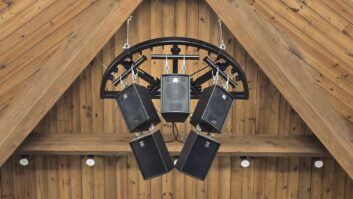
Another priority, particularly for older churches originally designed to lift the acoustic voice rather than support amplified sound, is speech intelligibility, Jones observes. “That was quite difficult in years gone by but we’re now getting loudspeakers that sound better and are much smaller, such as K-array columns,” he says.
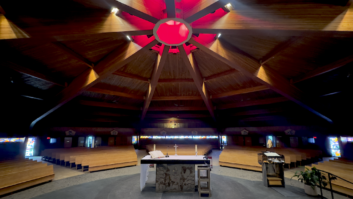
Europe does have a sizeable proportion of churches built in the American ‘mega-church’ style – modern buildings with multiple rooms and purpose-built technical infrastructure. But the majority of European houses of worship are old, sometimes ancient, buildings. Alex Lepges, technical director of Audio-Technica EMEA, says these older buildings require low-visibility loudspeakers and present “very challenging” wiring restrictions.
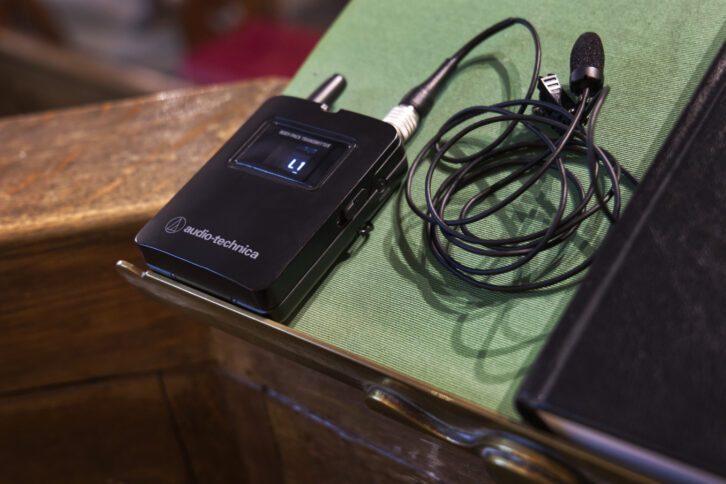
As opposed to evangelical houses, Lepges says, most older European churches do not usually require a great number of microphones. He explains: “What we face is a low channel count, but at the same time the requirements for the overall system are huge, such as using a wireless mic outside in the graveyard as well as inside the church. So the coverage has to be right, with multiple antennas, receivers and automatic mixers.”
Intercom might not be immediately associated with HoWs, but as broadcast and live production set-ups become more sophisticated, communication between technical teams is becoming as critical as it is on a major tour or in a TV studio. Brian Grahn, market outreach manager at Clear-Com, comments that many churches are using the Arcadia Central Station to link musician talkback to a wider intercom system. “A remote intercom system connection for multiple campus interconnect could also double as the way real-time translation audio streams are transported from one location to another,” he says.
Intercom technology has expanded over the last 20 years to offer a variety of technologies, from wireless to digital partyline to IP-based and scalable matrices. Julia Rodgers, regional sales manager for the US Southeast region at Riedel, comments that all have been designed to scale from HoWs with modest budgets up to multi-campus operations. “It’s the core design challenge HoW has to solve that a lot of the rest of the AV market doesn’t,” she says.
MODERN PROBLEMS
Something else HoWs of all faiths now have to consider is a technology that the secular world now expects to be freely available everywhere: Wi-Fi. This includes the Sheikh Zayed Grand Mosque in Abu Dhabi, the biggest in the United Arab Emirates, which has free Wi-Fi in its visitor areas and outside courtyards. Richard Jonker, vice president of commercial business development at NETGEAR AV, observes that HoWs now must face what he calls “modern world problems”, which can involve running in fibre and Power-over-Ethernet.
Given these technical challenges, houses of worship – having followed other AV sectors for so long – could now be influencing those markets in terms of technology choice and implementation. NETGEAR’s Jonker agrees, though says the influence is not direct. “There is no horizontal cross-pollination between vertical markets, but manufacturers are learning from this,” he says. “The innovation is driven by headaches and problems that get communicated to them. An example is PTZ cameras. HoWs wanted better quality and optical zoom, not digital, and better motors. And we’ve seen the major camera brands work on much higher quality equipment for PTZ cameras.”
OPERATIONAL LESSONS
Nick Mourn at LEA Professional observes that the wider AV market can learn from HoW on an operational level. “One of the biggest lessons is designing systems around people, not just equipment,” he says. “Technology in a HoW must serve the needs of the audience, presenters and operators, often with limited technical resources.”
Riedel’s Julia Rodgers adds that HoWs have never had the luxury of building for one type of user, with the sound desk run by an experienced engineer one week and “a sweet volunteer” the next. “What the AV world can borrow from this is that the best technology doesn’t have the longest spec sheet, it gets out of people’s way… and quietly does the job,” she says.
Alex Jones at DM Music says its clients mostly have tight budgets, putting the onus on churches to decide on the right approach. And Samantha Potter at Allen & Heath, who also works with a company introducing the next generation of pastors to technology and production techniques, says the main takeaway is that building a system people cannot use fully is not worth the effort.
“We in the AV industry can be very involved in the technology and we forget that it’s not always understood,” she says. “Sometimes there are better options. I think HoWs are extremely grateful for the technology and understand they could very well not have any of this.”
Having once looked to other sectors for technological inspiration, the house of worship market is now developing approaches from which the wider AV industry can learn. Its greatest lesson may be a simple one: however sophisticated the technology becomes, it only succeeds if the people using it can make it work.
You can subscribe to Installation magazine for free here and the daily newsletter here.