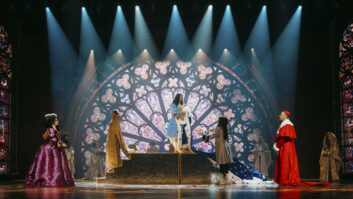
Brompton Technology’s Tessera LED processing platform and Absen’s Saturn LED panels delivered the visual experience at this year’s Olivier Awards, the UK theatre top honours, held at London’s Royal Albert Hall to mark the ceremony’s 50th anniversary and its return to prime-time BBC television.
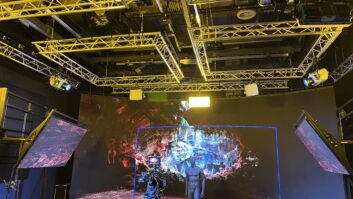
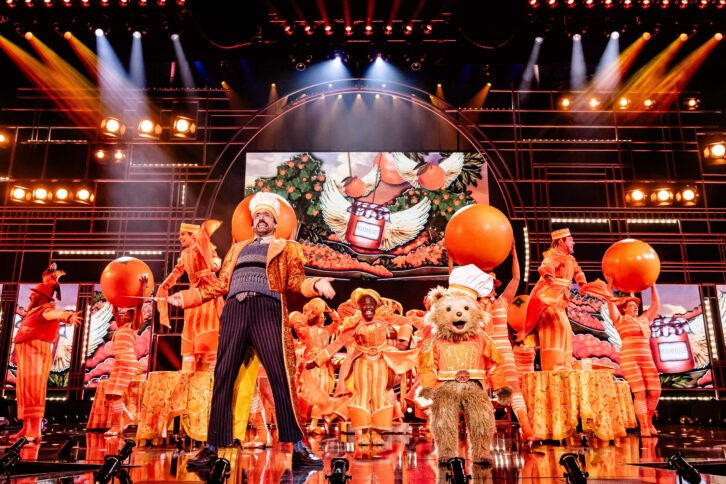 The LED rig was split into seven pieces: a central 16:9 screen that flew in and out throughout the ceremony to display VT packages and scenic content, and six further screens built into the scenery as “posters” used for scenic content and imagery celebrating nominated and winning productions.
The setup comprised two Tessera 4K SX40 LED processors and two Tessera XD 10G data distribution units for the main flown screen, with a matching configuration of two further SX40s and two XDs powering the poster screens.
This year also saw a transition to Absen’s latest Saturn 2.6mm panels, chosen to run on Brompton processing. The new panels weigh less than half their predecessors, a benefit for the automation and rigging teams working within the venue.
Darren Jackson, business development manager (UK and Ireland) at Absen Europe, said: “Productions of this scale demand complete confidence in every element of the LED workflow. The combination of Absen Saturn panels and Brompton processing gave [the production team] the performance, colour fidelity and reliability needed for a live prime-time broadcast, and we’re proud to have contributed to such a landmark celebration of British theatre.”
The system was deployed by Blue-i Theatre Technology, whose head of technical theatre, Sam Jeffs, was working on his 12th consecutive year on the show. As a broadcast production, redundancy was a priority.
Jeffs, head of technical theatre at Blue-i, added: “Being a live broadcast, project timings are really tight, so ensuring we could load in quickly and have a rock solid system with full redundancy was very important. The SX40 and XD combination allowed for multiple layers of redundancy, which makes it one of our favourite Brompton features.”
Low latency was also critical for the live camera feeds central to the broadcast, with the processor reducing end-to-end latency to one frame. Because the production signal had to pass through an outside broadcast system, minimising latency at every point in the chain was a key consideration. Genlock was used to synchronise the LED system to the production’s house sync, intended to help eliminate on-camera artefacts during transmission.
The colour control offered by the SX40s, including the ChromaTune 14-way colour corrector, was used to work with the broadcast engineering team to achieve the required on-camera look.
Jeffs added: “Having the fine colour controls was heavily used to work with the broadcast engineers to get things looking just right on camera. The different levels of control really helped dial things in quickly.”
Jeffs also pointed to Brompton’s Stacking feature, which propagated changes across all four SX40 units simultaneously, and the Frame Store feature, which allowed the team to store and recall video snapshots as a contingency during the live broadcast.
Patrick Goodden, technical sales manager (UK and Ireland) at Brompton Technology, said: “The Olivier Awards’ return to prime-time TV is a landmark occasion. Live broadcast is one of the most demanding environments for LED processing, with latency, redundancy and colour accuracy requiring no margin for error. The fact that Blue-i have built their entire workflow around the SX40 is a real testament to what the platform can deliver; it’s a privilege to support them in making something this special look its very best.”
Into The Woods and Paddington The Musical, which also features Brompton processing, led the evening’s nominations with 11 each, with Paddington The Musical winning seven awards including Best New Musical.
You can subscribe to Installation magazine for free here and the daily newsletter here.