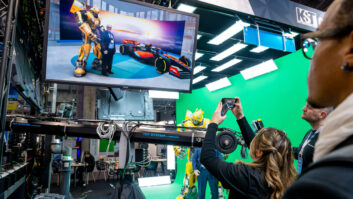
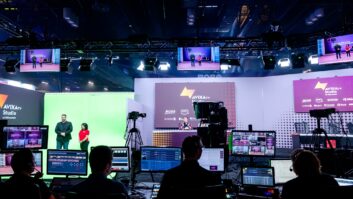
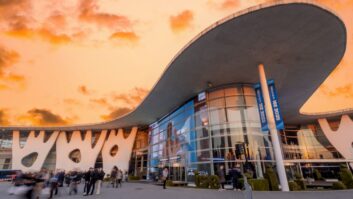
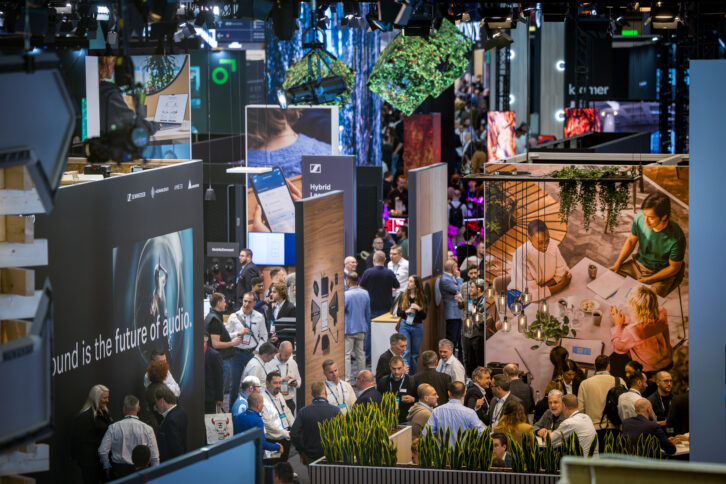
ISE delivered the highest attendance figures in the show’s history this year, underlining Barcelona’s status as the global focal point for pro AV, systems integration and adjacent broadcast technologies.
AV’s premier show welcomed 92,170 visitors and hosted 1,751 exhibitors – including 323 first-time participants – across 101,000sqm of show floor space. Registrations reached 120,914, with over 212,000 visits recorded across the four days of February’s event.
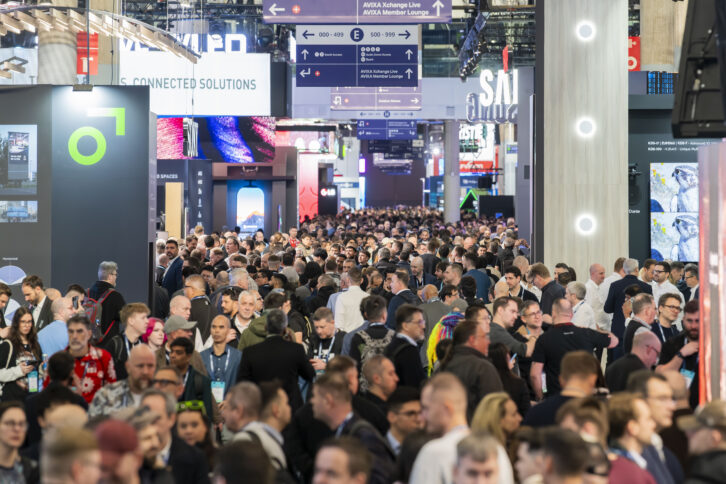 The momentum built quickly at the Fira de Barcelona Gran Via. On the opening Tuesday, ISE welcomed 55,156 unique attendees, up 10 percent on Tuesday 2025 (49,981). On Wednesday, ISE recorded its largest single day ever with 64,198 visitors – almost equalling the pre-pandemic record attendance of an entire ISE show (64,908 at ISE 2019 in Amsterdam). The total for unique attendees across the whole event climbed to 87,648 by Thursday, marking the highest in ISE history.
Mike Blackman, managing director of Integrated Systems Events, which runs ISE, said the close of the show left him “truly inspired by the passion and strength of our community”, adding: “Over four extraordinary days, we celebrated groundbreaking technology, ignited bold ideas, forged lasting connections, and set new benchmarks for our industry.”
PALPABLE ENTHUSIASM
Installation heartily agrees: this was without question the most exciting ISE to date, and the enthusiasm on the show floor was palpable, with exhibitors reporting huge footfalls and top-quality booth visitors.
“ISE was brilliant this year,” said Andy Bellamy, EMEA technical director at AJA, pointing to “a steady flow of traffic” through the week. “Footfall was exceptional, and the lead quality was fantastic,” he added.
Vicky Fox, head of communications – global, PPDS, likewise described 2026 as “arguably our busiest yet”, with the Philips booth “filled to capacity throughout the week”, while noting that the quality of visitors “in business terms” was again “very pleasing”. James Hill, sales director UK at Shure, commented that footfall was “excellent”, and that the quality of conversations “really stood out”.
Thomas Müller, vice president of sales and marketing West Europe at ViewSonic, said ISE’s expanding scale and international reach helped drive a “150 percent surge in qualified leads” this year, adding that “while the high footfall was impressive, the quality of engagement was the true standout”.
Martijn Blokland, vice president and general manager, international, at Neat, said: “Footfall at the Neat stand was consistently strong and busy throughout the show,” adding that “the quality of conversations stood out”. Ed Morgan, DisplayNote Technologies CEO, agreed that footfall was “strong”, but “more importantly, the quality of conversations was exceptional”.
And while Promethean’s Nedelka Phillips said her booth’s location at the East Entrance (utilised in the absence of the originally-planned-for Hall Zero – now expected in 2028) ultimately meant that “footfall wasn’t what we had hoped”, she stressed that “the quality more than made up for the quantity”, adding that there were “very few times that our demo stations weren’t in full use”.
Blackman described ISE 2026 as “record-breaking and deeply rewarding on both a personal and professional level”, pointing to the event’s continued maturation in Barcelona and the tangible value delivered to exhibitors and visitors alike. “The scale, the quality of conversations, and the diversity of applications represented across the halls really demonstrated how central the pro AV and systems integration industry has become to so many sectors.”
He also highlighted how the show’s growth reflects the resilience of the wider industry – and the increasingly porous lines between markets. “ISE 2026 highlighted how boundaries between sectors are increasingly blurred, with technology playing a pivotal role across commercial, residential, and creative applications,” he said.
CONVERGENCE TRENDS
That theme – convergence not as a buzzword, but as an organising principle – surfaced repeatedly across the show floor: broadcast vendors pushing into enterprise and live environments; AV vendors positioning up toward ‘broadcast-grade’; and standards-led, IP-centric infrastructure sitting underneath both. For ViewSonic, Thomas Müller, vice president of sales and marketing West Europe, said ISE’s expanding scale and international reach helped drive a “150 percent surge in qualified leads” this year, adding that “while the high footfall was impressive, the quality of engagement was the true standout”.
A key debut at ISE 2026 was Spark, an initiative aimed at bringing together creative minds and technologists from broadcast, live events, marketing, design and gaming. “Watching Spark come to life… was a standout moment for me,” Blackman said, describing it as a space where ideas could be shared and audience experience pushed forward.
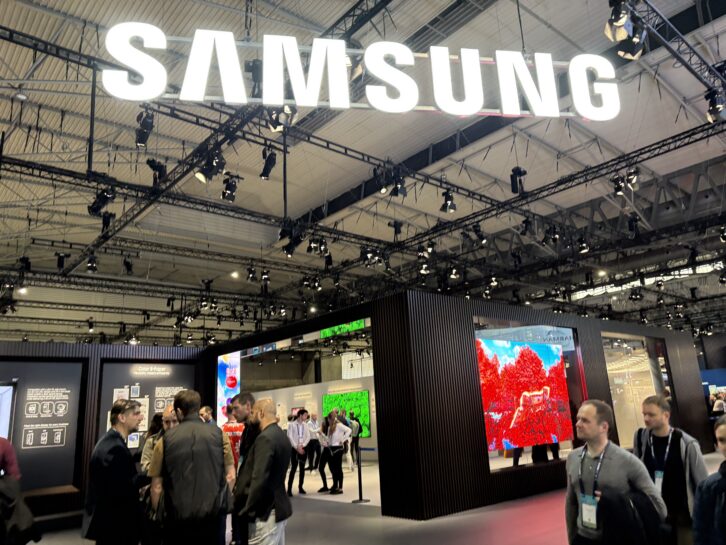
Spark’s ‘powered by Samsung’ launch also became part of ISE’s broader story about new features and shared spaces being used to optimise the existing footprint while Hall Zero remains pending, due for a 2028 launch.
This year, the show also announced the new ISE Foundation, backed by co-owners AVIXA and CEDIA and supported by the City of Barcelona and the Government of Catalonia. Blackman framed ISE as “no longer just a four-day event” but a year-round platform – with the Foundation structured around talent development, innovation and social responsibility and designed to consolidate and scale local contribution projects while enabling new initiatives throughout the year.
AVIXA CEO David Labuskes emphasised that while ISE remains the largest gathering of AV professionals, “beyond the numbers is a more remarkable story: people connecting with one another… and exchanging ideas that will live on past the convention centre walls.”
CEDIA global president and CEO Daryl Friedman echoed the theme of cross-ecosystem collaboration: “ISE 2026 once again demonstrated the extraordinary power of collaboration across our global technology ecosystem… The energy on the show floor and throughout the conference programme reflects a thriving industry that is not only embracing emerging technologies, but shaping how they enhance the spaces where people live, work, and connect.”
High attendance brings its own friction points. Asked about feedback around long lunch queues, Blackman acknowledged the issue: “High attendance is a good problem to have, but it does mean we need to work with our partners to scale food and beverage options accordingly. We will work closely with the Fira team to explore ways to address these concerns.”
BOOTH TOURS
If the macro story was record-breaking growth and maturing show structure, the micro story was how product categories were evolving – and converging. Installation visited as many booths as physically possible across the four days, and below is a walk-through of key themes and launches, grouped by product genre to reflect how integrators and end-users are actually building systems right now.
Sony used ISE to spotlight the new BZ-P Series of 4K HDR professional displays (43in-85in), presented to Installation by Adam Dover, senior marketing manager for professional displays, Sony Europe. The three-tier lineup spans the flagship BZ40P with Deep Black Non-Glare Premium technology (47 percent anti-glare) and 700 nits brightness; BZ35P (500 nits, IP5X dust resistance); and BZ30P (400 nits). Sony positioned the range around efficiency too, claiming up to 31 percent lower power consumption compared with the previous BZL series, aided by an AI-powered XR processor and a high-efficiency optical system. Dover also pointed to a partnership with Crestron to strengthen integration and interactive workflows.
Samsung’s booth leaned into ‘spatial signage’ and experimental form factors. Adam Brooks, head of QSR, highlighted spatial signage solutions in 85in, 32in and 55in sizes (with the latter two due later in 2026), plus colour e-paper displays in multiple sizes with ultra-low power consumption and embedded batteries. The booth also included a transparent micro LED prototype (600 nits), a 105in high-resolution display, and a 130in RGB screen.
In the wider signage ecosystem, PPDS, headed up by Vicky Fox, made announcements across all four days, led by the launch of a Philips LED Configurator platform designed to streamline LED wall specification, plus the Philips Signage 2000 Series entry-level 4K UHD signage range.
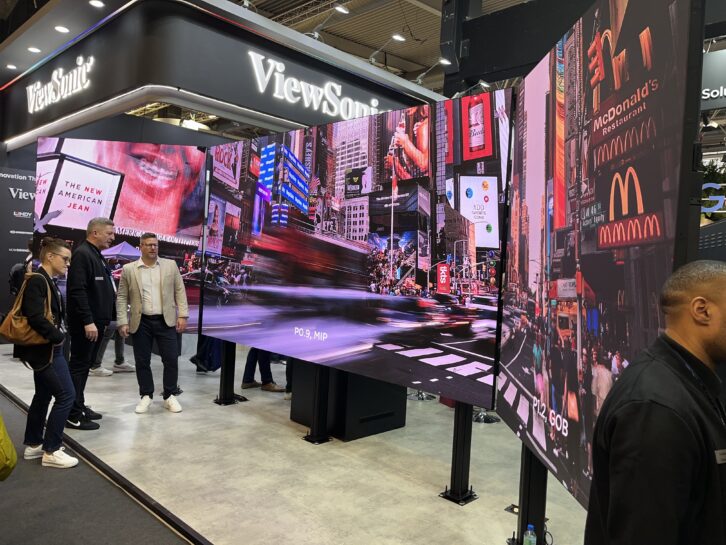
ViewSonic’s booth centred on large-space and meeting room display solutions, including a Micro LED in Package (MIP) focus, the LDS 138 foldable mobile LED display, and an ‘All-in-One’ LED solution positioned around faster installs through an LVDS cable system. The company also showed a ‘Future Meeting Room’ concept combining interactive flat panels with TeamJoinOS.
Hikvision took an unusually hands-on approach to LED, running an ‘LED MasterLab’ where visitors could assemble and test rental configurations (floor, hang, corner and flexible formats). New launches included the Flex G2 Series indoor LED aimed at retail with a cable-free installation system, plus an LED Poster with a built-in controller and pre-installed structure.
GOOGLE PARTNERSHIP
Promethean’s stand featured the ISE debut of the ActivPanel D-Series, a non-interactive digital signage solution for communal areas. A partnership with Google was also highlighted, demonstrating Chromebox OPS compute device integration with the ActivPanel for instant access to collaboration tools.
ADI/Snap One unveiled major updates to its Control4 platform, including the global availability of Control4 X4 – featuring a redesigned interface with customisable home screen and interchangeable widgets – and Control4 Connect, an optional subscription for premium features. The upcoming T5 In-Wall Touchscreens, with minimal bezels and magnetic tool-free mounting, were also previewed.
Marking its 25th anniversary, Absen showcased a wearable-free motion capture solution developed with EnlightV, designed for immersive interactive experiences across commercial and themed entertainment applications without specialist equipment or training. Meanwhile, making its ISE debut as part of the VITEC family following its acquisition, Datapath unveiled the Aligo Workstation for mission-critical control room environments. Built around its OneControl technology, the workstation allows operators to switch keyboard and mouse focus across multiple screens by cursor movement alone.
Barco expanded its QDX projection platform with three new RGB models, positioned around Rec.2020 coverage for colour-critical content. Inge Govaerts, director of commercial communications, highlighted lens compatibility (including TLD+ optics) and lens shift up to 150 percent for creative placement in complex architectural environments – and pointed to the platform’s role in major mapping work such as the Freedom 250 show at the Washington Monument.
Panasonic showcased additions under the MEVIX brand (for more on this see page 26), led by the PT-HTQ20, described as the company’s first projector to support the Rec.2020 colour gamut (over 95 percent coverage) using newly developed RGB-plus-phosphor laser tech, delivering 20,000 lumens and 4K output. “MEVIX is the expression of our strategic shift – Panasonic-grade quality with a leaner, bolder mindset,” said Panasonic Projector & Display CEO Yousuke Adachi. Also shown at ISE: the TL-55LV12A LED display (1.26mm pixel pitch) and VMQ85 projectors delivering 4K via 2-axis pixel shifting.
Digital Projection marked the start of its 30th anniversary and used the show to frame a new 8K flagship based on Satellite MLS architecture, separating light source from projector head. The firm also introduced the first products in the TITAN Luma range, including the TITAN Luma 35000i (positioned as ~30 percent smaller and lighter than its predecessor), alongside Nexus AI calibration and blending for multi-projector arrays.
Disguise’s stand centred on the GX 3+ media server, with live activations including an immersive audio-reactive tunnel in partnership with L-Acoustics and an interactive basketball experience with ASB GlassFloor’s digital court technology. Demo pods offered hands-on access to new projection mapping tools and AI workflow assistant Ask AId3n.
Emergent debuted two AI-driven products at the ROE Visual stand. Pulsar VS is a virtual production control solution that can generate virtual environments from a single text prompt, while Nova GFX is an AI-powered broadcast graphics platform that automatically transforms live data feeds into broadcast-ready visuals.
Neat added to its collaboration portfolio with the Neat Pad Pro – a 10in controller/scheduling display due Q2 2026 – integrating microphones and environmental sensors.
Airtame’s Jonas Gyalokay demonstrated Airtame 3, a cloud-managed device-agnostic platform integrating with Teams, Zoom, Google Meet and Webex, supporting PoE+ for 4K sharing and new dual-screen functionality. A software option for Android and Windows retrofits existing hardware.
Crestron showcased its new 80 Series Touch Screens, built on Microsoft’s Device Ecosystem Platform (MDEP), supporting scheduling services (Teams, Zoom Rooms, Outlook), environmental controls, 802.1X authentication and TLS encryption – and tying into XiO Cloud for remote management.
At Jabra, a scalable, modular approach to meeting rooms was presented, built around the PanaCast 55 VBS video bar and expandable multi-camera options, with room kits shown in one- three- and five-camera configurations aimed at consistent performance without complex programming.
And DisplayNote CEO Ed Morgan demonstrated an efficiency play with NowSignage: a dual-mode approach where a single meeting room screen can serve as signage when a room is unoccupied, then switch to one-touch collaboration mode when in use.
PureLink’s Vuelogic series headlined its ISE showcase, including the VL-PTZ100, a compact 4K PTZ camera with AI-driven speaker and presenter tracking, and the VL-BYOD200, a 4K multiview and BYOM switch with USB-C Power Delivery. At the PTZOptics booth, Claudio Barbiero, VP of global marketing, showcased workflow-driven demos including multi-camera setups with voice tracking. Among the highlights was the SimpleTrack 3 camera and a new wireless PoE device enabling
AUDIO EXPERIENCE
Biamp marked its 50th anniversary, using the show to underline its evolution from performance-focused audio into full-line AV, with updates to the Biamp Workplace platform, MAX Connect’s new ‘Auditorium Mode’ for up to 200 participant devices, and solutions such as Parlé Participant Lift for large-space voice reinforcement. The BMA 360D ceiling tile microphone array brought Dante connectivity and beamforming, while the Parlé VBC 2800 conferencing bar gained Teams certification.
Shure introduced the IntelliMix Bar Pro, an all-in-one video bar aimed at medium-to-large rooms, with IT management and security positioned as core requirements for AI-driven workplace environments.
Nureva previewed an update to the HDL310 audio conferencing system introducing a coverage map and camera switching based on XY sound location data – enabling IT managers to define camera zones and trigger presets as participants speak. The company also previewed a new HDX system due summer 2026, designed for full-room audio and distributed programme audio in spaces up to 12m x 18m, including Auracast assistive listening.
For assistive listening, Ampetronic/Listen Technologies expanded its Auri ecosystem based on low-latency Auracast broadcast audio, with new products shipping in 2026 including a telecoil-supporting lanyard accessory, transmitter options and docking/transport cases.
Elsewhere, Amina Sound showcased the Sapphire 375 invisible speaker designed for installation behind timber, stone, plaster or fabric, targeting both residential and commercial 100V systems while claiming 44Hz bass without a sub. EM Acoustics demonstrated new cardioid subs (CS15 and CS18) designed to achieve cardioid performance without requiring actively driven two-channel alternatives.
Networking and standards crossed into audio too. d&b audiotechnik launched the U-Series compact point-source loudspeakers and introduced multiple Milan-enabled audio-over-Ethernet products, alongside new loudspeaker options aimed at space-conscious installations. Adamson introduced the MS8.2 Milan AVB-ready switch aimed at touring, installation and spatial audio networks.
CORRECTION SOFTWARE
For Dirac, Anders Storm, CEO, outlined the company’s room correction software, which digitally processes acoustics to improve audio quality. The firm offers three product tiers – Dirac Live, Dirac Live Bass Control and Dirac Live ART – while its MIMO technology enables multiple speakers to work as a cohesive system.
Meanwhile, Sam Simon-Norris, VP sales and marketing, DPA Microphones, highlighted the firm’s N-Series digital wireless microphones, first launched at ISE 2025 and due for wider release in August 2026. The CORE+ update reduces distortion across pre-amplifiers, while a new MicroLock system is designed to ensure more secure connectors.
Richard van Nairn, sales director, Innosonix showcased the µMA04/M, a four-channel mains-powered amplifier delivering 120W per channel, bridgeable to 240W, with built-in DSP, FIR filters, and AVoIP options including Dante and AES67.
Sennheiser’s ISE presence extended across 20 partner stands including Barco, Crestron, Q-SYS and Lightware. New camera tracking collaborations were announced with Laia and Vaddio, alongside a partnership with Pleneo focused on AI-ready collaboration for medium and large meeting spaces.
L-Acoustics spread its presence across three locations, with HYRISS (Hyperreal Immersive Sound Space) its immersive audio technology for luxury commercial and hospitality environments a key focus. Also spotlighted was Soundvision Connect, a new cloud-based extension of its 3D modelling software enabling real-time collaborative design.
Renkus-Heinz officially launched the ICLX-48S column subwoofer, designed to extend the IC Live X Series of modular steerable arrays with a matching vertical form factor for flown or wall-mounted installation. Also previewed was RHAON 3, a reengineered control platform featuring an updated OmniBeam beam-steering algorithm and a new “Snap to Audience” configuration feature.
LD Systems centred its stand on the forthcoming QUESTRA 1.4 software platform, designed to bring audio, video and control into a single management environment with OSC protocol support. New hardware included the NMP 8 and NMP 32 DSP audio matrices with AES67 support and the SPAV 14 HDMI splitter, supporting resolutions up to 8K60.
Pliant Technologies exhibited on the Telos stand, showcasing the CrewCom wireless intercom ecosystem alongside the more compact CrewCom CB2, suited to installations that don’t require the full CrewCom feature set. New to the headset range was the PHS-IEHU In-Ear Universal Fit Headset, compatible with custom ear moulds.
Sonos introduced the Amp Multi, a multi-channel streaming amplifier offering eight outputs at 125W each across up to four configurable zones. Designed with integrator input, outputs can be reconfigured across zones without rewiring.
TAKE CONTROL
Lutron showcased three new lighting control products: the Vierti keypad with hand-finished brass and hybrid system/load control options; Lumaris RGB plus tunable white tape light; and the Aviena toggle keypad with heritage design and brass finishing.
Humly debuted Humly Visitor, a visitor management platform with expanded options and a branding shift toward integrations – including integration with Q-SYS for room control.
And Utelogy demonstrated its cloud-first operations platform for managing enterprise-scale AV and UC environments, positioning monitoring, analytics, automated discovery and ‘self-healing’ automation (such as auto-resetting display inputs) as essential to scaling support and meeting service-level expectations.
At the Symetrix booth, Ty Hawley, vice president of sales and marketing, presented Cognio, a new audio, video and control platform developed over five years. Featuring a shared firmware (Cognio OS) across devices, the platform includes code-free, vector-based touch panel design tools aimed at non-experts. Cognio is scheduled for Q2 2026. The show also marked Symetrix’s 50th anniversary.
Meanwhile, Eliran Toren, CEO, MSolutions, presented the MS-RSE-G, a compact control solution (60x37x23mm) for managing IP and legacy serial devices. Now shipping, it bridges IP and RS-232, allowing legacy devices to be placed onto IP networks for centralised management.
SUPPORTING STANDARDS
The broadcast/AV overlap was of course evident on multiple stands. Studio Technologies’ Mark Townsend pointed to rising demand for Dante, Ravenna and SMPTE ST 2110 standards across both sectors, while MultiDyne emphasised bridging IP and SDI workflows – even offering its VersaBrix fibre transport platform in an all-white finish designed to visually align with white AV hardware in meeting rooms and classrooms.
On the standards side, Macnica showcased the production-ready ME10 SoC for building IPMX-compliant devices, positioned as an AVoIP integrated chip enabling high-volume production of lower-cost endpoints. Support for SMPTE 2110 and JPEG XS compression (bandwidth reduction from 18Gbps to 1Gbps) illustrated where the market is heading: compact, mass-deployable, standards-led hardware that integrates into existing networks rather than sitting apart from them.
PlexusAV presented multiple IPMX-enabled products including encoder/decoder endpoints supporting JPEG XS and integrated KVM, plus ChargeLink, a USB-C one-cable connection hub for meeting spaces offering network access, USB data, video sharing and up to 100W power delivery.
AJA showed openGear-based conversion and multi-format bridging, including products positioned around UHD encode/decode/transcode and bridging SMPTE ST 2110 IP networks with SDI and HDMI infrastructures.
Vizrt’s demo – developed with Zoom – offered a particularly clear snapshot of ‘broadcast tools moving into enterprise’. InteractifAI enables broadcast-style graphics overlays directly in Zoom meetings using templates for branded visuals, while CaptivAIte targets Custom AV Zoom Rooms with AR graphics via AI keying, remote contributor ‘teleportation’ and NDI for AVoIP connectivity, aimed at corporate and higher education use cases like town halls and executive presentations.
Grass Valley framed its direction in explicitly enterprise terms too, speaking to broadcast AV teams under budget and operational pressure and pushing reusable, scalable workflows with resilience embedded at the architecture level – citing earnings calls and investor briefings as contexts where production quality carries tangible business impact.
Bosch’s security and communications presence reflected the shift to Keenfinity Group following Triton Partners’ acquisition and the July 2025 rebrand. David Cheesman, VP of growth for EMEA and APAC, outlined the company’s sharpened focus on video surveillance, access control and PA. The booth reflected this repositioning, featuring an Esports-style demo combining intercom, PA and BYOD-ready conferencing, plus product highlights including DICENTIS and PRAESENSA and strengthened PTZ capability through the acquisition of Avonic.
Kim Brown, marketing manager, Matrox Video, highlighted the Matrox Mura DVW, an IP-based 4K distributed video wall appliance, with new enhancements introducing live preview of IP and web sources, EDID management, and audio decoding. The company is also planning a product announcement for InfoComm in June.
At the Lynx Technik booth, Vincent Noyer, CTO, announced an executive leadership transition effective July 2025, with Markus Motzko appointed CEO. New products on show included a four-channel fibre converter with dual power redundancy and the IPST 2110 IP conversion product.
DEPLOYABLE INFRASTRUCTURE
Several booths focused less on headline devices and more on the infrastructure that keeps systems deployable at scale. Lightware demonstrated USB-C extension and BYOD meeting room integration, including the USB-C BOOSTER-V1 (extending USB-C functionality up to 12m while supporting 4K video and up to 100W charging), plus AVoIP updates and cable connectivity options.
Lindy used ISE to announce its newly established US operations and promote a connectivity portfolio including a USB-C fibre optic hybrid cable supporting high-speed transmission up to 10m, alongside training via Lindy Academy.
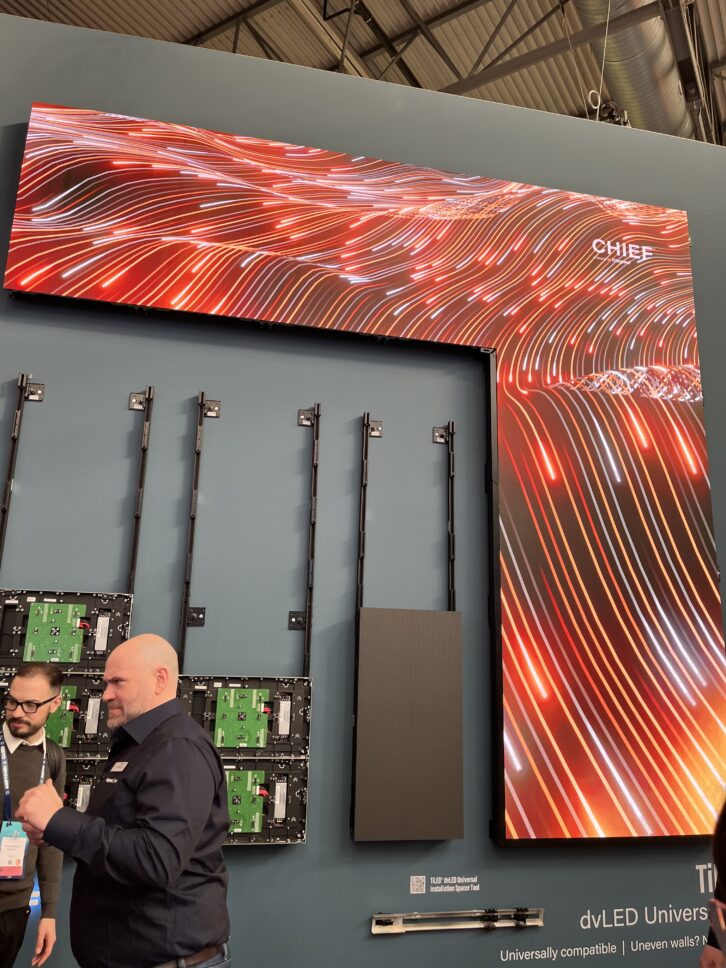
Legrand/Chief debuted the TiLED Universal dvLED Mounting System, designed for service access and offsite pre-loading of AV devices – a practical nod to how labour, access and serviceability have become just as important as device performance.
PureLink’s Vuelogic series headlined its ISE showcase, including the VL-PTZ100, a compact 4K PTZ camera with AI-driven speaker and presenter tracking, and the VL-BYOD200, a 4K multiview and BYOM switch with USB-C Power Delivery.
Eliana Toren, CEO, MSolutions, presented the MS-RSE-G, a compact control solution (60x37x23mm) for managing IP and legacy serial devices. Now shipping, it bridges IP and RS-232, allowing legacy devices to be placed onto IP networks for centralised management.
LOOKING AHEAD
Looking ahead, CEO Mike Blackman has said that ISE 2027 will “build on the momentum of 2026 rather than reinvent the wheel,” with continued focus on innovation, education and experience, alongside refinements to show layout and the visitor journey. Growth, he added, will be “carefully managed” within the current hall constraints, through smart floor planning, enhanced zones and improved use of shared spaces – while exploring ways to create additional exhibitor space ahead of the much anticipated Hall Zero opening for ISE 2028.
For now, though, ISE 2026 leaves a clear impression. The attendance numbers may have made the headlines, but walking the halls, the bigger shift was in how products were being talked about.
IP was assumed. Cloud connectivity was built in. And whether it was displays, audio, control or broadcast infrastructure, very few manufacturers were pitching standalone boxes.
Broadcast vendors were clearly courting corporate teams. AV brands were comfortable referencing SMPTE, IPMX and production workflows. IT language – security, authentication, remote management – cropped up almost everywhere.
ISE didn’t need to shout about convergence. It was there in the detail. The hall map may still divide the sectors, but across the booths those lines are increasingly blurred.
ISE 2027 will take place 2-5 February 2027 at the Fira de Barcelona Gran Via.