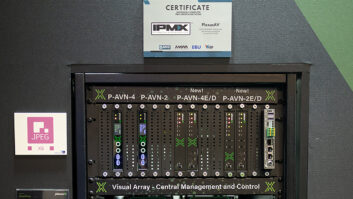
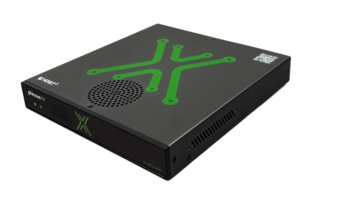
PlexusAV, the pro AV division of Sencore, is presenting a lineup of new AVoIP solutions at ISE 2026 (Hall 5, Booth 5J700), designed for enterprise and professional installations. The portfolio includes high-performance encoders and decoders, low-latency streaming solutions, USB-C collaboration hubs, and networked ceiling speakers.
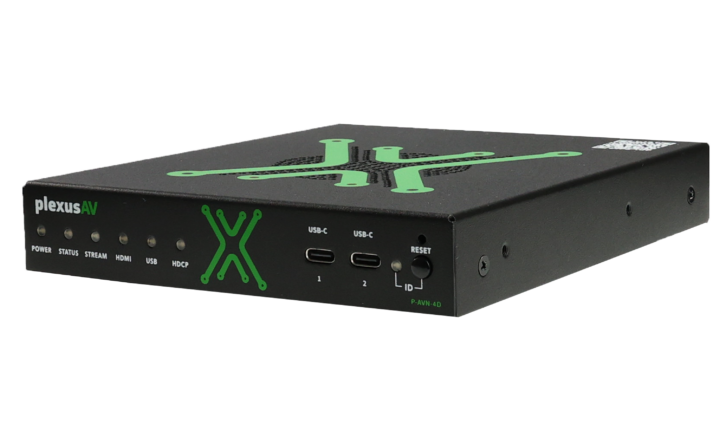 The PlexusAV ChargeLink (P-AVN-CL100) offers a USB-C one-cable solution for small and mid-sized meeting spaces, delivering network access, USB data, video sharing, and up to 100W power over a single connection to simplify meetings.
The company is also highlighting low-latency H.264/H.265 streaming with the P-AVN-2E encoder and P-AVN-2D decoder, achieving 33 ms end-to-end latency at just 40 Mbps. Native USB support enables KVM routing and interactive workflows even on constrained networks.
Entering the networked audio market, PlexusAV will showcase the P-ANS-6CW1D (Dante) and P-ANS-6CW1A (AES67) ceiling speakers. These full-range PoE+-powered speakers require a single Ethernet cable for power, audio, control and management, and are fully NMOS-enabled for integration with modern AVoIP and IPMX workflows.
Steven Cogels, global director of business development, said: “At ISE 2026, PlexusAV will introduce a comprehensive lineup of new IPMX-enabled solutions, starting with the P-AVN-4-E and P-AVN-4-D encoder and decoder. These dedicated IPMX JPEG-XS/FIP endpoints are engineered for high performance and cost efficiency, supporting JPEG-XS and FIP/TDC for visually lossless quality with even the most challenging desktop content.”
Cogels added: “Featuring sub-frame latency, fully integrated KVM, and optional Dante audio, the 4-Series sets a new benchmark for standards-based AVoIP workflows with its exceptional price-to-performance ratio.”