Panasonic and HIVE have published a joint whitepaper examining how distributed media playback could reshape the deployment of large-scale immersive AV installations, with claimed reductions in installation time of up to 70 per cent.
Entitled The Future of Immersive Deployments, the report outlines an architecture combining Panasonic’s Intel Smart Display Module (SDM)-enabled projectors and professional displays with HIVE’s BeeBlade media engines. Installed directly into compatible devices, the modules handle playback locally and connect over standard IP networks, reducing reliance on centralised media servers and associated signal distribution infrastructure.
Traditional immersive installations typically rely on rack-mounted media servers connected to projectors through extensive cabling and signal distribution systems. While this approach remains appropriate for demanding applications, Panasonic and HIVE argue that many installations could benefit from a more modular architecture that reduces the need for dedicated equipment rooms and cooling infrastructure.
Each BeeBlade renders the portion of a larger visual canvas assigned to its display, while HIVE’s BeeSync technology maintains synchronisation between devices by monitoring GPU-level frame timing and compensating for variations. This addresses one of the principal technical challenges associated with distributed playback across multiple projectors.
Based on HIVE’s deployment experience, the whitepaper estimates infrastructure and media playback cost savings of 30-40 per cent for new installations, potentially rising to 60-80 per cent when replacing legacy media server systems. Further claimed benefits include power consumption five to ten times lower than conventional rack-mounted systems, reduced cooling requirements and the ability to upgrade individual playback modules without replacing the associated projector or display.
The report cites deployments at the National Museum of Qatar and BBC Earth Experience in Melbourne to illustrate the technology’s capabilities. At the Qatar museum, Panasonic projection technology is combined with HIVE’s distributed playback platform, allowing individual media engines to be serviced or upgraded independently as exhibition requirements evolve.
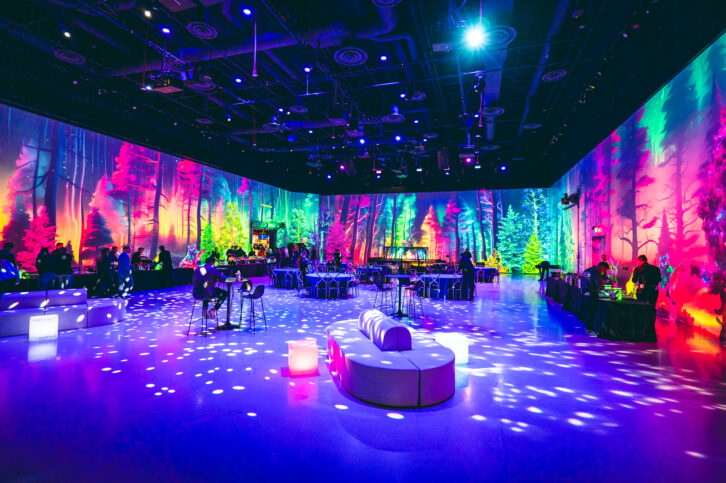
BBC Earth Experience in Melbourne uses 70 Panasonic projectors and 49 BeeBlade SDM media engines. Deployed by Australian AV specialist TDC, the system employs HIVE’s BeeSync technology to maintain synchronisation across a 127-million-pixel visual canvas.
For integrators, the distributed approach could simplify commissioning and allow immersive installations to expand one display at a time, without requiring additional centralised processing capacity. The whitepaper acknowledges that conventional media servers remain suitable for applications demanding particularly high levels of performance and flexibility, while arguing that distributed architectures offer a more economical alternative for many museums, visitor attractions and other immersive environments.
The full whitepaper, The Future of Immersive Deployments, is available here.
You can subscribe to Installation magazine for free here and the daily newsletter here.