Immersive audio is often associated with spectacular effects, enveloping audiences in sound from multiple directions. But for the growing number of venues and productions adopting spatial audio technologies, the benefits can be more fundamental. By allowing sound designers to position individual sources precisely and deliver more consistent coverage throughout a venue, these systems are challenging some of the longstanding limitations of conventional stereo configurations.
From theatres and concert halls to museums and experiential attractions, spatial audio is finding applications that extend well beyond creating a sense of immersion. Yet despite the maturity of the technology, adoption remains uneven, with cost, complexity and established production practices continuing to present obstacles.
Grant Youngman, head of professional audio research at Futuresource Consulting, says that, outside of cinema, immersive audio is specified in only a minority of new projects, adding: “Take-up is lowest in houses of worship and hospitality. It is higher in performing arts and highest in themed and experiential venues.”
BEYOND STEREO
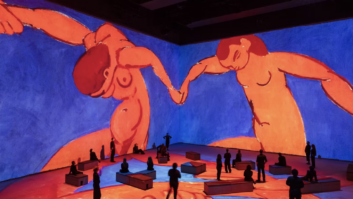
Yann-Gaël Gicquel, director of product management for spatial systems at L-Acoustics, identifies festivals, theatres, performing arts centres and experiential museums as among the sectors adopting immersive audio. Museums, he says, are “one of the most dynamic at the moment”.
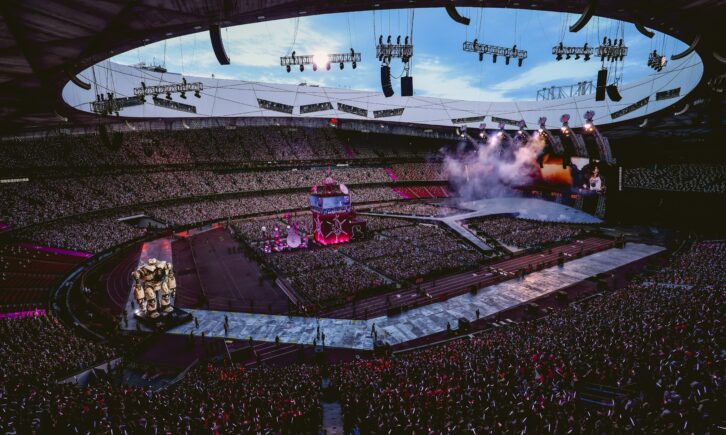
For Gicquel, a key aim of spatial audio is to create “a better connection between the artist and the audience”, with greater clarity than conventional left-right (L-R) systems. He also points to localisation as a big advantage of immersive approaches. Arrays positioned above a concert stage, for example, can ensure that sounds reach the audience directly from the performers.
For years, system developers have worked to eliminate the venue sweet spot. While conventional stereo systems can deliver consistent sound levels across a venue, the perceived position of individual sound sources can vary considerably depending on where audience members are seated. Spatial audio aims to overcome this limitation, delivering more accurate localisation across a much wider listening area. In the era of immersive installations, designing for an isolated sweet spot appears so hopelessly restrictive that many in the industry are opposed to it. “I’m a champion against the sweet spot,” states Steve Ellison, director, spatial sound at Meyer Sound.
Ellison says immersive systems are generally designed to deliver coverage from as many directions as possible, with loudspeakers overlapping so that different sounds arrive from different positions. This sense of immersion, he explains, comes from the whole rather than any single object, adding: “It’s the group of localised objects that can help envelop you.”
The overall audio environment, with sounds placed in different positions and planes, is often referred to as a ‘soundscape’. Robb Allan, head of product management for d&b’s own soundscape solution, Soundscape, highlights localisation as the most important aspect. “I’ve been mixing in arenas and stadiums for 30 years and basically you mix in mono because the sweet spot in stereo is a very small group of people,” he says. “And the soundscape is what it says, it opens it up so you’re not hearing the loudspeaker, you’re hearing an audio landscape.”
Soundscape achieves this by manipulating delay and level rather than simply panning between loudspeakers, placing the object specifically where the performer is. Allan explains: “Localisation for us is probably the most important part of Soundscape.”
MULTIPLE LOUDSPEAKERS
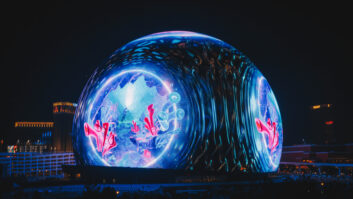
Another technique for creating immersive sound is wavefield synthesis (WFS), which uses multiple loudspeakers, with carefully controlled delays and levels, to generate virtual wavefronts. One of the leading developers in this field is HOLOPLOT, which was acquired by Sphere Entertainment in 2024. Its technology forms the basis of Sphere Immersive Sound, deployed at Sphere in Las Vegas and two New York venues operated by MSG Entertainment: the Beacon Theatre and Radio City Music Hall.
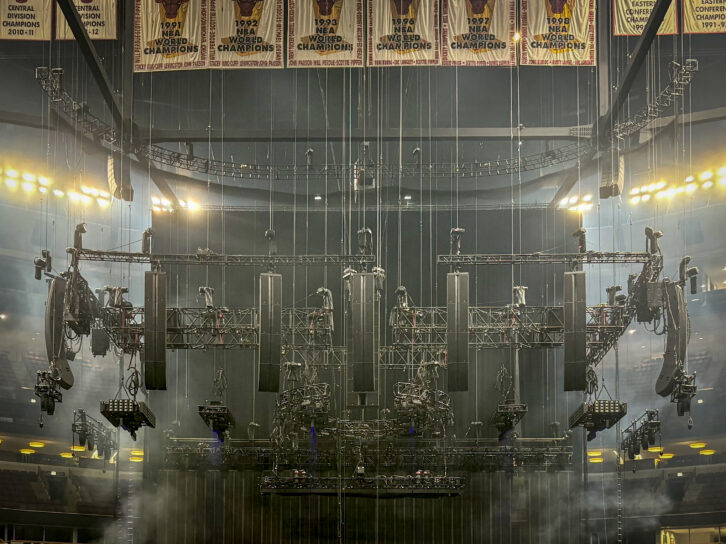
“The ultimate goal is immersion,” says David Dibble, vice chairman of Sphere. “Consistent audio levels from point of origin to destination provide each audience member with an exceptional listening experience. It’s headphone-quality sound without the headphones.”
Among the longest-established spatial technologies for live performance is TiMax. Its main system today is the SoundHub processor, an object-based dynamic delay and level-based matrix. Despite its ability to handle multiple sources and zones, commercial manager Rik Kirby says that not every application needs sound coming from everywhere. “Often, when people ask for an immersive system, they’re actually looking for localisation,” he adds.
PINPOINT POSITIONING
Applications can range from straightforward theatrical tracking – which Kirby argues is “considerably more valuable than having sound effects fly around” – to mapping audio, to moving visuals across a shopping mall video wall. “We now have the technology to do tremendous things but it all begins with, ‘What’s the creative goal?’ It’s also determined by what is important to the audience or what they expect.”
Audience expectations are evolving, according to Giacomo Previ, director of marketing and strategic partnerships at DirectOut. For signal distribution and networking, that means delivering low-latency transport and deterministic synchronisation across setups of all sizes. “You don’t want issues of overlapping signals or phase problems,” he adds. “There are already so many acoustic issues to take into consideration; you at least need to have a backbone that is rock solid.”
This network backbone frees sound designers to look beyond the limits of stereo, delivering consistent, fatigue-free audio across the entire venue. Ian Nelson, audio technical manager at sound hire and installation company Adlib, explains that a frontal system spread across the entire width of a venue evens out the coverage, eliminating hotspots and cancellations.
“That’s a fundamental improvement in the audio and the horizontal localisation of your sources,” he says. “From a mix engineer point of view, suddenly we have space we’ve never had before to create mixes. Where you place your objects, everybody hears it. From an audience point of view, it brings that harmony of listening to what you’re seeing. It’s a lot more convincing and less fatiguing to listen to.”
Many theatrical productions, especially musicals, have exploited the potential of spatial sound in recent years. Because producers want most shows to have long runs, sound designers tend to build immersive into the installations from the outset. Respected sound designer Gareth Owen says that although making an immersive system work is much harder than for a traditional L-R system, “the toil reaps the benefits and the end result is much more satisfying”.
Owen says his goal is to give every theatregoer the best possible experience. Enveloping them in the music is a great way of achieving this. “Immersive can also be used for theatrical storytelling – a thunderstorm is far more convincing when coming from all around you than from the front only,” he says.
EXPANDED COVERAGE
Owen adds that when he first started exploring immersive, systems were limited to quite narrow sweet spots, which meant around a third of the audience heard “something epic”, with the experience being “seriously unsatisfying” for the rest. “Now it feels like you can achieve something great for 80 per cent of the audience, with the remaining 20 per cent still being more than good,” he says. “Obviously, we are aspiring to be 100 per cent amazing. We’ll get there eventually.”
The corporate sector does not immediately come to mind in relation to immersive audio but there is occasional interest. Despite the infrequency, Emma Bigg, project manager at Technology Architecture Design (TAD), has worked on two spatial sound projects. The first, which happened before she joined TAD, was for a presentation space based on a Dolby Atmos cinema system. Bigg says she understood the intention, but had to explain that because there were no fixed listening points, not everything would be in the Dolby format.
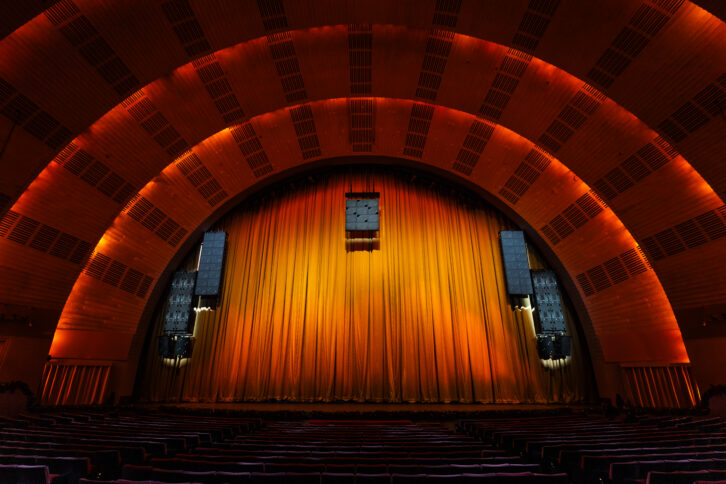
A current TAD project caters for multiple uses rather than a single fixed application, with the added challenge of acoustic reflections off large LED video displays. Bigg has elected to deploy a multichannel system to have audio in the right place depending on how the client wants to use the room, as well as to mitigate the acoustical challenges. “It also means it’s a really fun, immersive space and we’re using an agnostic multichannel processor, so we could do 7.1.2,” she explains.
“What surround and immersion does is make the listening experience more equal for everyone in the room. You will see an adoption because it will feel like a better experience and it’s not about being in the sweet spot.”
ENTRY BARRIERS
Adoption of immersive audio is different in the various market sectors and still relatively small in some areas, particularly live touring. This is due to perceived barriers to implementation, the most common being cost. Youngman, at Futuresource, observes that the premium comes primarily from additional loudspeakers, amplifier channels, rigging points and design fees. He also cites programming time and new skills training for designers and operators, including object-based design and mixing.
Meyer Sound’s Steve Ellison argues that cost could be cited as a barrier to almost any high-quality audio system. A more fundamental problem is poor acoustics. “If the room is very reverberant, that’s hard because it’s going to blur the localisation and what you hear,” he says. “So room acoustics and architecture, background noise levels and the environment you’re working in are often barriers.”
Gicquel says that L-Acoustics is endeavouring to counter perceptions around the high cost of spatial audio by demonstrating that enclosure counts remain close to those of conventional systems: “When you compare a very long L-R system, with front fills and sometimes delays, to an immersive system, there is a comparable number of speakers, but they are placed differently.”
SOFTWARE LEARNING
While sound engineers are accustomed to software-driven workflows, immersive processing introduces an extra layer of system management. For Rik Kirby, mastering it is simply a matter of familiarity: “At its simplest, all you’re doing is moving coloured blobs around the screen and putting them where the instrument or performer is. The computer works the rest out for you.”
That accessibility is helping drive adoption as clients look to balance their production values. “We’re seeing a lot more focus on immersive audio because people have realised they’ve invested in video and audio is now the weak point,” Kirby adds. “The conversation is happening a lot more.”
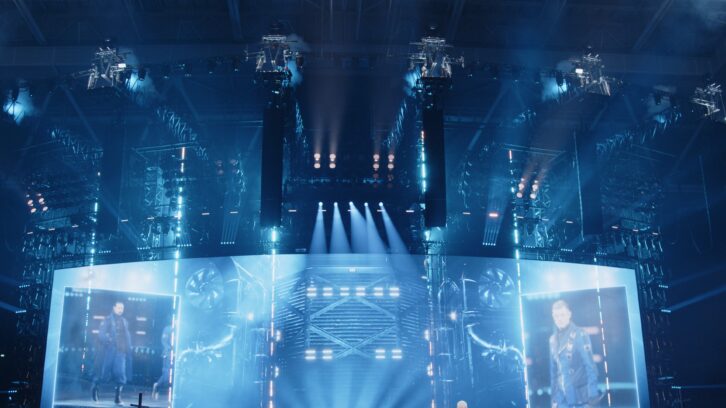
While traditional surround setups are common on Broadway and in the West End, Gareth Owen notes that true object-based spatial audio remains a rarity. “If, however, you’re talking in the context of Soundscape, L-ISA and TiMax, I’m not sure it is anywhere close to becoming the norm,” he says. “On Broadway and in the West End, perhaps 10 per cent of shows are utilising the technology.”
PRACTICAL REALITIES
Major music artists, including Taylor Swift, U2 and Andrea Bocelli, have made immersive audio a key part of their large-scale productions, but live touring lags behind. Ian Nelson at Adlib comments that for that to change, tours need to be operated differently. At the moment, the size of the audio crew on an arena tour would double due to the longer set-up times, with rises in wages, as well as accommodation and transport costs. “If an artist played fewer locations in a country for longer, that might be a more viable solution to touring an immersive production,” he says.
For immersive audio in general, Youngman expects steady rather than explosive growth, with software running on existing platforms offering the fastest route to mainstream adoption.
For all its creative potential, immersive audio is unlikely to displace conventional stereo systems across every application. But as the technology becomes more accessible, its appeal is extending well beyond dramatic surround effects. Greater clarity, more accurate localisation and a more consistent listening experience across an entire audience offer compelling reasons for venues and production teams to reconsider how sound is delivered.
You can subscribe to Installation magazine for free here and the daily newsletter here.