The idea that the introduction of new technology into schools and colleges is a piecemeal affair, done over time and in a relatively detached fashion, has long passed into history. Even so, it can be hard to fully ascertain quite how much the overall philosophy regarding the investment in, and deployment of, new technology has shifted during the past decade.
There’s little doubt that the Covid era of remote learning served as a major catalyst for AV renewal, but the truth is that the gradual transition to a more holistic approach had started long before that. Digital signage, wayfinding, networked infrastructure, room scheduling, centralised management, remote monitoring and analytics were among the developments already ensuring – and, to some degree, demanding – that AV transform from a set of individual systems into an all-encompassing, integrated platform.
Of course, it has turned out that a more holistic ethos is ideally suited to an era in which there is an increased incidence of remote learning and teaching. It’s also proven to be conducive to a time in which educational institutions are facing renewed budget pressures and are obliged to minimise operational inefficiencies, as well as confronting an increasingly perilous security environment – one that has, just this month, been the subject of fears about an AI-related ‘cybersecurity apocalypse’.
In this article we’ll explore how universities are focusing on infrastructure, management and campus operations to support more diverse teaching methods and ensure that their activities remain protected. We’ll discover that making the right choices – and ensuring you have the appropriate support to make those choices – is more critical than ever before.
GENERAL CONSENSUS
There is certainly a general consensus that – whilst the holistic vision might be some way from being the default mindset – a move towards more integrated technology infrastructures is now firmly underway.
Claire Kerrison, principal analyst, consulting & advisory – education at Futuresource, says that institutions are increasingly assessing new technology in terms of how well it connects with existing networks, platforms, teaching spaces and workflows rather than looking at individual hardware categories in isolation. “The importance of this is particularly clear in Western Europe,” she says. “Futuresource’s recent HiEd End User survey found that 46 per cent of ITDMs [Information Technology Decision Makers] from this region say integration/interoperability has increased in importance when selecting vendors over the last two to three years, rising to 60 per cent among large institutions.”
Mike Sullivan-Trainor, senior industry analyst at AVIXA, also points to recent research in highlighting awareness of the importance of integration between different AV systems. “Educational institutions are on the adoption path toward a broader integrated infrastructure,” he says. “Most have moved past the assessment phase to early adoption, with varying degrees of deployment depending on the technology. In a 2025 AVIXA study, sponsored by Logitech, an average of 52 per cent of 300 AV professionals working in education in Western Europe (France, Germany, Spain, UK) cited integrating with other systems as the technological improvement that has had the greatest impact on reducing support needs.
INFRASTRUCTURE BARRIERS
But whilst there is a growing desire to move in this direction, it’s not always possible. Kerrison confirms with reference to the same Futuresource study that 35 per cent cite integration challenges as a barrier to greater AV/IT investment and 41 per cent cite legacy infrastructure. She believes that we’re seeing something of a transition. “Institutions increasingly want an integrated ecosystem, but many are still working through inherited infrastructure, skills shortages and budget limitations,” she says.

Meanwhile, as progress accelerates, there is also an acute awareness that the user experience of technology should remain dependable and relatively uniform. Anthony Lear, presales consultant at AV integrator Kinly, says that technology across campuses should provide a consistent experience, from small classrooms through to large lecture theatres. “While the technology implemented may vary between spaces, the user experience should remain as consistent as possible,” he says. “Teaching and learning approaches will differ, but the technology deployed should provide accessible experiences that enable students and lecturers to collaborate and engage effectively. AV strategies should focus on providing flexible yet consistent teaching spaces.”
There is also – albeit with some variations – a good deal of agreement over what constitutes the ‘connected campus’ concept that so many schools and colleges are now embracing. In particular, it is evident that a powerful network is the critical enabler of these integrated ecosystems as it is the foundation for other systems. Consequently, as more elements are added, the network increasingly becomes the service underpinning the entire institution.
Joel Mulpeter, senior director, product marketing at Crestron, remarks that as more and more solutions live on a network, a truly connected campus will be one that acts as a single technological ecosystem. Deploying disparate devices that sit on a network is one thing, he argues, but deploying one cohesive platform that all works together under one management tool is quite another. “In the latter, rooms aren’t treated as rooms,” he says. “The network’s treated as a singular system and each room is a part of the whole. And then that means uptime’s better, solutions are more consistent and more reliable, and things can be fixed faster. It’s a change in thinking because you’re truly managing a service at that point.”
CAMPUS SYSTEMS
Guilhem Krier, head of new business and market development (EMEA) for broadcast & pro AV at Panasonic Connect Europe, says that IP-based and software-defined workflows can be used to integrate multiple video sources, remote production, and enable seamless interoperability between systems across a campus. “AV environments require customisable, software-based workflows, in contrast to the fixed, hardware-centric models of the past,” he comments.
Richard Jonker, VP commercial business development at NETGEAR Enterprise, echoes the sentiment about a connected campus being one where AV is network-connected. He gives several reasons: “The first one is to interlock the 50+ AV and IT applications that run on campus. The second one is to enable remote monitoring and troubleshooting. The third one is the newest and most exciting; AV systems become sensors and feed telemetry to an agentic AI layer (via an MCP server). This is the next version of proactive management, automated troubleshooting, and root cause analysis, and new service models will be developed based on it.”
For many institutions – especially those making extensive use of real-time collaboration and high-resolution video – low-latency will be a crucial component of the network infrastructure. It is also important, says Rainer Stiehl, Extron vice-president of marketing for Europe, to consider a “layered security strategy” when integrating and deploying networked AV systems. “AVoIP systems must also support IT security requirements such as 802.1x admission control; audio, video, and control encryption; and Active Directory support to assist in user and password management,” he says.
PRACTICAL QUESTIONS
But whilst the technology is important, it is also vital to consider the key practical questions surrounding its usage: To what extent can staff optimise their use of the network and AV technologies without support or training? How much more can be added – from extra capacity to new facilities – without the underlying architecture having to be reworked?
Answering those questions requires a series of organisational decisions, says Richard Jonker: “Who owns the AV network: the AV team IT or estates? What standard is written into every capital project from the outset? Are rooms classified into tiers so that specification is decided once rather than repeated 40 times? Institutions buy on seven- to ten-year capital cycles, so a strategy has to survive a decade of incremental additions.”
The growing remit of digital signage is a case in point. In many institutions it was initially regarded primarily as a marketing portal, but now frequently handles timetable changes, wayfinding, and mass/emergency messages. Then there is the management and analysis of occupancy – the effective utilisation of which is often critical to balancing the books.
“Space is the most expensive asset an institution holds, and usage data feeds directly into timetabling and estate decisions,” says Jonker. “It also needs handling carefully. In EMEA in particular, anything that resembles monitoring students or staff raises data protection questions, so the data should be anonymised and clearly governed.”
This view is widely echoed across AV. Stiehl notes that by integrating scheduling displays and occupancy sensors directly into an enterprise calendar, the AV team can gain real-time visibility into space usage and improve energy utilisation while facilitating centralised management. “Combined with visual status indicators, students and staff can identify available spaces at a glance,” he says.
REMOTE MANAGEMENT
Effective remote management has also become of huge benefit, especially when deployed over large and complex estates. Far better that AV teams be able to maintain remote visibility so they can “handle a monitoring alert at 7am rather than receiving a frantic call from a lecturer at 9.05am”, says Jonker.
In terms of specific individual technologies, wireless conferencing is reported as having performed especially well in education over the past 12 months. Referring to Futuresource’s HiEd End User report, Kerrison notes that in Western Europe, 47 per cent of institutions have invested in wireless conferencing, ahead of integrated video conferencing at 38 per cent: “That reflects a broader move towards spaces where students and academics can move seamlessly between in-room, personal-device and remote participation.”
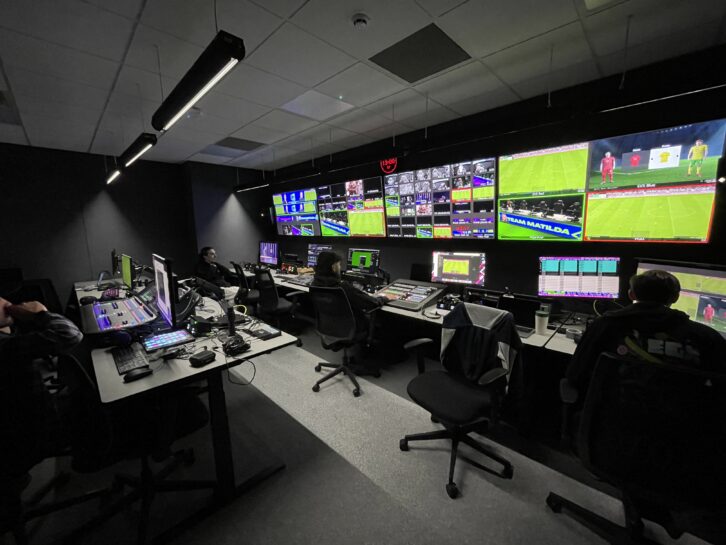
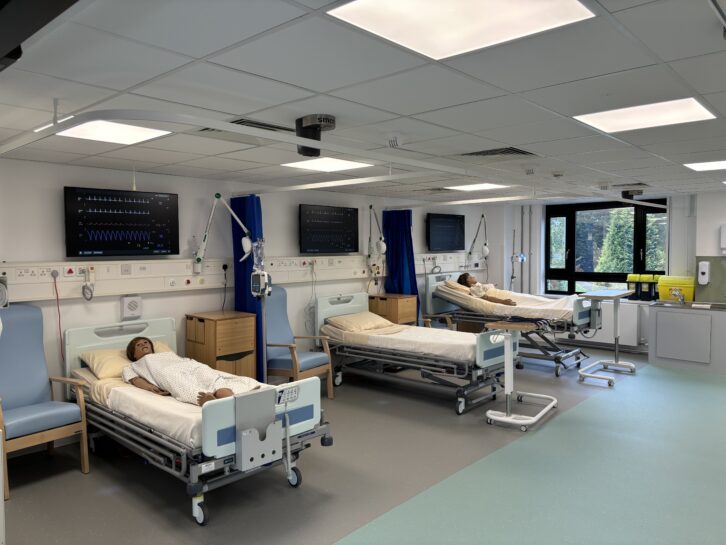
Lecture capture/classroom recording has been another centre of growth. Again according to the Futuresource report, this is currently used by 81 per cent of North American institutions and 70 per cent in Western Europe, while live streaming reaches 57 per cent and 47 per cent respectively. In terms of emerging technology, the same study reports that among Western European institutions containing immersive environments, over 80 per cent use simulation software.
Regarding another key component of the connected campus – display technology – Avocor SVP & global GM Dana Corey says it has a key role to play in the connected environment as it can ensure “collaboration equity” and allow hybrid and remote students to feel just as present as those sitting in a classroom. In addition, he says that by leveraging a combination of touch and non-touch, standard and large format displays, the screen also becomes a “versatile tool for presenting lesson and lecture content in a wide variety of ways, tailored to suit the demands of the student and the lecturer”.
NEXT GENERATION
When considering what the next generation of integrated campuses will look like, it’s perhaps inevitable that there’ll be an element of ‘the same, but more so’. With hybrid and flexible learning now built into most institutions’ modus operandi, networks and individual technologies will continue to evolve to make this more seamless, efficient and higher-quality. It’s also inevitable that the long-term trend away from straightforward presentation towards interaction and active learning will accelerate, as will the technologies that make this possible.
“Accessibility, inclusion and the development of pedagogical practice will be key drivers in defining the next generation of educational campuses,” says Lear. “The technology required to support learning will increasingly rely on connected and intelligent buildings that can adapt to the needs of both educators and learners.”
Then, of course, there is AI. There seems to be agreement that this, along with immersive learning, could – in Kerrison’s words – “create a new layer of AV demand”, with the transformative effect expected to be particularly notable in large estates where thousands of devices are being managed.
In such scenarios, says Mulpeter, AI can be “very efficient”, but he adds a note of caution: “You need a human in the loop; someone to say to the machines, ‘Yes, do that.’ But to go through a network and find devices that are offline and old and not being used – and to keep data entry across those devices aligned – AI’s great at doing those things.”
Anomaly detection, predictive maintenance and automated fault triage are among the operational tasks that AI can help address. Speaking about educational tasks, Jonker says: “In-room AI, auto-framing and voice reinforcement matter primarily because they narrow the quality gap between people in the room and those joining remotely.”
TRANSFORMATIVE AI
Krier – who thinks that virtual production technologies are also become more accessible – says that AI will “continue to transform production workflows”, automating tasks such as auto-tracking, auto-framing, intelligent camera operation, switching and content management. Rather than replacing operators, these technologies will enable smaller teams to deliver “higher-quality outputs more efficiently”, he says.

AI-facilitated video monitoring is also set to be another area of great activity. Colin Farquhar, senior vice president of sales at VITEC, says: “As campuses face increases in demand for video content, institutions will in all likelihood transition to some form of ‘smart’ monitoring. As such, AI-driven analytics will monitor video stream health, predict bandwidth shortages and flag hardware problems before a lecture or campus-wide broadcast can be disrupted.”
It’s certain that AI will also facilitate hyper-detailed data collection and analysis – not least with regard to energy management and sustainability. It’s here where cognitive dissonance seems particularly inevitable: whilst AI will allow schools and colleges to manage their use of energy with greater accuracy, the phenomenal amount of energy required to power the data centres supporting AI will remain a profound environmental and societal challenge.
Krier concludes: “Decision-makers face the challenge of balancing greater functionality with simplicity, ensuring that increasingly sophisticated systems remain intuitive and manageable for smaller teams and non-specialist users. So it’s vital that campus decision-makers understand where their organisation is heading.”
CLEARER DIRECTION
The direction of travel, though, is becoming clearer. The connected campus is less about filling teaching spaces with more technology than ensuring that AV, IT and building systems operate as a coherent whole. As networks become more capable, management more intelligent and AI more pervasive, the challenge will be to make increasingly sophisticated infrastructure feel simpler to those using it. For institutions planning technology investments that may remain in place for a decade, that means designing not just for today’s classroom, but for a campus whose requirements will continue to change.
You can subscribe to Installation magazine for free here and the daily newsletter here.