The last five years has witnessed a steady – but undeniable – shift in the role that control platforms perform in an array of pro AV environments. From corporate facilities to colleges and beyond, control is no longer restricted to straightforward areas of responsibility such as source selection, audio level adjustment, and display settings.
Instead, with the profound changes brought by developments such as AVoIP and cloud connectivity, control has evolved to the extent that it is now increasingly defined by software-driven operational tools for monitoring, management and analytics. Moreover, it’s often the case that these platforms are now required not only to oversee a single facility – but to also offer the capacity to run entire AV estates remotely and with a minimum of on-site involvement.
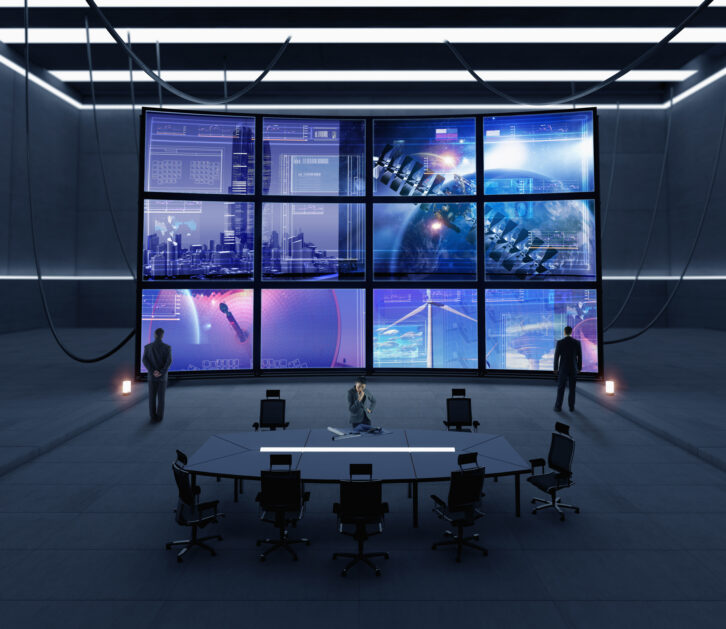
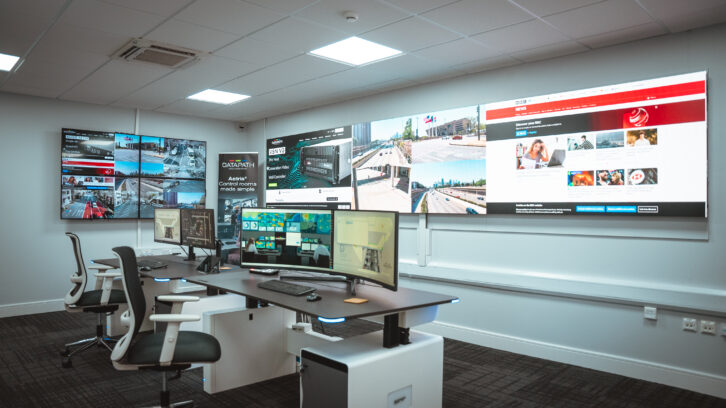
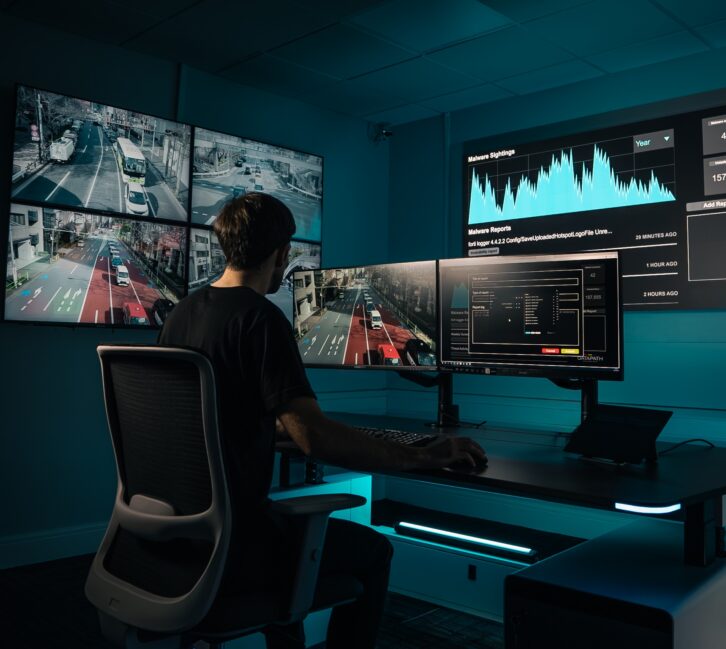
This operational shift is also evident in sectors such as control rooms and security operations centres, where platforms from vendors, including Datapath, increasingly combine source management, visualisation and monitoring within unified software environments.
In this article we’ll explore the extent to which control platforms have evolved in the last few years, and the attendant new expectations shared by many customers and end users. We’ll also consider the impact on integrators, the implications for the relationship between AV and IT, and the new business opportunities arising from this growing emphasis on software-oriented control – while bearing in mind the fact that many of the basic device control needs continue to be of general importance.
Vendors and integrators cite various factors in explaining the recent evolution of control technology, but two words – connectivity and consistency – do tend to recur. AV customers are now acutely aware of the ability that exists to monitor and manage systems in a more efficient way, which includes the pre-diagnosis of potential problems and the avoidance of potentially costly emergency call-outs. Simultaneously, it has also become increasingly evident that the same control platforms can often be used to manage at scale, including multiple sites over long distances – even across different countries.
CONNECTING PLACES
Summarising the primary driver of change is Josh Arnold, director of collaboration application strategy at QSC, who notes that many customers are now wanting to enable high-performance workplaces at scale: “Organisations are no longer thinking about individual rooms, but about connecting places, spaces and applications to deliver consistent, reliable experiences across the environment. This shift is driven by the move from fragmented, hardware-centric systems to software-based platforms that unify audio, video, control and data. As a result, AV control has become part of the digital infrastructure, enabling scalable, data-driven insight across many spaces.”
The same trend is reflected in the growing adoption of IP-based KVM and remote access technologies, from companies such as Adder Technology, where control, connectivity and secure management increasingly form part of wider operational workflows.
Crestron senior director product marketing Joel Mulpeter observes: “The demand for connected spaces has never been greater. We need AV-related control solutions for each of those spaces, so there’s an obvious need for consistent, intuitive, frictionless control platforms — and with that comes the need to monitor and manage them at scale.”
There is a general consensus that the ascendancy of IP-based workflows and the growing convergence between AV and IT infrastructures have been fundamental to the transition. “Expectations around AV control have expanded well beyond task-based operation,” says Daniel Collin, senior product manager at Matrox Video. “Users increasingly expect remote access, real-time system visibility, and the ability to manage distributed environments through a single interface.”
In broadcast environments especially vendors such as Cobalt Digital are also helping to drive the transition towards software-defined infrastructure, with monitoring, processing and signal management increasingly handled through networked and remotely managed platforms.
Consequently, we are now in the midst of a distinct new phase where the software layer is increasingly becoming the operational hub of complete installations. Accordingly, there is a growing expectation that the overarching platform “simplifies deployment, enables scalability, and provides an intuitive, browser-based experience that makes complex systems easier to manage”, says Collin.
Hand-in-hand with this greater operational role is ease of scalability. “The biggest driver is the need to move beyond fragmented, hardware-centric AV systems toward more connected, software-driven environments,” says Arnold. “As AV, IT and building systems converge, customers need solutions that can scale and adapt across multiple spaces. This evolution is most pronounced in enterprise, education and large-scale environments, where managing hundreds of spaces requires centralised visibility, automation, and repeatable deployment workflows.”
APPEALING INTERFACES
In terms of the precise capabilities of the latest software control systems, it’s not surprising that the need for straightforward, appealing user interfaces remains undimmed. In fact, it’s arguable that their intuitive capabilities are viewed as being more pivotal than ever, including the capacity to access and interpret highly detailed information about system performance.
Rainer Stiehl, vice president of marketing at Extron, says: “Users are looking for a clean, intuitive user interface that allows them to use the AV system with high reliability and minimal training. From a building or campus-wide point of view as well management of spaces has evolved over time, and the appetite for information derived from them is greater than ever.”
In particular, it seems that customers are keen to access information that means they can be “proactive, not reactive” in terms of what’s happening in each space, indicates Mulpeter, who adds: “You want to know what kind of ROI you’re getting for each space – is that room being used enough and in the right way? That will certainly inform future developments as your organisations grows. Because Crestron Control and the XiO Cloud [operations management] platforms can be so seamlessly integrated, they present themselves as something of a singular solution to the average user.”
Alignment between AV and IT style workflows has been another distinct trend as part of a drive to “reduce operational friction”, indicates Collin: “By embedding control directly into the platform and making it network-accessible, Matrox Video is supporting the shift toward software-defined AV systems that can be managed as part of a wider operational environment.”
VENDOR INNOVATIONS
Whilst many customers are moving towards more complex, multi-site control infrastructures, vendors are aware that this won’t be appropriate for everyone – and that individual device and small-scale deployments will also continue to be required. Hence there is plentiful evidence that manufacturers are working to support the full range of control requirements, with cloud management now an important element in many environments.
For example, Crestron Control technology is being embedded in many devices, whilst the company also offers keypads – such as 3-Series media presentation controllers – and server-side control options like the VC-4 virtual control software. Interface-wise, the new 80 Series touch screens have more processing power and features than previous iterations. Beyond that, there is an emphasis on tight integration between cloud management, devices and control programmes.
“Knowing when the room is on, knowing when the room is off, knowing when displays are on or off – all those kinds of things have to be tightly integrated,” says Mulpeter. “A system that understands what’s happening in the room is different than just device monitoring; you need something to orchestrate all the devices, and that’s what Crestron Control does.”

For Extron, the TouchLink Pro TLP Pro 35 Series touch-panels have introduced the latest Extron control technology and arrive in four sizes with multiple configuration options. All models feature advanced IPS technology – delivering vibrant colour reproduction along with improved contrast, brightness and wide viewing angles – as well as a new Extron HTML5 stack that allows rich, interactive control pages that scale seamlessly across different screen sizes and orientations. It also supports embedded multimedia elements, including H.264 video streams, dynamic graphics and real-time data widgets.
However, Extron’s view on the role of the cloud might well be more multi-faceted than that of some other vendors. “Describing the impact of the cloud on control platforms is a matter of perspective,” observes Stiehl. “The concept of ‘cloud’ has very broad connotations in our industry, much like the term ‘AI’ in the larger technology world. Whenever you see the word cloud used, you should equate it with recurring costs that someone will need to pay to use the service. There are questions that need to be answered, like: ‘How many clouds do I need to pay for?’, or ‘Is this cloud service valuable?’ or ‘What happens when the cloud service stops working?’”
Meanwhile, Matrox Video describes its approach as one of “simplifying control while supporting more scalable, distributed environments”. Whereas control once depended upon installed software and manual setup, the focus now is on centralised-browser based management. In the case of Matrox Mura DVW – an IP-based 4K distributed video wall appliance that allows users to combine multiple units to create a fully synchronised video surface across a wide range of sizes and rectangular layouts – this translates into integrated tools that allow users to configure, manage and monitor video walls from anywhere on the network, covering everything from system setup to layout control and ongoing operation within a single interface.
The platform also enables direct interaction with web-based content through the control interface, including keyboard and mouse output, while support for HTML-based content alongside IP video streams allows users to visualise a broader range of information. This spans “dashboards to custom data-driven applications – reinforcing the role of the video wall as an operational display surface”, says Collin.
The growing prominence of dvLED environments from manufacturers including INFiLED is also influencing expectations around control and monitoring, particularly in applications where large-format visual systems are increasingly integrated into wider AV, data and operational platforms.
Elsewhere, QSC’s Q-SYS continues to advance its Full Stack AV Platform, which is described as a unified, scalable, cloud-managed and data-driven ecosystem that brings together hardware, software and services. The most recent developments include expanding the portfolio with Q-SYS RoomSuite Modular System – a streamlined, web-based, no-code workflow for fast, repeatable collaboration deployments unified through Q-SYS Reflect – as well as the MPAQ Series network amplifiers and the X Class Server Core X50r to support demanding, large-scale AV applications.
In addition, QSC has enhanced Q-SYS Reflect for centralised cloud management and is advancing automation through solutions like Q-SYS VisionSuite, which brings AI-driven room automation and more natural meeting experiences.
INTEGRATOR OPPORTUNITIES
For QSC, Arnold observes that the impact of the cloud on AV control is continuing to grow, with the consequences including a profound shift from reactive support to proactive, data-driven operations. Looking forward, it’s likely that cloud platforms will serve as the intelligence layer, where data from AV (such as real-time health monitoring, remote management and actionable insights), buildings systems and users is unified, underpinning AI-driven automation and more context-aware experiences.
This is also destined to bring some welcome new opportunities for integrators as customers look to optimise their cloud-based investments. “Control platforms are extending the role of integrators well beyond deployment into ongoing lifecycle management,” says Arnold. “With cloud-based monitoring and analytics, integrators can deliver remote diagnostics, predictive maintenance, and continuous optimisation. This opens up new service-based business models, where integrators provide long-term value through managed services rather than one-time installations.”
Installation closed out its interviews with various leading vendors by asking about their longer-term expectations for the future of control. Now that the software-driven revolution is well underway, it’s to be expected that there is a general feeling that the industry will continue along its current pathway, with more and more devices and functions brought onto the same software platforms in the service of increased efficiency, scalability and simplicity of control. But with AI-powered data gathering, analytics and decision-making also looming on the horizon for many areas of pro AV, there is also an anticipation that automation will have a significant role to play in enabling the next generation of control solutions.
For Extron, Stiehl notes: “We expect to see customers continue to embrace AI enhancements for control system development, workflow improvements, room data acquisition, and remote support. Open systems promote the use of open data models. Closed control system architectures will limit the types of technologies that can interact with these data sources.”
Last word to Arnold, who indicates that seamless, intelligent platforms will be some of the most desired elements in all kinds of pro AV environments: “The future of AV control is about enabling high-performance workplaces through intelligent, connected platforms. As AV, IT and building systems converge, platforms will increasingly use data and AI to connect places, spaces and applications, allowing environments to adapt in real time to people and context. As a consequence we will move beyond static automation to systems that continuously improve, using insights across spaces to deliver better experiences, higher reliability, and more efficient operations.”
You can subscribe to Installation magazine for free here and the daily newsletter here.