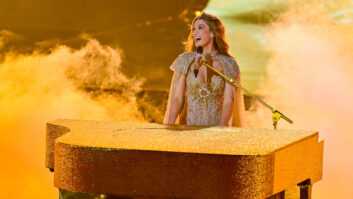
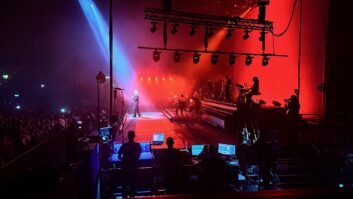
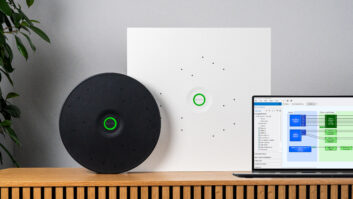
Sennheiser deployed its Spectera system at the Eurovision Song Contest 2026’s first semi-final on Monday night, held at the Wiener Stadthalle in Vienna – marking the first time the technology has been used at the world’s biggest live music broadcast. This week’s contest – which was broadcast to more than 100m homes – is the largest deployment of Spectera base stations, bidirectional bodypacks and handheld microphones anywhere in the world to date.
Spectera, which came to market in April last year, is designed to address a persistent problem in live wireless audio: signal dropouts caused by radio frequency reflections inside large venues. Where conventional wireless systems transmit on a narrow band of spectrum – typically around 200kHz – Spectera uses an 8MHz-wide carrier, borrowing techniques from 4G mobile networks and digital broadcast television and optimising them for the low-latency demands of professional audio.
 Speaking to Installation in Vienna right before the show, Jan Watermann, RF systems engineer at Sennheiser, said the wider transmission scheme is key to eliminating the fading that narrow-band systems cannot avoid. He said: “With previous narrow-band techniques, you typically have dropouts due to reflections in the venues. With the new technique, the transmission scheme is so wide that even where you have signal fading in parts of the band, you have gains elsewhere – so in summing everything up, we always have reception.”
The Eurovision deployment also marks the live debut of Spectera’s handheld transmitter, a device that is not yet commercially available. The handhelds used in Vienna are described by Sennheiser as pre-production samples that have been fully certified.
Also speaking to Installation before the show, Sebastian Georgi, product manager for Spectera at Sennheiser, added that certification of the new form factor proved straightforward. He said: “The electronics inside the handheld are almost identical to the beltpack. So with the first iteration we anticipated some more issues, but it was absolutely flawless.”
Italian rental and production company Agorà is handling technical production for host broadcaster ORF having also supported events in Lisbon, Tel Aviv and Turin. Prior to the event, all Spectera devices were shipped to Sennheiser’s headquarters in Wedemark for endurance testing, before being sent on to Agorà in Italy for rack configuration and two days of dedicated Spectera training.
A core feature of Spectera is that every device in the system communicates bidirectionally with the base station in real time. This gives engineers continuous visibility over parameters that are invisible on conventional wireless systems – battery states, IEM volume positions, and even whether a performer’s headphone cable has been disconnected.
Watermann added that the latter, while a simple detail, has real consequences on a show of this scale. He said: “Sometimes just the cable is plugged out and nobody knows. The artist says ‘louder, louder’ and nothing happens. Now we have plug detection, and you can immediately see the problem on screen.”
Because all Spectera devices share a synchronised clock – a requirement of the system’s time-slotted architecture – the platform also eliminates phase coherence problems that can arise when multiple digital microphones pick up the same source simultaneously. Watermann said this capability was largely a by-product of how the system is built. “We have to synchronise anyway, so we could also synchronise the word clock in each mobile device. For the sound engineer, putting multiple microphones together is now much easier.”
RF frequency management at an event the size of Eurovision normally demands dozens of broadcast trucks and visiting teams from across Europe. Spectera’s approach, the company says, simplifies the task considerably. Rather than managing dozens of narrow carriers, engineers deal with just two or three wide ones, making it easier to detect and resolve interference from external sources. “Typically, this was a large problem on several Eurovision events,” explained Watermann.
Sennheiser opened Spectera’s control API to third-party developers three months ago, and says the response was faster than anticipated. Within 36 hours, customers had built their own AI-generated monitoring tools using the interface. Georgi added that the development pointed to demand for more customisable control environments. “People said they liked our web UI but wanted to do things differently – and now they can.” For Eurovision specifically, Sennheiser developed a bespoke firmware variant that includes a level recorder, allowing engineers to review metering data retrospectively. This was useful on a show where critical moments can be missed in real time.
Research on the core technology behind Spectera began at Sennheiser in early 2013. With last night’s semi-final completed and the grand final approaching, Georgi concluded: “I’m really looking forward to the sleepless night on Saturday,” he said.