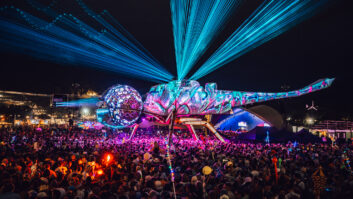
For the first time, Sennheiser’s Spectera – the world’s first wideband, bidirectional digital wireless ecosystem – provided wireless audio coverage across Glastonbury Festival’s Arcadia dance music area, which features the 13m-long The Dragonfly DJ installation crafted from a transformed from an old Royal Navy helicopter with insect-like mechanical additions.
Performance art collective Arcadia Spectacular debuted at Glastonbury in 2007 with The Spider, a 360-degree installation, and the collective has held a permanent place at the titular Arcadia area ever since. The Dragonfly debuted in 2024, and is augmented by 360-degree lighting distributed across ten towers, a six-point immersive sound system based on L-Acoustics L and K Series loudspeakers, plus lasers (for the wings), projection mapping (the body), and LED panels (the eyes).

This year’s Dragonfly installation demanded reliable wireless coverage across a large area while maintaining audio quality in a busy festival landscape. The performance takes place suspended above the audience inside a near 100m diameter ring of inward facing PA towers. Since the stage is well within the PA coverage, and therefore subject to significant delay, in-ear monitors (IEM) are essential for performers.
Six Spectera SEK bodypacks provided IEM mixes for DJ and MC monitoring, as well as featured artists. Sennheiser says its ability to connect multiple antennas to a single base station meant one antenna could be positioned inside the helicopter structure, and another at the front-of-house position, providing range extension across the festival. The base station was located at FOH and connected directly to the mixing console.
Meanwhile, four channels of EW-DX handheld transmitters, equipped with Sennheiser’s MM 435 capsules, handled DJ and MC vocal duties in a hybrid side-by-side configuration. A pair of omni-directional active antennas were installed inside the helicopter, with the EW-DX microphones operating exclusively within the Dragonfly body and running analogue signals to an SD rack.
Rob Cook, FOH engineer for the Arcadia Stage, said: “Spectera made this setup effortless. We placed the base station at FOH with a local antenna that also covered the entire Arcadia field. A second antenna, connected via a 100m ethercon run, was installed at the structure entrance with direct line of sight to the performers. Both antennas transmitted and received on the same TV channel, providing seamless, dropout-free coverage across the field, even including catering.”

Jacob Kuenzler-Byrt, stage manager and deputy technical manager at Arcadia, added: “We can’t deploy vocal monitors due to the limited space, which makes the IEM system absolutely vital. Spectera’s power and pristine clarity delivered across the board, allowing each vocal artist to immediately feel comfortable and connected in such a unique environment. The coverage of the entire arena, as well as the stage, was flawless, and the options it creates for dispersed performance elements are really exciting. This extended coverage was a huge improvement from 2024.”
Spectera was also used for Nile Rodgers & Chic’s performance on the Pyramid Stage, along with Dhani Harrison’s Friday slot on the Acoustic Stage.
Click here to read the in-depth feature from the latest edition of Installation about the AV technology deployed at the 2025 Glastonbury festival. A dedicated article digging deeper into Arcadia at Glastonbury 2025 will feature in the September/October edition of Installation.