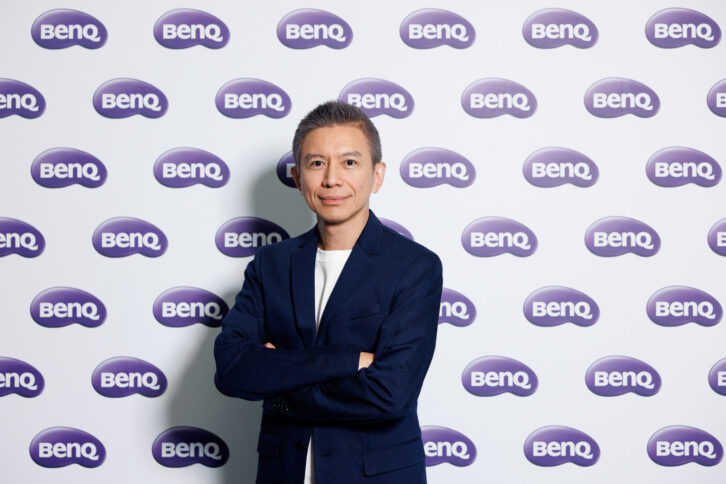
Lighting has not traditionally featured heavily in conversations with pro AV integrators, but BenQ believes that is starting to change. As the company strengthens its presence in the enterprise market with its ScreenBar monitor light range, including the newly launched ScreenBar Halo 2, JC Pan, head of strategic business unit, BenQ Lighting, argues that personal lighting – individual, desk-level lighting, as distinct from a room’s shared ceiling or ambient lighting – deserves a place alongside displays and control systems in the broader AV conversation.
“Personal lighting in enterprise is very important,” Pan said at BenQ’s Taipei headquarters during Installation‘s recent visit to Taiwan during Computex. “I read a survey that said employee satisfaction with their job comes partly from a sense of control over their own environment, especially the autonomy to adjust their own lighting. Not everyone likes to work in the same brightness or same colour temperature. In my office, I prefer warm light, but I know some of my colleagues like a cooler light because it helps their concentration. So personal lighting is very important, because it gives the employee control over their own environment, and that improves their satisfaction and productivity.”
Pan also made an energy efficiency argument for personal lighting over relying solely on ceiling-mounted ambient lighting. He described two scenarios reaching the same target brightness at a desk. One involved using only ceiling lighting, while the other using reduced ceiling lighting topped up with personal task lighting. “Which one saves more energy? The second one,” he said. “Research suggests enterprises should not always rely on ceiling lighting alone. If you reduce the amount of ceiling lighting but give your users personal lighting they can control themselves, you not only get positive feedback from your employees, but you also save energy.”
 EFFICIENCY GAIN
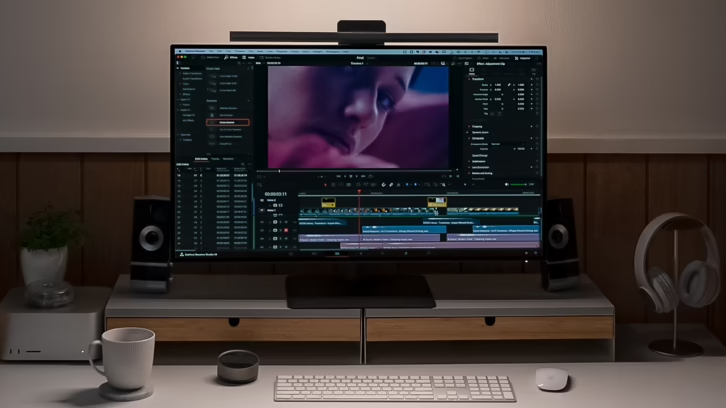
He argued that BenQ’s ScreenBar design adds a further efficiency gain over traditional desk lamps, because conventional lamps are symmetrical. Therefore, half of the light coming from a traditional table lamp is not useful, and could even be harmful as it shines directly back at you. “So our design doesn’t do that – it angles the light towards your desk instead. According to our data, we can reach the same brightness across the same coverage area, but using half the energy compared with a table lamp. So ScreenBar isn’t just better for the user experience, it also saves energy. We think that’s very good for enterprise.”
Pan argued that other manufacturers had underestimated the importance of lighting even in Europe where Germany is the most advanced region in commercial lighting. “There’s a German company that is the powerhouse of commercial lighting. They are the best in that field,” he said. “But they have never made personal lamps – only traditional table lamps. They’ve never thought of another way to deal with this. So I would say yes, the lighting industry has underestimated the importance of this.”
HYBRID WORKING
Hybrid working has added a new dimension to the lighting question, Pan continued. Hybrid working increases the demand for lighting, he says, but not simply because people are spending more time at home. “It’s that office lighting is usually better than lighting at home. At home, you’re in an environment that wasn’t designed for it. An office always has some government regulation setting a minimum requirement for lighting in the working environment. At home, there’s no such regulation,” he said.
On integration with broader building and AV control systems, Pan suggested BenQ favours open, software-driven approaches over the closed ecosystems that have traditionally characterised the lighting industry. In an ecosystem now led by smartphones, there is a more open opportunity for control, he believes. “So we are moving towards these shared-protocol systems, rather than a single vendor’s closed system, because that benefits more people. The point is, these closed systems are only built for control – but we don’t want to control the light, we want the light to adapt to what you’re doing. For example, what software you’re using tells us what you’re doing, and our light can respond with the appropriate light, or connect to MacOS.”
Pan acknowledged that lighting is often among the first budget lines cut when companies review AV or workplace technology spend, and admitted BenQ has not yet produced a formal white paper to help its regional B2B sales teams make that case internally. “We mostly talk about the fact that everyone underestimates lighting’s effect on employee satisfaction,” he said, of how the company currently briefs its sales teams. “It’s about changing the way businesses look at this – but the truth is, businesses haven’t really seen it yet.”
He noted that certification schemes are starting to shift that thinking: “When companies want LEED certification for green buildings, lighting is a big part of that. There’s also another indicator that measures healthy workplace environments, and lighting is an important part of that evaluation too. So enterprises do see the importance of lighting.”
Asked whether BenQ’s position as a lighting specialist gives it an opportunity to offer more integrated solutions than rivals, Pan said the company is still building that capability internally. “We are starting to try this – we’re starting to train our own sales teams not just to talk to enterprise customers about selling them a monitor, but to sell the whole experience, including lighting,” he said, noting that BenQ’s lighting business itself is only a few years old. “Thankfully, we don’t just offer excellent monitors, we also have great ScreenBars. This is something we’ve been building since we started our lighting business a few years ago.”
AI SCEPTICISM
On artificial intelligence, Pan was sceptical of how far the technology has actually progressed in smart lighting deployed today. “AI will bring change, but right now we know the proportion of that happening is almost zero,” he said.
He argued that the realistic near-term direction is recognising user behaviour and environment while respecting privacy. “Based on those two data points, behaviour and environment, the lighting system can proactively provide the most suitable light, because we know most users don’t know how to adjust their lights to their own needs,” he said. “Right now, the system doesn’t know if I need light suited to a small task or a large one. It can only use a kind of default – it just knows the angle of the overall environment. So in the current situation, no matter what I’m doing, the output is the same, because it doesn’t understand.”
He gave automatic on/off switching as a more achievable near-term example. If an engineer wants to solve this, they use passive infrared sensors, he argues, but the problem is, once you stand still, it doesn’t detect you. “If you don’t move for maybe ten seconds, it turns off,” he said. “Now we have mini radar, and mini radar can detect breathing. So even if you’re watching a video and standing still for ten minutes, it stays on, because it knows you’re there.”
Precision is critical to user acceptance. If a manufacturer adds an auto on/off feature into a corporate product, it has to be done very precisely, or people will turn the function off and never use it. “So what we try to do is make the experience better and better, and once it’s good enough, the corporate will adopt it, and employees will keep it on, because once they finish a meeting they don’t need to remember to turn it off.”
On education, Pan said lighting’s relationship with children’s eye health is an area BenQ is investigating with schools, though he said the research is necessarily slow. “Research on children has a lot of academic restrictions, so it’s a slow process,” he said. “We’ve started working with schools to test things like the degree of damage to the retina, and the degree to which it affects eye axial elongation. These things related to children are a long process, because verification has to be very rigorous.”
He said the underlying challenge as still unresolved: “The most important question is, how do we know which kind of light is best for children? Is the light at home more important, or the light at school? What I’ve talked about so far is mostly health-related. I believe the relationship between light source and eye health, in terms of performance outcomes, hasn’t really been researched yet. For schools, that would be a more useful area to look into.”
Read Installation’s two in-depth explorations of the rise of AVL here and here.
You can subscribe to Installation magazine for free here and the daily newsletter here.