Pro AV and broadcast have been moving closer together for years, driven by developments in IP networking, software-based production and the growing use of professional video technology outside traditional broadcasting. Corporate studios now employ equipment once associated with TV production, while broadcasters have embraced cost-effective tools developed for AV and live events.
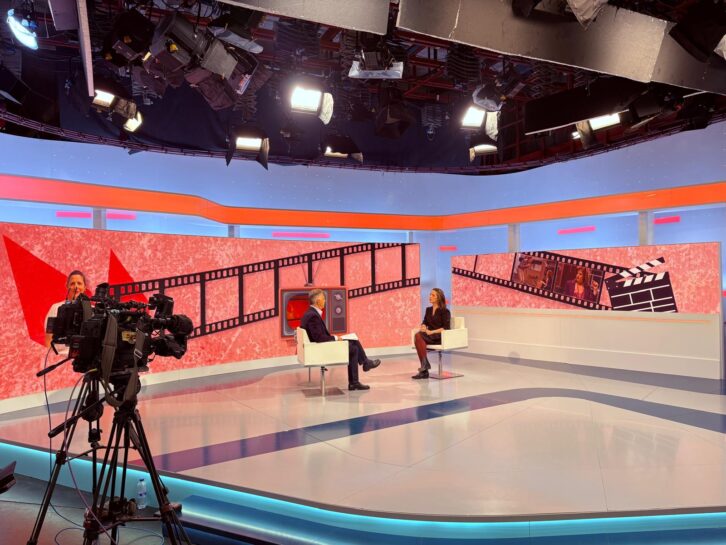
But the growing overlap raises a question about the direction of that relationship. Does the adoption of common technology mean AV and broadcast are becoming a single industry, or are they developing distinct approaches to solving different problems? The latter proposition emerged strongly during AV & Broadcast Convergence: Where Are We Now?, the opening panel of the Installation and TVBEurope AV & Broadcast Summit, held online on September 2.
CHANGING DEMANDS
Helen Matthews, senior market analyst for pro AV at Futuresource Consulting, identified the pandemic as a decisive accelerator of convergence. Before Covid-19, pro AV and broadcast largely operated within separate technological environments, with AV focused on transporting signals reliably within buildings and broadcasters using dedicated infrastructure to produce and distribute content.
The sudden expansion of enterprise video communications altered those requirements. Organisations needed to deliver corporate announcements and training to dispersed audiences, while broadcasters were adapting their production operations to accommodate remote working. Both sectors found themselves pursuing greater flexibility through IP-based infrastructure, with technologies such as NDI helping to connect previously separate workflows.
Matthews said the changes were not confined to networking. Enterprise organisations were buying cameras and production systems once found mainly in broadcast, while broadcasters were making greater use of equipment developed for professional AV. The two sectors were also beginning to share skills and purchasing approaches.
“So you could have kind of ended up with convergence happening on four fronts at once,” she explained, identifying networking, hardware, talent and buyers as areas of growing overlap. The shift was particularly evident in enterprise communications, where organisations were seeking the production quality and resilience traditionally associated with broadcast.
But Miguel Coutinho, head of NDI, the panel sponsor, challenged the idea that IP itself was the principal catalyst. Asked whether networking had done more than any other technology to blur the boundaries, Coutinho disagreed: “Maybe surprisingly, I would say no.”
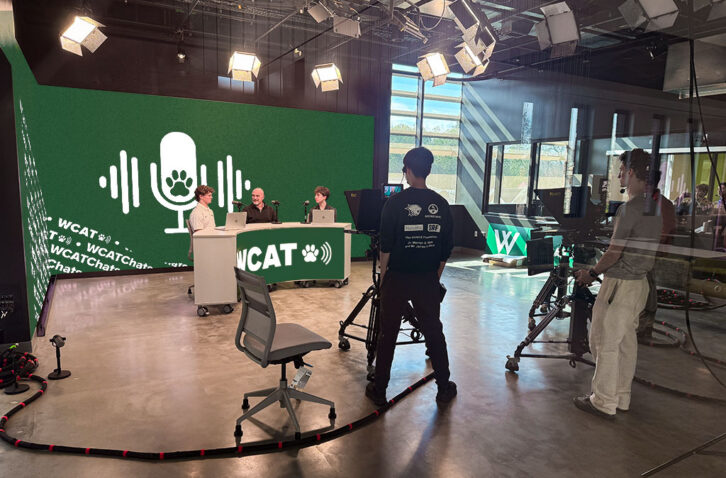
Instead, Coutinho identified general-purpose computing as the more fundamental influence. As software-based tools became central to both enterprise communications and professional production, the demand for flexible connectivity followed. IP has enabled that transition to scale, but the underlying change lies in how video can be created and manipulated through computing platforms rather than dedicated hardware.
COMMERCIAL DIFFERENCES
The technologies may be becoming familiar to both industries, but their business models remain substantially different. Robert Ambrose, co-founder and CEO of Caretta Research, pointed to a difference in how the two industries approach equipment compatibility. In broadcast, products from different manufacturers are generally designed to work together. In parts of pro AV, manufacturers still favour proprietary systems that work best with their own products.
“If you’re working in a broadcast environment, you’re very used to being able to buy boxes and devices from pretty much any manufacturer, and they all plug together,” he observed, pointing to protocols including NDI, SDI and SMPTE ST 2110.
Within AV, particularly meeting-room technology and some AVoIP systems, manufacturers often maintain proprietary ecosystems. Ambrose acknowledged that these approaches can simplify deployment, although he questioned whether commercial incentives sometimes encourage manufacturers to restrict interoperability. “Maybe the cynic might think that there’s also a little bit of an attempt to lock people into the walled garden,” he suggested.
For broadcast vendors entering pro AV, the differences extend beyond technical compatibility. Matthews said AV manufacturers often have to deal with buyers who have little technical knowledge of the systems they are purchasing. Decisions may be made outside the AV department, unlike in broadcast, where suppliers are more accustomed to technically knowledgeable customers.
That makes established systems integrators important to manufacturers entering the AV market. They understand how customers make purchasing decisions and can provide ongoing support. “That’s why systems integrators are gold in pro AV,” Matthews explained.
She warned that broadcast manufacturers bypassing established integrator relationships risk undermining the support arrangements on which AV customers depend, damaging longer-term prospects.
Investment decisions also reflect different priorities. A broadcaster may evaluate infrastructure against revenue generated by content, whereas the return on enterprise AV investment tends to be measured through productivity. The disruption of a major meeting or university lecture costs money. These differences help explain why equipment designed for high-end broadcasting may be inappropriate for many AV installations.
CLOUD QUESTION
One of the discussion’s most revealing exchanges concerned the adoption of software-defined infrastructure. Ambrose described how broadcast production has moved towards virtualised processing and shared computing resources, reducing dependence on equipment dedicated to individual studios. “In the AV world, the normal approach is there’s a rack in the corner with a bunch of hardware in it,” he explained.
By contrast, he argued, broadcast has increasingly moved processing capabilities into software running in the cloud or on virtual machines elsewhere within an organisation.
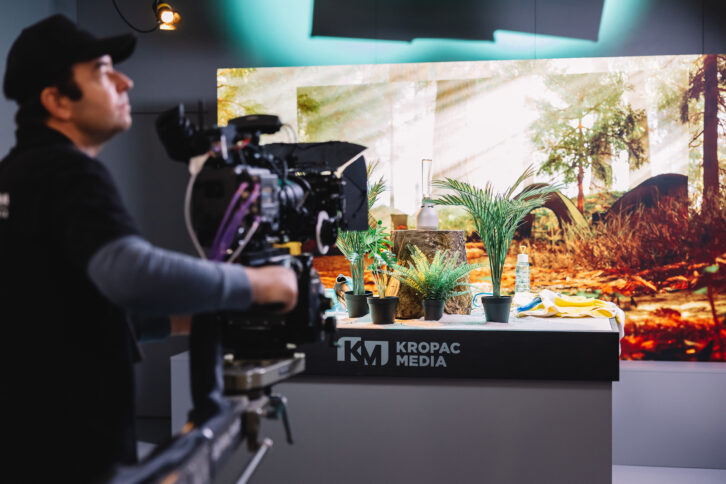
Ben Pain, head of audio visual resources at the Royal College of Physicians, offered a different perspective, arguing that AV’s adoption of software-defined infrastructure is more advanced than Ambrose’s assessment suggested. He pointed to the growing use of cloud-based monitoring and remotely managed systems as evidence that AV is moving beyond hardware-dependent installations. For example, Pain described how the Royal College of Physicians’ Liverpool building uses Q-SYS infrastructure to route signals between rooms and beyond the premises, departing from the conventional model of isolated systems serving individual spaces.
He also highlighted the development of cloud-based monitoring and automated recovery tools, particularly in corporate AV. Systems can be tested remotely when rooms are unoccupied, allowing faults to be identified and often resolved without an engineer visit.
“The buzzword I think in AV at the minute is self-healing systems,” he observed, describing how automated processes can detect problems and return rooms to their intended operational state.
Rather than regarding AV as behind broadcast in its adoption of cloud technologies, Pain argued that the two sectors were pursuing different applications.
“I just think that the two areas are using cloud-based computing for maybe slightly different priorities at the moment,” he concluded.
Ambrose acknowledged the distinction, observing that AV places particularly high value on immediate system availability. The consequences of a delayed event can be measured in wasted time across a substantial number of users, whereas broadcast productions may have dedicated preparation periods in which technical problems can be identified before transmission.
The exchange illustrated why measuring convergence primarily through technology adoption can be misleading. Similar computing capabilities may be deployed for quite different purposes, with each industry’s priorities influencing where investment delivers the greatest benefit.
CREATIVE SHIFT
The changing relationship is also reshaping the skills expected of AV pros. Pain offered a strong example of how his department’s priorities have evolved. “I used to hire AV technicians who knew how to use cameras. I now hire videographers,” he said.
The distinction reflects a growing emphasis on composition, lighting and visual storytelling. Pain argued that organisations are now seeking to create content that engages audiences accustomed to sophisticated production across digital platforms. “We are moving from using video… just moving the signal from place to place,” he said. “Now we’re starting to get into the realm of storytelling and narrative.”
This places new demands on AV departments deploying video to communicate widely. Pain suggested that stronger creative skills can sometimes produce better results from modest equipment, while giving organisations a clearer understanding of when investment in higher-end production technology is worthwhile.
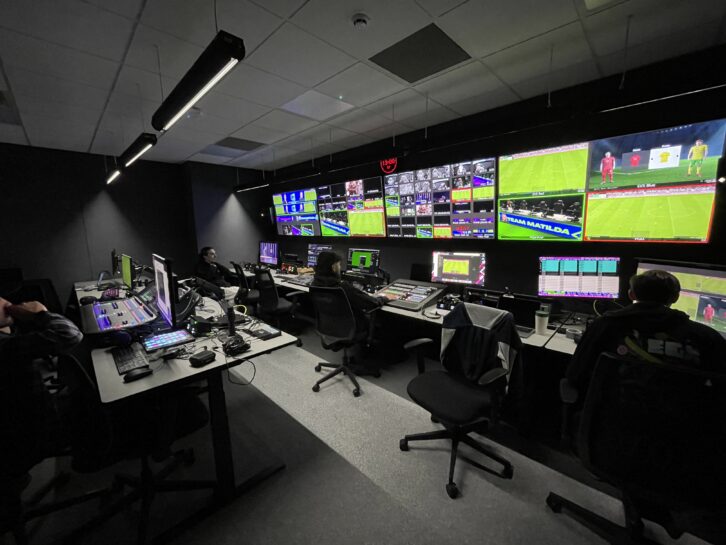
Technical skills are evolving alongside creative expectations. Ambrose identified IT and networking knowledge as a major challenge for professional AV, particularly where audiovisual infrastructure must operate within corporate environments whose network teams have little experience of specialist video systems. “The AV market experience [people] don’t necessarily historically have the IT skills, and the IT people don’t necessarily care too much about the AV,” he observed.
Broadcast organisations have spent years developing expertise in IP, cloud computing and software-defined production. AV departments, meanwhile, often face the challenge of integrating specialist systems into networks primarily designed around other business requirements. Security concerns can reinforce that separation, leaving audiovisual infrastructure isolated from the wider IT environment.
Knowledge transfer is nevertheless occurring in both directions. Ambrose cited vMix as an example of software gaining credibility in AV and live events before finding applications in broadcast. Pain likewise argued that AV professionals’ experience across several technical disciplines offers expertise from which broadcast can learn.
Coutinho suggested that IP-based technologies such as NDI and IPMX are making video workflows more flexible, with software development tools enabling capabilities to be created around existing infrastructure.
“In a weird way, because of IP technology and many other things that we have discussed here, video is becoming a little bit like text in a computer,” he explained, comparing the manipulation of video content with the ease of moving and editing text within software applications.
DISTINCT FUTURES
Despite the growing exchange of technologies and skills, the panellists were broadly sceptical that AV and broadcast would ultimately merge into a single industry.
Ambrose noted that proAV itself encompasses markets with significantly different requirements, from corporate offices and universities to hospitality and live events. The technologies employed may overlap, but their applications and the organisations purchasing them remain distinct.
Matthews also argued that the sectors would remain distinct, not least because they buy and use technology in different ways. Coutinho suggested that manufacturers might seek to address both markets with common technology, but the commercial outcomes expected by customers would remain different.
Pain challenged one remaining distinction: the suggestion that producing content fundamentally separates broadcasters from other organisations.
“We are all unfortunately content creators these days,” he argued, pointing to the widespread creation of video for social media, business communications and personal interaction.
Organisations across many sectors, he suggested, now regard content production as an important part of how they engage with their audiences.
His observation points towards perhaps the most significant consequence of convergence. As professional-quality content creation spreads beyond broadcasting, AV departments are acquiring responsibilities once associated with specialist media organisations. At the same time, broadcast is adopting technologies and working practices developed to meet AV’s demands for accessibility and operational flexibility.
The opportunity for manufacturers and integrators lies in understanding those differences rather than assuming technological convergence will eliminate them. Products capable of serving both markets still need to accommodate distinct purchasing processes, levels of technical expertise and operational expectations.
For pro AV, the relationship with broadcast is therefore becoming more consequential than a straightforward transfer of technology. It is influencing how systems are designed, how services are delivered and the capabilities expected of the people operating them. The two industries may never become one, but their continuing exchange of expertise is already changing both.
This article is based on “AV & Broadcast Convergence: Where Are We Now?”, the opening panel of the Installation and TVBEurope AV & Broadcast Summit, held on September 2, 2026. The discussion featured Robert Ambrose (Caretta Research), Helen Matthews (Futuresource Consulting), Ben Pain (Royal College of Physicians) and Miguel Coutinho (NDI).
Watch the full panel discussion
You can subscribe to Installation magazine for free here and the daily newsletter here.