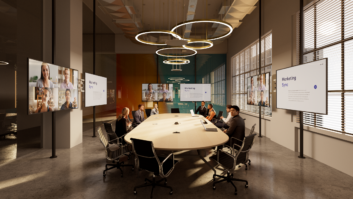
Without wishing to over-reference the pandemic as we hit its five-year anniversary, there’s no doubt that it had a profound impact on the expectations of conference and meeting rooms. Literally overnight in many cases, there was a need for meetings to accommodate significant numbers of remote participants with high-quality audio and video. Many businesses found that their existing infrastructures were simply not fit for purpose, prompting them to embark on a wave of investments – some of which were destined for greater longevity than others.
As 2026 begins in earnest and we all head to ISE, there continue to be rumblings in some areas of the corporate world about a more comprehensive ‘return to the office’, although it’s generally accepted that hybrid working is here to stay. At the very least, many employees spend a least a couple of days per week at home, and inevitably have to join meetings remotely on at least some of those days. This means that the expectation of a seamless meeting experience, wherever the participants are located, has now become a permanent one.
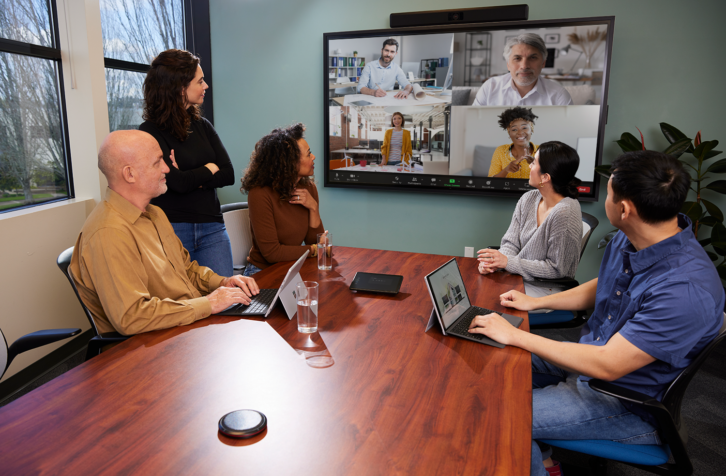
In this article we’ll explore the typical stages through which new conference room projects typically proceed. But we’ll also acknowledge a broader overarching shift in enterprise AV that is neatly summarised by Alistair Johnson, principal consultant collaboration and pro AV at Futuresource, who opines that, since the pandemic, enterprise AV has moved from being a collection of room-based projects to becoming core enterprise infrastructure.
“What’s also changed is the scope of enterprise AV,” he adds, “and we’re seeing a clear broadening of roles: traditional collaboration vendors moving upmarket, while broadcast, professional video and professional audio companies increasingly target enterprise use cases.” Boardrooms, corporate studios, town halls and executive suites now demand much higher production values than they did pre-2020, he says.
“At the same time, AV ownership has shifted decisively toward IT. Enterprise buyers now expect AV systems to behave like IT assets: standardised, secure, manageable, and scalable. That combination — broader ambition, higher expectations, and IT ownership – defines the current phase of enterprise AV.”
When it comes to designing new conference rooms, or refreshing existing ones, the chief priority seems to be ensuring that all participants have a comparably superlative communication experience – something all of our contributors to this article agreed with.
Jack Cornish, technical director of AV design and installation company Tateside, recalls that pre-pandemic some meeting rooms were still being designed “with nice screens and speakers, but no video-conferencing kit”. But the requirement to have the equipment to enable remote meetings “definitely sped up during the pandemic” and since then everyone has focused on what’s required in those spaces.”
Zach Snook, director of product management at Biamp, goes on to outline the impact of these changing working practices. “Hybrid work reshaped expectations for meeting room technology in a profound way,” he says. “The shift wasn’t only about working remotely; it created a surge in the number of spaces organisations needed to support and accelerated demand for reliable, high-quality conferencing across global teams.” At the same time, platforms like Microsoft Teams, Zoom, Google Meet and Cisco Webex raised the bar for the in-room experience. “As these services evolved, they introduced features designed to give every participant – whether in the room or remote – an equal presence.”
Consequently, Snook adds, “parity between in-room and remote participants has become fundamental”. Remote participants were common long before the pandemic, but what he calls ‘true video conferencing’ was often too complex or expensive to deploy broadly. “The combination of modern UC platforms lowering that barrier and the shift to remote work revealed how essential it is to see and understand the people you’re collaborating with.”
MEETING EQUITY
Greg Baribault, VP of product & portfolio management at HP Hybrid Systems, believes that ensuring meeting equity across remote and in-room participants is essential, as organisations now measure collaboration success by how inclusive and natural the experience feels for everyone involved. “Systems should perform identically regardless of location, providing clear audio, intelligent video, and seamless content sharing,” he says. “Solutions should also recognise and amplify the benefits of meeting together, using capabilities such as AI-powered content capture, speaker attribution and transcription to add unique value to collaboration in the room. Scalability remains equally important. As requirements shift, organisations benefit from systems that can seamlessly integrate with existing tools, scale across different room types, and accommodate new features or hardware without disruption.”
Samuel Recine, vice president global strategic partnerships at Matrox Video, agrees on the importance of the meeting equity “trend” affecting everything from lower mid-range rooms to the most well-equipped spaces is meeting equity. “This can have different technical implications depending on budgets, room layouts, and workflows or purposes,” he says. “One way this can influence design is to shift from PTZ cameras toward arrays of multiple cameras. Rather than relying on the intelligence of a single camera to track speakers and adjust focus, groups of cameras can provide a better tracking experience, more consistent framing for each participant, and less imbalance based on where people are seated in the room.”
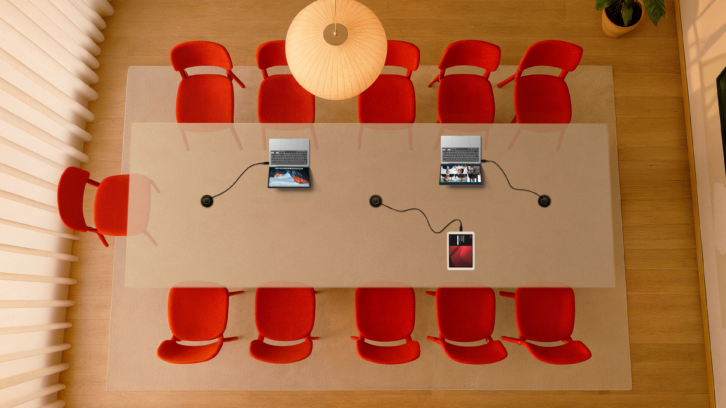
Meanwhile, Neil Fluester, head of portfolio and alliances at Logitech for Business, underlines how significant some recent changes in requirements have been: “Traditionally, video conferencing meetings were always set up as a ‘point-to-point’ solution, joining rooms from location to location, such as London to New York. However, expectations have shifted toward a more complex hybrid environment where the focus is on the fluidity of the experience for every individual, regardless of where they are physically located.”
And, from Johnson’s perspective, the ascendancy of hybrid work exposed a simple truth: if some participants can’t see, hear, or meaningfully contribute, meetings don’t work. “That applies whether the meeting is a formal board session, a hybrid all-hands, a customer briefing, or a quick ad-hoc huddle,” he says. “As a result, enterprise AV is now designed around inclusivity and equity of experience, rather than just room aesthetics. The key shift is from designing for rooms to designing for outcomes – ensuring every participant, wherever they are, can engage effectively.”
HYPOTHETICAL SCENARIOS
Installation invited several integration companies to ponder a hypothetical scenario in which a company wishes to renew and refresh a number of meeting rooms to ensure they are suitable for today’s hybrid working requirements. What would be the initial questions they would ask in order to begin developing a solution that would meet their needs – both now and for the foreseeable future?
“The key initial questions are about understanding their hybrid work policy, says Simon Watson, global head of innovation at AV and UC integrator Kinly. “What are they trying to achieve? And then after that you would possibly want to break it down into verticals to see who they want to bring back in the office, such as front-end sales or HR teams, or whether it’s a general policy of wanting everyone to come in three days a week.” Then it’s possible to ascertain how much remote meeting capacity is required, although wherever participants are located “meeting equity” is now essential.
Cornish adds: “Firstly we would try to understand what they are trying to do with each room because not everyone will [necessarily require accommodation] of remote participants. Now that people are back in the office more in some cases, there is a need for people to be more collaborative in those spaces. So there will be conversations about everything from table size to screen size, [although] with some clients there will be the desire to put a huge screen in a small meeting room because they’re really data-driven and that’s really important for them. Of course, for some clients that’s not so important. What this means is that you need to have the humanistic conversation before the technical one.”
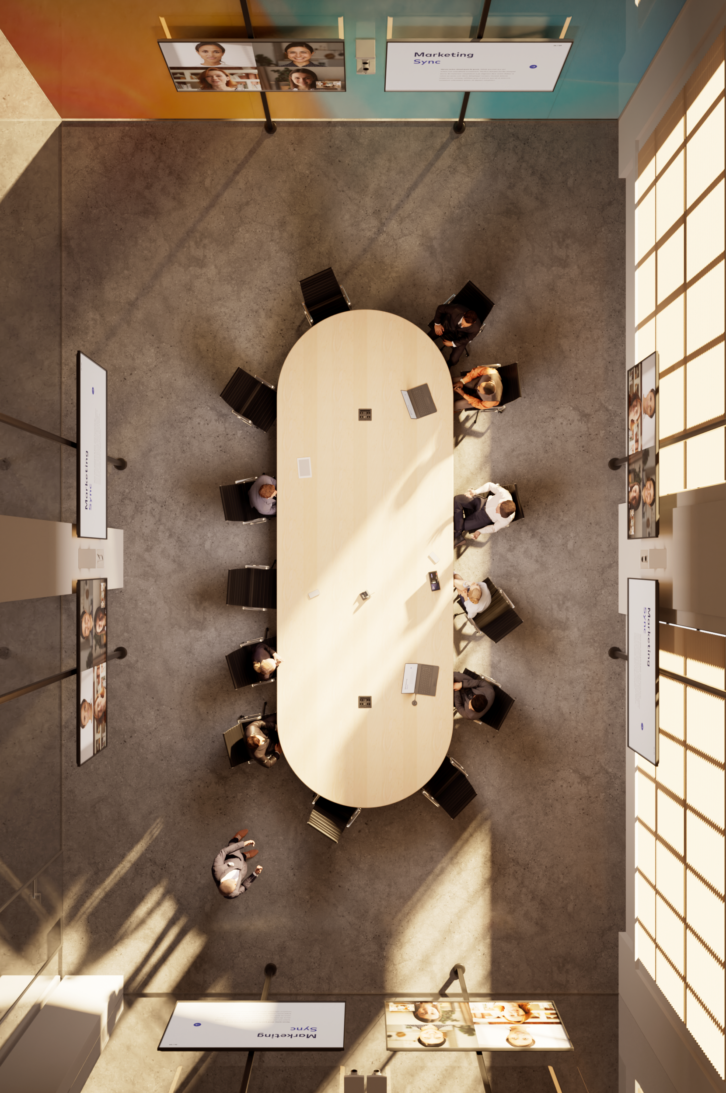
ECHOED SENTIMENTS
Several of these sentiments are echoed by Andrew Pymm, technical director of AV integrator Whitwam AVI. “First of all we want to understand their exact use cases,” he says. “For a room with remote participants, we’d want to find out how many they are likely to have and how often the room is going to be used. It might also be the case that the focus is on having a local capability, for example with 20 people [on-site] and then a couple more using the space remotely. We also like to try and investigate their experiences to date so we can address the things they might have found frustrating in the meeting spaces they’ve been using or had experience of, because that can quite often colour how the eventual solution is proposed and accepted.”
Once the core principles of the project have been established, the focus will tend to shift to the budgetary and aesthetic requirements, which will in turn inform the actual technology that is specified. “You have to have a clear understanding of the budget and where we’re trying to sit with that,” says Cornish. “Then we have to understand aesthetics; what is the impact going to be visually? Because if it’s a client-facing meeting room, it’s not just about the technology working – it’s also a place to show what the business is about, and you’re going to be looking more at lighting, feature walls and so on. Once you have all of those aspects clear you can move forward and start thinking about the technology that fits inside all of that.”
Pymm concurs that a close examination of the “actual spaces” is a decisive stage. “What are the acoustics like? What about the lighting in the space? Are there any external influences that are going to cause issues with the operation of the room, such as air-con or background noise,” he notes. “All of these things we ask about and will feed into the specification of a solution.”
As to whether enterprise customers have become more savvy in general about what’s actually available in terms of meeting room technologies, Pymm responds that they “tend to be” more well-informed now. “Also, a lot of the responsibility in the corporate world falls under the auspices of the IT team nowadays. Whereas there might have been a bit of a ‘sticking plaster’ approach [during the pandemic], there is now an understanding of the need for a much higher specification and so you do see systems being updated in a lot of places.”
He adds that a lot of these developments have been driven by the manufacturers’ technologies, “so they’ve all been trying to differentiate themselves from each other and bring different features to market as they’ve upgraded their product ranges”.
Which prompts two related questions: what are the technologies now making an impact on the conference/meeting room sector, and which are the ‘ones to watch’ for the next few years?
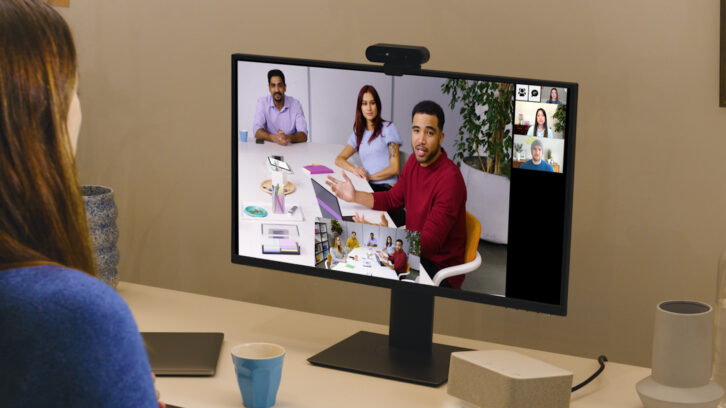
There is a consensus view that video capture technology for conference applications has matured significantly in the last few years, meaning that all sorts of enterprises can benefit from innovations such as AI-based video framing and automated cameras in their meeting rooms.
“Those are all key technologies,” agrees Watson, “with many software revisions having happened recently, which makes them very powerful – especially for multi-camera setups within large meeting rooms.” And where the AI within the system itself acts as a director, it’s possible to “really hone in” and build that meeting equity.
“Multi-camera in larger, more complex spaces and AI are huge growth areas,” says Fluester. “The ability to capture people from different angles in larger rooms ensures that remote participants have a ‘front-on’ view of everyone in the meeting. Beyond that, AI integration for real-time transcription and translation will allow users to communicate seamlessly across borders and overcome different language barriers, making global collaboration much more effective.”
MAJOR TRENDS
HP’s Baribault notes that the next major trend in meeting room technology is likely to be the move toward fully AI-enabled spaces that actively support the flow of collaboration. “We’re entering a phase where AI will manage the entire meeting experience, from how people join to how the room adapts to shifting dynamics,” he says. “The goal is to remove the friction that still exists today and make meetings feel more natural, especially when teams are spread across different locations. Every new product in our portfolio is being designed with AI at the centre. We’re focused on creating spaces that anticipate what users need, make collaboration feel seamless, and create a consistent experience whether someone is in the room or remote.”
Biamp’s Snook observes the beginnings of a “significant shift” in how intelligence features in meeting spaces. “Today, AI mostly serves as a transcription or note-taking tool, but its potential goes far beyond that,” he says. “I expect AI to become more like an active assistant within the meeting – capable of surfacing information, helping teams brainstorm, summarising decisions in real time, and supporting collaborative work as it happens.”
The impact of AI on the audio side should also not be underestimated. Craig Collin, senior manager sales at Shure, believes that the next major audio trend will be the integration of AI-driven features such as real-time transcription, translation, agenda management, and talker identification. “These innovations rely on high-quality audio to function effectively,” he says. “Shure is aligning its roadmap with leading platforms including Microsoft Teams and Zoom, focusing on audio-centric unified communications products that support these advanced features and enhance meeting efficiency.”
For Johnson, the fastest growth at present is occurring where enterprise reliability meets professional-grade performance. “On the video side, we’re seeing higher-end cameras – many originating in broadcast or pro-video – increasingly deployed in boardrooms, corporate studios, and large meeting spaces.” he says. “It’s less about raw resolution alone and more about framing, image consistency, and how the camera behaves in real rooms. Then on the audio side, professional audio technologies are moving decisively into enterprise AV. Audio quality is one of the strongest drivers of perceived meeting quality, and organisations are increasingly willing to invest in better microphones, DSP, and room audio to reduce fatigue and improve clarity.”
SUSTAINABILITY DRIVE
Meanwhile, enterprise customers are also looking to make their solutions last longer as part of their sustainability drive. “Everybody’s still got a focus on trying to be cost-effective, but there is also more of an emphasis on sustainability,” says Pymm. “There has always been an impetus to specify a system and build in some future-proofing, but because the refresh of equipment is getting faster we need to keep up with the capabilities that could be addressed further down the line. So if there is a possibility to reuse, recycle or extend the life of some products, I think that is helping to tick some customers’ sustainability criteria.”
The fact that customers are now taking a longer view also helps to explain why there is now such a focus on post-installation support and maintenance agreements – a part of the business that has become increasingly important for many integrators. And with a slew of AI-powered applications emerging, that support may become more crucial as enterprises begin to negotiate a future that, whilst involving some complex decisions, holds tremendous opportunities to enhance and enrich meetings of all kinds.
You can subscribe to Installation magazine for free here and the daily newsletter here.