Samsung provided display and mobile technology to the Health Security Operations Center (HSOC) during the 2026 World Cup this summer, enabling data sharing and collaboration among 30 participating organisations. The HSOC, part of the National Center for Health Security and Resilience, is a collaboration between Georgetown University and MedStar Health, and produced daily situation reports and twice-daily briefings over more than six weeks before, during and after the tournament.
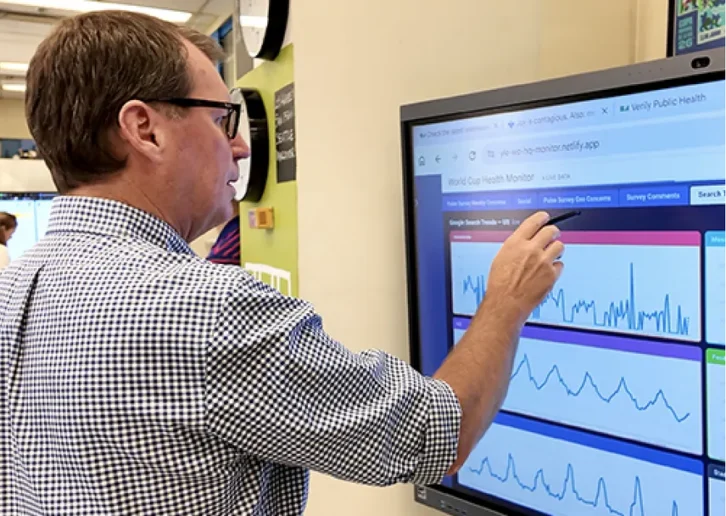 Samsung worked with the HSOC coalition to build a functioning operations environment ahead of the tournament, supplying laptops, tablets and large-format displays to help public health experts collect, analyse, visualise and communicate health intelligence. Samsung’s QBC Series signage aggregated data from multiple sources into a single view, with 4K ultra-high-definition screens allowing the team to collectively review trends and emerging risks.
During meetings, Samsung WAFX-P Interactive Displays supported collaboration by allowing team members to screen share directly from Galaxy Books and tablets, annotate on-screen and video conference with local health officials. The solutions helped the HSOC team act on public health information from more than 50 data sources across over 145 jurisdictions, including data connected to airports and tournament travel, as the team monitored signals across hundreds of pathogens.
Todd Maxwell, director of regulated business development at Samsung Electronics America, said: “Public health operations centres can prove critical during international events and gatherings of all sizes, especially mass gatherings that draw millions of people from around the world. In these instances, health leaders need coordinated, multidisciplinary situational awareness to aggregate and analyse disparate public health data, and enact immediate communications and response if a risk emerges.”
Rebecca Katz, professor at Georgetown University and HSOC director, added: “Having connected technology is critical for end-to-end flow of intelligence, from aggregating real-time public health data to presenting a unified view of disease signals for monitoring and decision making. Our goal was to make the HSOC a trusted resource for the public health community, health systems, and most importantly, the public.”
AT&T provided wireless connectivity to extend the technology ecosystem beyond the operations centre, while Samsung subsidiary HARMAN supplied JBL speakers and headphones to support audio and voice communication among HSOC teams.
You can subscribe to Installation magazine for free here and the daily newsletter here.