Professional audio has always been central to AV installations and live events. But until relatively recently, it often sat apart from the wider system architecture. In many cases, audio was made up of its own ‘islands’ – a front-of-house (FOH) desk driving the main PA in a concert setting, a separate processing chain for distributed sound, standalone control for conferencing or paging. It worked, but it wasn’t necessarily integrated.
That began to change as digital processing and control platforms made networking more practical and scalable. Audio systems that once relied on point-to-point connections could be linked, routed and monitored far more easily.
The shift accelerated with the rise of Audio over IP (AoIP), particularly protocols such as Dante and AES67, and the growing willingness to run audio over standard IT networks. What had been separate signal paths started to sit on shared infrastructure – often alongside video and control traffic.
The convergence between audio and IT is just as significant as the much-discussed crossover between AV and broadcast, but it tends to attract less attention. While AV and broadcast are visibly borrowing from each other, the shift in audio has been quieter – and arguably more fundamental.
Networked audio, immersive formats and software-driven control have changed how systems are specified from the outset. Increasingly, audio sits on shared IT infrastructure, shaped as much by network architecture and security policy as by loudspeaker coverage or console choice.
“Audio has reached an inflection point,” agrees Scott Sugden, director of production management for innovation at L-Acoustics. “We’re seeing a convergence across sectors that was unthinkable five years ago. The same networking protocols, processing capabilities and immersive technologies now serve live touring, fixed installations, hospitality, residential and broadcast applications. The market has matured beyond delivering sound pressure levels. The technology [still] enables this but the real shift is in how we think about audio and how it is essential to creating the best shared experiences.”
CROSSING OVER
Telos Alliance is among the broadcast-oriented audio companies that are part of the cross-over with AV. Executive team strategy advisor for media and entertainment Costa Nikols comments that although the conjunction of AV and broadcast is “the headline story”, the merging of audio with IT is “arguably more significant” because it has an impact on nearly every project. “The AV-broadcast shift is primarily about formats, standards and workflows between two professional fields,” he explains. “But the audio-IT transition is a profound change in culture, skills and ownership because audio now operates on enterprise networks, adhering to IT policies for cybersecurity, QoS [quality of service] and redundancy. For many organisations, the critical question is not broadcast readiness but whether the audio system integrates seamlessly as a good IT citizen and scales with the existing infrastructure.”
Nikols adds that “the most noticeable day-to-day changes” result from audio sharing over the same switches, fibres and monitoring devices as everything else on an IT network. Gustavo Robles, sales director at AEQ, agrees, saying that AoIP installations are now utilising IP switches and computers more than traditional audio equipment, such as XLR connectors and jack plugs. “Most of the projects we are managing worldwide always use AoIP, no longer analogue or digital audio,” he says. “This calls for a totally different approach to the installation, with different connectors, patch panels and matrices. Working with IP technology now means more IT [systems] than audio itself.”
BASIC PREMISE
While the basic premise sounds relatively simple – swapping one, somewhat limited infrastructure for another that is wider in scope – the practical reality is more involved. As Samantha Potter, install and commercial audio manager at Allen & Heath (A&H), observes, the coming together of audio and IT has been more of a challenge than that between broadcast and AV.
“We now have to start talking to people about technology that was never designed for AV,” she says. “It has been more significant a convergence with IT [and audio] than with broadcast [and AV} because it’s merging two very different worlds that had previously no relation to each other and do not share the same language.” But, Potter adds, there has also been a raised awareness of the importance of audio and what it can do for pro AV and AV/IT after “the rise of video”, particularly for conferencing and videowalls, initially overshadowed sound. “Over the last 18-months to two years it seems people are understanding that good audio does make a difference, with speech intelligibility being really important.”
Good quality audio has always been the goal of development engineers, equipment manufacturers and those working in AV, live sound and broadcast. At one time, however, it was often at a premium. The advent of mass-produced components as the basis of cheaper but still decent sounding systems democratised the various market sectors, a trend that has only been accelerated by digital technologies and, now. AoIP. This has created a situation where good quality sound is expected and the emphasis has shifted towards how mixing consoles, microphones, loudspeakers and amplifiers are not only going to work together but with the other parts of an AV installation.
“The quality of audio equipment is still very important, but it’s not just that anymore,” says Logan Helps, brand development manager for Europe at Audio-Technica. “It’s how easy it is to incorporate into a solution and how easy that solution is to design, install and commission.” Helps continues that another important consideration is supporting installers, system integrators and freelancers. “We need to do that in all areas so it’s easy and straightforward [for them]. For a lot of people, IT has become part of their skillset but for some installers, that’s also a barrier. Being able to support them within a product portfolio is really important.”
Increasingly, this level of support, often involving a degree of technological integration, is rolling out across the audio market. Interconnectivity is now a crucial part of audio systems and has been fully enabled by IT. “With IT, the key word is integration,” acknowledges Nicolas Sturmel, senior network technologist with DirectOut. As an example of this, Sturmel cites the Automator automated trigger function within the company’s PRODIGY Series of audio matrices, which is able to link an audio event to other components of a networked installation using protocols like OSC (Open Sound Control). “This requires increased planning to enable the integration to significantly increase productivity. The enhanced infrastructure makes it possible to facilitate complex and deeply integrated multimedia systems where one action can impact audio, lighting and more.”
Sturmer continues that cloud production and hybrid infrastructures are “blurring the lines between live and broadcast audio applications”, which, he explains, makes streaming content alongside live audience events more achievable but requires a greater knowledge of IT. Within this new framework, an audio device such as a microphone is evolving from being solely a sound energy converter into a vital point in a much bigger networked audio-visual system.
DIGITAL WORKFLOWS
Among the companies looking to push this is Shure, starting with its DCA901 mic array, launched in December 2025. Shure’s vice president of strategy and innovation, Scott Sullivan, explains that the DCA (Digital Capture Architecture) concept came from a MEMS (Micro-Electro-Mechanical Systems) microphone for “the conferencing space” developed in 2016. “The DSP around that changed the way rooms were configured and who got to be heard without having to pass microphones around,” he says. “Then we said, let’s [look at] broadcasting and figure out how these digital input devices work. We realised there were a lot of copper-based analogue workflows in broadcasting and [wondered] what it would mean if we could be part of driving a change to digital workflows.”
The DCA901 was designed for broadcast, but Shure says it can also be used for sound reinforcement applications, including concerts and houses of worship. Sullivan’s colleague, global strategic business development manager Jason Waufle, comments that the mic array includes integrated DSP and a GUI controlled mixer, with eight ‘lobes’ that can be steered to different points in a soundfield. “Now it’s not just, for lack of a better term, a dumb or passive microphone,” he says. “We’ve taken the IP infrastructure and asked how we leverage these endpoints and give it more horsepower… We’re well versed in Dante and AES67 native products and advancing onboard DSP and GUIs, making microphones essentially an edge device for a network.”
The increased levels of audio networking in AV and live sound have been enabled through a combination of IT infrastructure technologies and AoIP protocols and standards including Dante, RAVENNA and AES67. RAVENNA was conceived by Philipp Lawo, chief executive of mixing console and, latterly, IP video system developer Lawo. “He had a dream that everything in broadcast at that time should be networked because it was more efficient and flexible,” says the company’s head of marketing content, Chris Scheck. “That hasn’t changed but we’ve moved beyond broadcast to also cover theatres, houses of worship, parliaments and corporate buildings. In AV, projects are getting bigger and more complicated, which means people are actively looking for solid and resilient IP, which is SMPTE ST 2110. And the growing success of IPMX [IP Media Experience], which is derived from ST 2110 [and AES67 and NMOS], with the addition of AV-specific functions, clearly indicates that even AV projects now want to work with an open IP standard like ST 2110.”
As to whether this has changed the way technicians work, Scheck replies that it depends on whether they are those responsible for choosing new equipment or the ones who operate it. “The project manager for IT and technical network at La Monnaie [National Opera of Belgium] in Brussels, Karl Ancia, started out as an audio engineer but is now [effectively] head of IP,” he says. “The operators,
some of whom are freelancers, don’t think too much about the IP part and the user experience hasn’t really changed for them. But they appreciate the fact that every show is produced on two consoles, one for front-of-house and another using exactly the same signals for broadcast.”
IT and IP technologies have changed the way audio is transported and distributed in AV environments but, as Will Waters, principal product manager at Dante developer Audinate, observes, its nature and purpose remain the same as ever. “Audio is a utility layer and it decides fundamentally what the experience is,” he says. “It can win or lose the audience and when we think about this in installed AV, it’s things like speech intelligibility, mic management and room consistency. Is it discoverable and manageable? This is even more important as we’ve moved into this convergence layer and, on the audio side, I’d argue we’re much further into the need for IT management, governance and compliance controls. The big shift is that audio is fundamentally an enterprise fabric that needs to be thought about.”
AUDIO NETWORKING
Picking up on this, Audinate’s chief marketing officer, Josh Rush, comments that there are “a number of components” to the convergence with IT, which have had an impact on audio. “There’s obviously the benefits of audio networking and the flexibility and manageability that adds to any installation,” he says. “One of the things we’ve seen is that IT departments want to manage the system remotely and if you have ‘dumb endpoints’, there’s no access to that information. What we saw at ISE was a huge trend towards networked endpoints, particularly loudspeakers and microphones, which traditionally would have been analogue and plugged into I/O and then on to more networked systems. The trend now is to be networked all the way down to the loudspeaker. Part of this is flexibility but it also gives the IT department the ability to manage the complete network end-to-end.”

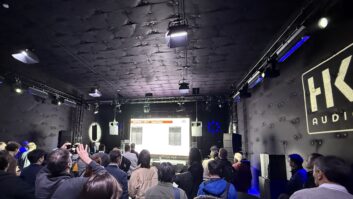
A running trend at recent ISE shows has been to regard audio as infrastructure rather than an add-on, as seen in immersive demo spaces and listening suites. In keeping with this, the Audio-Technica stand featured an integration area demonstrating how its products work alongside other DSP brands and IT-based systems. Another trend spotted by Costa Nikols at Telos was “audio crossing the line from boxes and wires to software and networks”, with virtual DSP, cloud services and AI-assisted set-up, while hardware “plays a supporting role at the edge”.
For L-Acoustics’ Scott Sugden, ISE 2026 reinforced several trends: “Immersive audio is becoming more accessible and flexible and cloud-based collaboration tools are enabling much better stakeholder communication.”
The overall takeaway, as Audinate’s Will Waters observes, is that “audio is no longer isolated.”