International acoustic design and AV technology consultancy Walters-Storyk Design Group (WSDG) has completed the acoustic design for the modernisation of the Zeiss-Planetarium Jena in Germany, as the world’s oldest surviving large-scale planetarium marks its centenary.
Appointed by the Ernst-Abbe-Stiftung Jena in June 2025, WSDG was tasked with developing a room-acoustic strategy that could accommodate a new projection surface and concealed immersive audio system without altering the protected concrete cupola and internal geodesic structure.
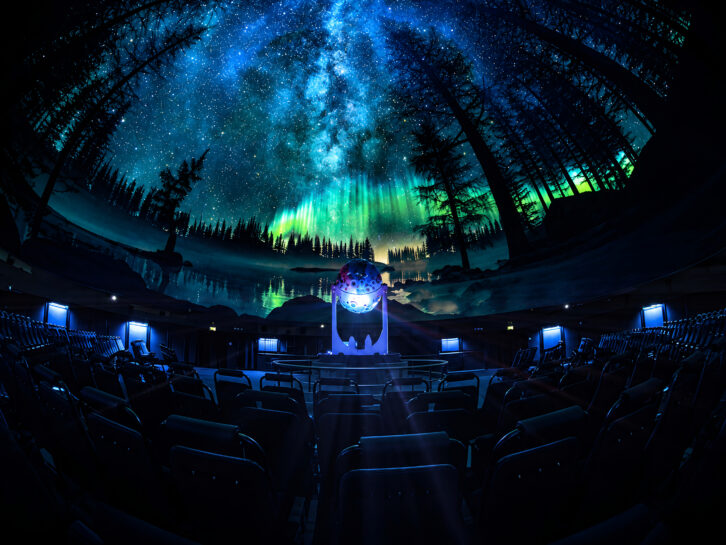 Opened in July 1926, the planetarium presented an unusual combination of visual and acoustic challenges. Its former inner dome comprised perforated metal panels whose borders and joints remained visible during projection, while the concave dome and cylindrical lower walls created reflections capable of concentrating sound energy in particular areas.
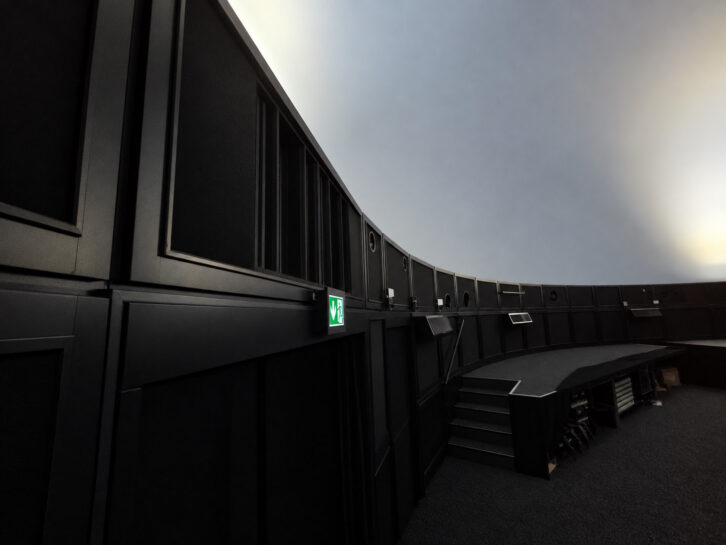 WSDG carried out acoustic measurements of the existing auditorium in October 2025 before its interior was removed, establishing its reverberation characteristics and modelling the behaviour of the curved surfaces.
Tobias Behrens, acoustic consultant at WSDG, said: “The architecture that makes the planetarium so extraordinary also creates a very particular acoustic challenge. In concave spaces, reflections can be directed towards focal points and sound energy can become concentrated in particular areas. Our task was to control those geometric effects while retaining a reverberation time appropriate for planetarium shows, film screenings, educational programmes and live events.”
A central part of the project was replacing the segmented inner dome with a continuous projection field using Endure Screens Micro Pro. WSDG assessed the material’s perforation and sound-transmission characteristics for use in front of concealed HOLOPLOT X1 and X2 Matrix Arrays.
A sound-absorptive layer installed behind the projection surface controls reverberation and acoustic focusing while preserving the uninterrupted white surface required for fulldome projection.
“The key was to treat the dome as a single architectural, acoustic and technological system,” explained Behrens. “The screen had to deliver a seamless image, the treatment behind it had to control the room, and the loudspeakers had to remain effective through the surface. None of those requirements could be resolved in isolation.”
For the cylindrical lower walls, WSDG developed a combination of quadratic residue diffusers, broadband absorbers and reflective surfaces. The diffusers scatter sound in multiple directions to disrupt focusing caused by the curved geometry, while absorptive areas control reverberant energy and retained reflective surfaces prevent the room from becoming excessively damped.
The acoustic work formed part of a wider centenary technology upgrade. ZEISS modernised the existing UNIVERSARIUM star projector and installed 11 ZEISS VELVET 4K projectors, providing an 8K fulldome image. Combined with the HOLOPLOT system, the technology supports a programme spanning astronomical presentations, fulldome films, educational events, concerts and immersive AV productions.
“Planetariums bring architecture, image and sound together in a uniquely immersive way,” concluded Behrens. “At Jena, the aim was to respect a landmark that helped define modern planetarium design while creating the acoustic conditions required for the next generation of planetarium experiences.”
The modernised Zeiss-Planetarium Jena reopened in July 2026 as part of its centenary celebrations.
You can subscribe to Installation magazine for free here and the daily newsletter here.