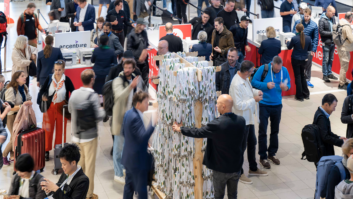
IBC2026 welcomed 41,225 attendees from 170 countries to the RAI Amsterdam, down around six per cent on the 43,858 recorded in 2025. But if the number of people through the doors was slightly lower, the exhibitor picture told a rather different story. More than 1,300 companies took part, including 256 first-time exhibitors – an increase of 36 per cent year-on-year and comfortably ahead of the almost 230 newcomers anticipated before the show.
Those figures perhaps reflect what IBC CEO Mike Crimp had predicted ahead of the event. Against a backdrop of geopolitical instability and disruption to global trade, he suggested businesses were becoming more intentional about investment and innovation, and would arrive in Amsterdam with a greater focus on collaboration, practical innovation and solutions to shared challenges.
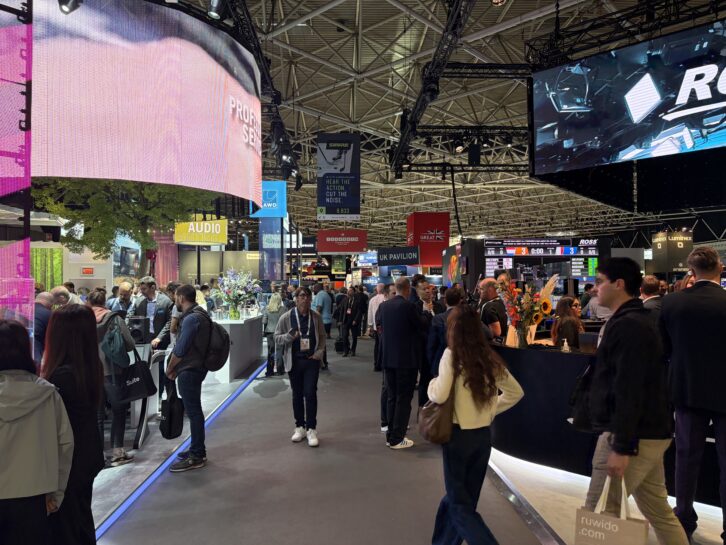 Four days at the RAI suggested he had called it pretty accurately.
“IBC’s superpower is the power to convene our industry,” said Crimp as the show closed. “Our industry has always been at its best when people come together, embrace new technology, and work through challenges to create real opportunity.”
The most striking impression from the show floor was not the emergence of one dominant technology. Rather, technologies that have been discussed individually for several years – IP, cloud, software-defined production, AI, virtual production and immersive media – increasingly appeared as parts of interconnected production environments.
For Installation readers, however, there was another significant shift. Technologies and workflows developed for broadcast are increasingly being applied in corporate, education, venues, houses of worship and live events, while AV technologies and suppliers are becoming part of the same IP-based production ecosystem. The much-discussed convergence of broadcast and pro AV increasingly looks less like a future trend than the market IBC is already serving.
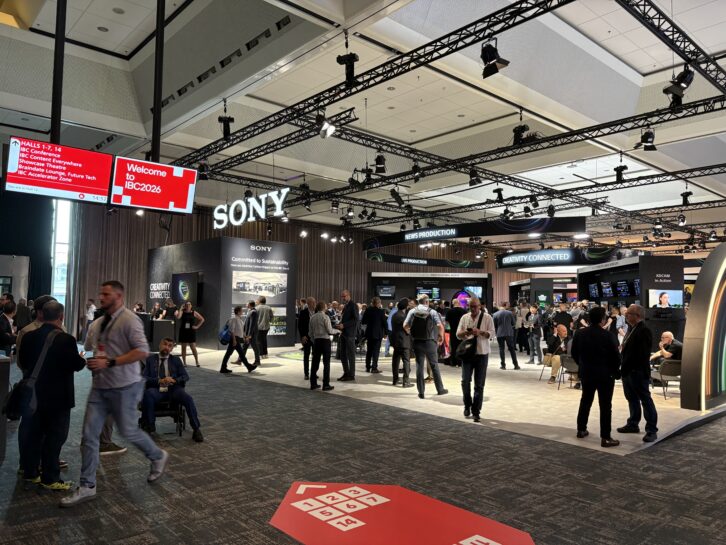 That breadth was also reflected in Future’s Best of Show awards at IBC2026, with judging across Installation and its sister titles recognising products spanning production, networking, audio, control, AI and software-defined infrastructure. Installation chose two winners: VITEC’s X-View integrated displays, which combine IPTV and digital signage technology with integrated display hardware, and Vizrt’s TriCaster Prizm, a scalable live production system aimed at applications including corporate communications, education, live events and sports streaming. Elsewhere across the awards programme, many of the technologies featured at IBC2026 also collected honours, providing another useful snapshot of just how broad the technology landscape has become.
BROADCAST MEETS AV
Prizm is particularly representative of that crossover. Its intended users extend well beyond traditional broadcast production teams into precisely the kinds of organisations increasingly creating and distributing their own content.
The widening constituency for broadcast technology was evident throughout the RAI. Diversified, exhibiting at IBC for the first time, dispensed with the conventional product-led booth in favour of a park-like environment where conversations centred on technology workflows. Its presence was itself significant. The integrator sees the distinction between broadcast and AV becoming less relevant as organisations and brands increasingly behave like media companies, while sports teams and venues build direct relationships with audiences through their own content.
The result is a requirement for hybrid platforms capable of supporting familiar AV functions such as collaboration and presentations alongside live production and content distribution. It is also changing the role of the integrator, with broadcast-quality production increasingly becoming part of wider enterprise and venue technology strategies.
Grass Valley addressed a similar market with AVORA, its new all-in-one live production system. Switching, graphics, audio, remote guests, replay, recording, monitoring, playout and delivery are brought into a single environment aimed at applications ranging from sports and live events to venues, education and enterprise media. AVORA picked up a TVBEurope Best of Show award.
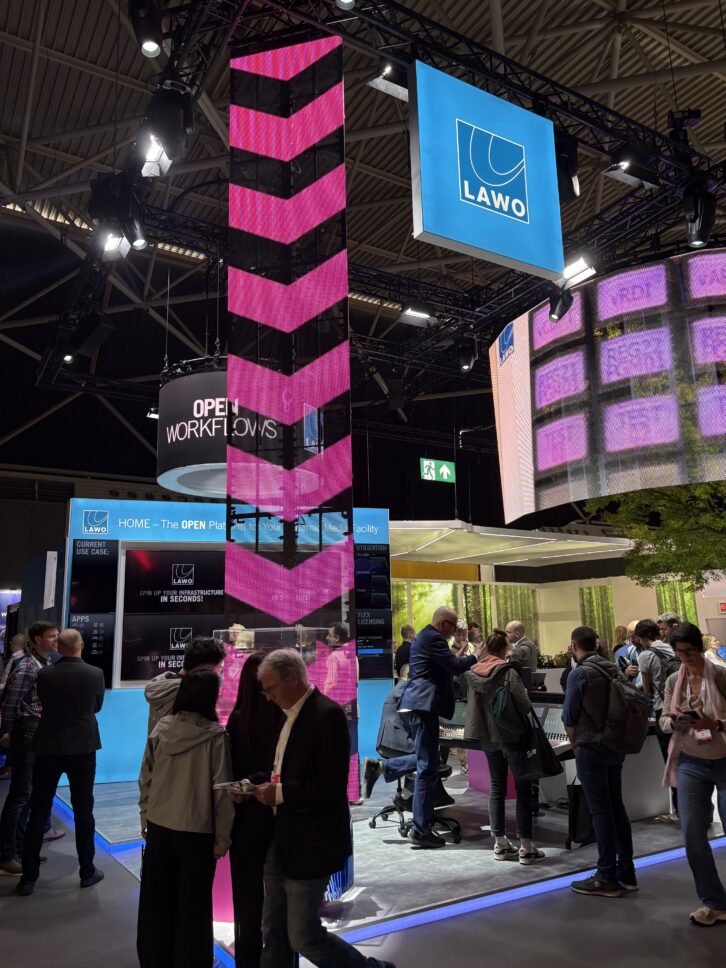 Elsewhere, Ross Video increasingly talks to a similarly broad constituency spanning broadcast, sports and corporate media, while Lawo’s new Edge One perhaps provided the most literal example of the crossover. Making its European trade-show debut and also winning a TVBEurope Best of Show award, the converged video and audio stagebox was developed specifically for broadcast and pro AV applications.
PUTTING AI TO WORK
AI provided another example of technology moving beyond its original production niches. The pre-show conversation had already shifted, according to Crimp, from what AI could theoretically do to how it could solve real production and business challenges. IBC2026 provided plenty of evidence of that transition.
Vizrt’s TriCaster Vizion AI/R combines real-time AI keying with AR graphics while reducing the specialist skills traditionally required to create immersive environments. The significance is less the addition of another AI feature than what it says about where the technology is heading: sophisticated production techniques are becoming easier to deploy by organisations that may not have the people or resources of a traditional broadcaster. Vizion AI/R also won a TV Tech Best of Show award.
ENCO provided another clear example with the global debut of enCue. The cloud-native production tool analyses long-form programmes and podcasts to identify potential clips, generate titles and captions and reformat material for different platforms. It can also match raw footage to a script or narration to assemble an initial news package for subsequent editorial refinement. Rather than replacing editorial judgement, the proposition is to automate repetitive work around it. Both enCue and ENCO’s enCaption Sierra captioning technology won TV Tech Best of Show awards.
ENCO’s Qimera Virtual Production platform – which won a TVBEurope Best of Show award – demonstrated a related development. Supporting traditional green-screen virtual studios, live AR graphics and LED-based XR from the same system, it allows multiple programmes and environments to be created within a single physical studio. Virtual production, in other words, is increasingly being presented as an operational and space-efficiency tool rather than simply a means of creating spectacular imagery.
That has obvious relevance beyond broadcasters. Corporate studios, universities and other content-producing organisations face many of the same pressures to create more material from limited production spaces and resources.
 Sony similarly combined immersive and AI-assisted production on its stand, including OCELLUS camera tracking, XYN spatial capture technology and Crystal LED displays. ROE Visual used IBC to unveil its Sirius IC driver for broadcast and film LED applications, while Leyard Europe took a collaborative approach, creating a functioning studio environment with KST Moschkau, Panasonic and Brompton Technology around its 0.9mm Planar DirectLight Pro LED.
The significance of the Leyard demonstration extended beyond LED. Acquisition, studio automation, robotics, production, LED processing and visualisation were brought together within an end-to-end ST 2110 workflow. For an AV market increasingly involved in studios, corporate content spaces and immersive environments, that integration between display technology and broadcast production infrastructure is becoming particularly significant.
SHARED INFRASTRUCTURE
Indeed, SMPTE ST 2110 was difficult to avoid in Amsterdam. But its prevalence was more interesting than the simple observation that broadcast continues to move from baseband towards IP. Increasingly, the story is about interoperability, openness and allowing production resources to exist as part of a wider networked technology environment.
That matters to pro AV. As corporate, education, venue and entertainment installations incorporate more live production and streaming, it becomes less practical to treat broadcast systems as a separate technological island. At the same time, standards such as IPMX are bringing concepts developed around networked media production directly into the AV market.
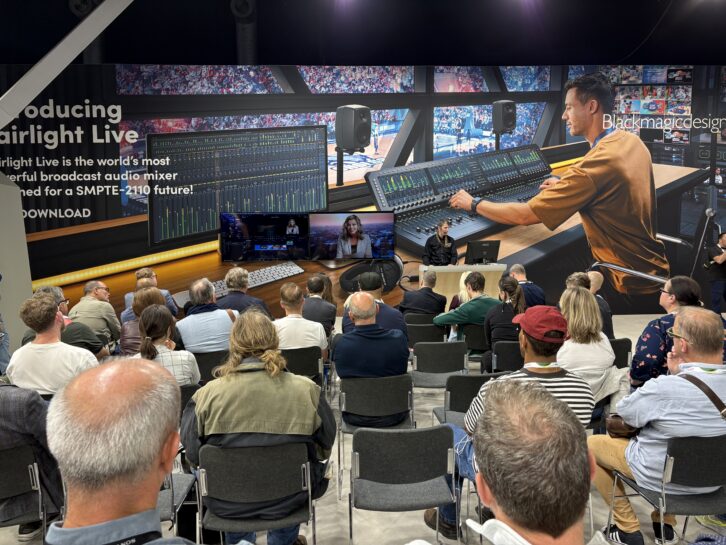
Blackmagic Design also focused on the increasingly shared infrastructure underpinning live production, with its URSA Cine 12K LF 100G bringing 100Gb Ethernet connectivity to SMPTE ST 2110 workflows. The company also highlighted the growing overlap between cinema and live production, alongside Fairlight Live across software and dedicated hardware – another example of previously distinct production environments beginning to overlap.
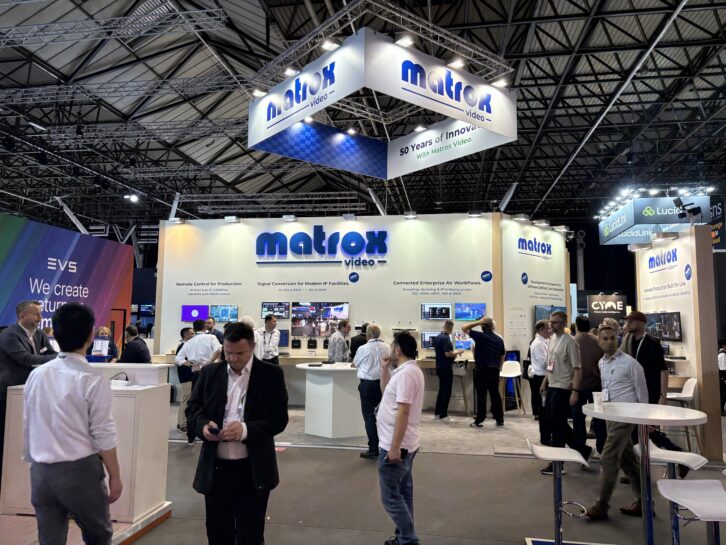
Matrox Video was particularly active here. Its ORIGIN platform was integrated with NVIDIA Holoscan for Media as part of the EBU Dynamic Media Facility showcase, enabling software-defined media services to operate within a Kubernetes environment and connect to the wider DMF deployment through the Media eXchange Layer.
Both DMF and MXL had been prominent in the pre-show programme, with SMPTE sessions examining the move towards software-defined media infrastructure and the EBU’s work on both technologies. More significantly still, MXL went on to win IBC’s Content Creation Innovation Award.
Established by the EBU with the North American Broadcasters Association and hosted by the Linux Foundation, MXL is intended to provide an open media exchange layer across software-defined environments. Grass Valley also demonstrated its Dynamic Media Facility approach at IBC, bringing AMPP, MXL, shared compute and orchestration together to connect software-defined workflows with existing infrastructure across on-premises, edge and cloud environments.
While much of that work originates in broadcast, the principles are familiar to AV: open architectures, shared compute, interoperable endpoints and the ability to deploy processing where it is required rather than building another dedicated hardware chain.
 The Innovation Awards provided further confirmation of that direction of travel. Alongside MXL, Reuters won the Content Distribution category for an API-orchestrated approach that allows capacity to follow live news stories; Globo’s DTV+ implementation in Brazil took Content Everywhere by combining broadcast reach with broadband personalisation; and the Social Impact award went to an AI-powered sign-language solution developed by G&L Systemhaus with Signapse, Norsk/id3as and Akamai.
Fergal Ringrose, chair of the Innovation Awards jury, identified a common thread of breaking down geographical, language and organisational barriers to create “collaborative, cloud-native, software-first digital ecosystems”.
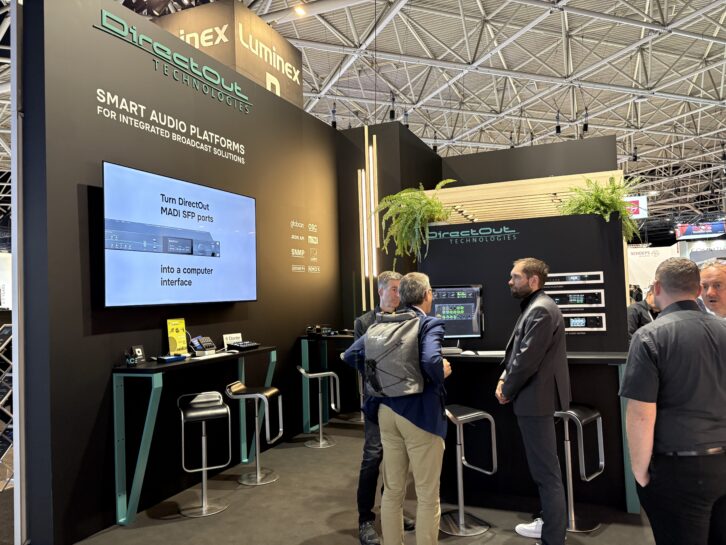
Similar principles could be found across the show floor. DirectOut added new RAVENNA capabilities designed to simplify remote and distributed audio production, including synchronisation directly from an incoming network stream, alongside NMOS BCP-008 support intended to improve interoperability within ST 2110 environments. Lawo’s HOME Stream Share App likewise enables media exchange across distributed facilities, OB trucks, cloud resources and partner platforms using open NMOS standards.
Ross Video’s new Ultrix FR30 tackled the infrastructure challenge at enterprise scale. The hyperconverged platform combines routing, processing, multiviewing, audio, production switching and control while supporting SDI and IP-based transports. Its positioning across broadcast, sports, OB and corporate media environments again illustrates how the potential customer base for technologies once regarded as predominantly broadcast is broadening. FR30 also collected a TVBEurope Best of Show award.
MIGRATION, NOT REVOLUTION
IBC2026 did not suggest, however, that the transition to IP was complete. If anything, some of the more useful products acknowledged the reality familiar to AV integrators: customers rarely replace entire infrastructures at once.
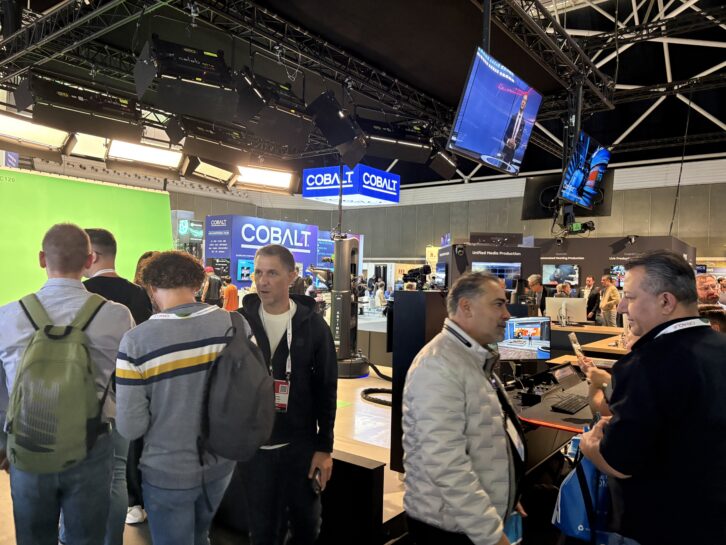
Cobalt Digital emphasised exactly that point with expanded IPMX capabilities designed to simplify the transition between hybrid SDI/IP workflows. AJA’s new OG-FiDO-4 fibre conversion cards were an equally useful reminder that SDI and fibre remain important, particularly as multi-camera deployments continue to expand across broadcast, live production and pro AV.
MultiDyne’s SilverBack-IP sat neatly between those worlds. The latest version of its camera adapter platform brings cinema cameras directly onto ST 2110 networks while retaining familiar camera-centric working practices. Another TVBEurope Best of Show winner, it effectively turns the camera edge into part of the IP infrastructure without requiring operators to rethink the way they work. The SilverBack platform has already found applications beyond conventional broadcasting, including concerts and houses of worship.
IPMX itself was increasingly relevant to Installation readers. Matrox supported the standard alongside ST 2110 and NMOS, with Chyron using Matrox Avio 2 IP KVM extenders to access centralised production systems. PlexusAV was another company demonstrating IPMX-based technology, providing a particularly direct link between broadcast-style media networking and AV-over-IP.
Control-room specialists including G&D, VuWall, Adder and APANTAC provided another point of crossover. G&D and VuWall used IBC for the public debut of vsNEO, a KVM-over-IP platform designed for applications including OB vehicles, esports and corporate control rooms, while Adder’s AIM 6 introduced a redesigned management environment intended to give administrators greater visibility and control over increasingly complex IP KVM installations. AIM 6 bagged a TVBEurope Best of Show award.
These are not uniquely broadcast challenges. Control rooms, network operations centres, command environments and increasingly sophisticated corporate media spaces face the same requirement to provide secure access to distributed resources without making the underlying infrastructure harder for operators to manage.
 BROADCAST EXPECTATIONS
The same crossover was evident in audio. Shure’s WAVETOOL 4 brings monitoring, replay, issue detection and team communications into a shared software environment spanning broadcast, live sound, theatre and houses of worship. Another TVBEurope Best of Show winner, it demonstrates how software-based production workflows can serve teams across several previously distinct markets.
Sennheiser likewise presented broadcast audio as an end-to-end networked workflow, with interoperability across technologies including ST 2110, Dante and NMOS. Calrec expanded its IP-native production offering while addressing applications including sports venues and podcast studios – another category whose boundaries now stretch from traditional broadcasting into corporate, education and content-creation environments.
Accessibility provided an equally relevant example of technology being directed towards audience outcomes. Alongside the Signapse-led Innovation Award winner, ENCO demonstrated a workflow that can generate real-time captions, translate them into multiple languages and convert the translated text into speech. Genelec and RTW, meanwhile, explored immersive monitoring and metering alongside Fraunhofer work using AI to assess dialogue intelligibility.
Those developments matter as much to universities, corporate events, public venues and houses of worship as they do to broadcasters. Expectations established by television and streaming – intelligible speech, captioning, localisation and high production values – increasingly follow audiences into every environment in which content is presented.
Private wireless infrastructure provided another example of an emerging technology moving into practical deployment. Riedel highlighted Mediacom’s use of its Easy5G private 5G system for live coverage of La Vuelta’s departure from Monaco, providing dedicated wireless connectivity for cameras without relying on congested public mobile networks. Private 5G was also among the technologies explored through IBC’s Accelerator programme. Elsewhere, Riedel’s MediorNet deployments illustrated the continued move towards distributed production architectures.
The relevance to AV is again not difficult to see. Stadiums, arenas and other large venues increasingly need production connectivity alongside their installed AV infrastructure, particularly as they generate more content for displays, streaming platforms, social media and direct-to-fan channels.
ONE MEDIA MARKET?
The changing exhibitor mix provided perhaps the simplest evidence of all. Visits to stands including Sharp, Analog Way, ROE Visual, Adder, G&D, VuWall, PlexusAV and APANTAC showed how comfortably companies familiar to Installation readers now sit within IBC alongside established broadcast manufacturers.
Conversely, technologies developed for television production are increasingly being packaged for corporate communications, universities, sports venues, live events and other AV environments. Vizrt Prizm and Grass Valley AVORA are obvious examples, but the same direction could be seen in networked audio, KVM, LED production, virtual studios and software-defined media processing throughout the halls.
That does not mean broadcast and AV have suddenly become identical disciplines. Their operational requirements, cultures and standards remain different in important ways. But the technology layers beneath them are increasingly shared.
IBC’s Accelerator programme reinforced the wider picture, with nine projects addressing real-world challenges spanning agentic AI, immersive experiences, private 5G, accessibility, content provenance and live-event streaming. The AI Agent Assistants for Live Production project, named Accelerator Project of the Year, brought ITN, the BBC and Channel 4 together with multiple technology vendors around a vendor-agnostic framework in which AI agents augment production while editorial control remains with people.
 What connected much of IBC2026 was therefore not a single protocol or fashionable technology but a desire to make increasingly sophisticated media systems easier to deploy, connect and operate. Software-defined infrastructure is allowing resources to move away from dedicated hardware; IP is turning signals into network resources; AI is increasingly handling repetitive or technically difficult tasks; and production capabilities once reserved for broadcasters are becoming accessible to a far wider range of organisations.
Even in a year when attendance slipped, IBC hardly felt like an industry retreating. The rise in first-time exhibitors and sheer number of collaborative demonstrations pointed instead towards a market attempting to make several years of rapid technological development genuinely useful.
For readers of this publication, perhaps the clearest conclusion from Amsterdam was that it is becoming increasingly difficult to discuss the future of AV without discussing media production at the same time. The technologies on display at IBC2026 were increasingly open, software-defined, IP-connected and AI-assisted – but they were also increasingly being designed for a world in which broadcasters, venues, enterprises, universities and other content creators are drawing from the same expanding technology toolbox.
You can subscribe to Installation magazine for free here and the daily newsletter here.