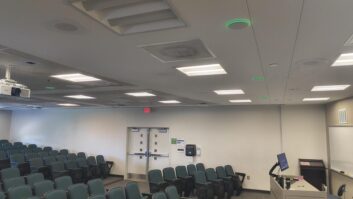
 For a long time, education AV was largely a room-by-room proposition. A lecture theatre needed upgrading, a classroom needed a new display, another space needed better audio or video conferencing. Technology was installed, the room was ticked off the list, and attention moved elsewhere. That model increasingly belongs to the past.
One of the clearest messages emerging from the education sector is that AV is becoming part of the underlying infrastructure of the institution. Displays, collaboration systems, digital signage, scheduling, wayfinding, monitoring and analytics are no longer isolated technologies. They increasingly sit on the same networks, feed into the same management platforms and contribute to the operation of the campus as a whole. That changes the conversation considerably.
The question is no longer simply whether a particular product is right for a particular room. Institutions also need to ask how it connects with everything else, how it can be managed centrally, what data it generates and whether the infrastructure supporting it can accommodate whatever comes next.
NEW THINKING
There is evidence that buyers are already thinking this way. Futuresource research cited in our lead feature found that 46 per cent of Western European education IT decision-makers say integration and interoperability have become more important when selecting vendors during the past two to three years, rising to 60 per cent at large institutions. At the same time, legacy infrastructure and integration challenges remain significant barriers to further investment.
The network is inevitably central to all of this. Once AV becomes networked at scale, the campus itself starts to behave less like a collection of technology-equipped rooms and more like a single technology ecosystem. That creates the possibility of remote monitoring and troubleshooting, better visibility of system health and, increasingly, using AV systems as sources of data about how spaces and technology are actually being used.
That matters when universities are under pressure to make better use of their estates. Occupancy information can influence timetabling and space planning; scheduling systems can improve utilisation; and remote management can allow support teams to identify problems before a lecturer walks into a room and discovers something isn’t working.
AI LAYER
AI will inevitably add another layer. Predictive maintenance, anomaly detection and automated fault triage could make large AV estates considerably easier to manage, although the need for human oversight – and sensible governance of the growing quantities of data being collected – shouldn’t be underestimated.
For AV suppliers and integrators, the implications are significant. Education customers increasingly aren’t buying a series of rooms. They’re investing in an infrastructure expected to remain manageable, secure and adaptable over many years.
And that means the best technology decision may not always be the product with the longest feature list. It may simply be the one that plays nicest with everything else.
See page 12 for a deeper dive into AV as institutional infrastructure.