The previous feature in Installation’s ongoing analysis of the developing resimercial sector considered how designers are making technology less visible within an interior to prioritise aesthetic considerations. Now the next challenge is to make the complexity disappear. Most people are accustomed to controlling their homes through apps and expect similarly automated scenes and simple interfaces in hotels, workplaces and restaurants. Manufacturers are therefore asking how they can adapt to changing consumer expectations.
AVIXA believes the shift across society is impacting how integrators deliver resimercial projects. Mike Sullivan-Trainor, senior industry analyst at AVIXA, believes the drive toward the connected home has become a factor in business user expectations. “This shift is contributing to the interest in intelligent workspaces, experience analytics, and enterprise broadcast,” he says. “For integrators, levelling up skills in these categories is an emerging requirement, as is working more closely in the home with designers and in the business with decision-makers. This is about more than designing display and audio. As in the home, it’s about customer satisfaction, which in business means meeting business goals.”
PERSONALISATION GAP
The connected home has set the benchmark for intuitive interaction. But achieving the same ease in the commercial world is not always straightforward as there simply isn’t the same freedom to tailor preferences. It’s still possible, though, with a few compromises. Joel Mulpeter, senior director of product marketing at Crestron, says: “Your personal media tastes and screen preferences are set to your liking in your home office. The trick in commercial spaces is ensuring that the greatest number of users find the tech intuitive.”
Mulpeter points to the smartphone as the model for meeting rooms that need no training. “After all, no one has to tell anyone how to use an iPhone anymore. Everyone just knows,” he comments.
Stephen Rhead, Sonos Professional manager for the UK and Ireland, sees the same expectation of ease in commercial spaces among customers who use Sonos speakers at home. Most people no longer draw a distinction between resi and commercial tech, even if the pro AV industry often still does, he says. “People use intuitive technology at home, so when they walk into a workplace, hotel, café or retail space, they expect the same simplicity,” Rhead adds.
These new expectations are shaping how projects are delivered. Arding & Hobbs, a former department store in London, was redeveloped as a workspace, leisure and community hub by integrator SCCI using a Control4 controller to unify the AV. The Club Room switches between daytime business and evening entertainment modes, while the events space uses a Halo remote as its single control point, kept discreet within the restored interiors.
Echoing Rhead’s views, Mark Reynolds, vice president and general manager EMEA, at Control 4 distributor ADI, says: “Guests expect the same kind of seamless, personalised technology experience they have at home, from intuitive control of entertainment and lighting to technology that works without extensive instruction. That expectation is influencing how commercial spaces are designed. The technology needs to be sophisticated, but the experience needs to feel effortless.”
Although the manufacturers agree on customer expectations, they don’t always share the same priorities for how to get there. Sonos sees a strong role for app-based management and Rhead often recommends a tablet rather than a phone. In contrast, Crestron’s Mulpeter questions whether asking people to use their own devices is the most intuitive approach. Personally, he has no desire to use his phone in a meeting room. “I don’t want to download an app and navigate its settings. That’s a complexity that’s fine in my home, but I don’t want it in every meeting room,” he comments. “It raises other concerns too: What if you turn the lights off in the wrong room? A touch screen is always there; no need to think about it, just go press a button.”
Voice control is the best example of a domestic habit that does not always translate to resimercial spaces. Mulpeter says meeting-room users have little patience for learning specific commands. Multiple voices in a room also makes recognition harder. Rhead adds that public environments bring noise, privacy and permissions problems. And Sullivan-Trainor says: “While voice assistants raise security and privacy concerns in business, one-touch operations that make a meeting room easier to use, for example, is a carryover trend.”
PERSONALISATION POINTS
There may also be conflicts of interest when trying to personalise shared spaces, where it often requires negotiation to keep everyone happy. Mulpeter sees education as a more consensual environment, but it’s a major stumbling block in meeting rooms. He says: “If multiple people are meeting, who are we personalising the room for? The presenter? To impress a client? The challenge of personalisation across multiple rooms in an enterprise environment could become unwieldy.” AVIXA’s Sullivan-Trainor agrees: “Personalisation is limited in the work environment, largely because most spaces are group spaces that must adapt to functions and work agendas rather than people.”
ADI’s Mark Reynolds sees a strong role for personalisation. He says that the right permissions and privacy safeguards, enable spaces to recognise preferences and automatically adjust controls: “In hospitality, that personalisation may apply to the occasion as much as the individual, with predefined lighting and audio scenes helping a space adapt to different service periods, events or audiences.”
Rather than recognising individual guests, manufacturers agree that some shared spaces – especially in hospitality and retail – are better served by changing settings to suit the time of day or event. A restaurant may need a different atmosphere for lunch, or an evening event, for example. Sonos’ Rhead comments: “Personalisation is increasingly important, but I think the conversation needs to be broader than simply recognising individual users. The bigger opportunity is creating environments that respond intelligently to context. That could mean changing content throughout the day, adjusting atmosphere based on occupancy, or ensuring audio, lighting and visual experiences work together.”
SCENE SETTING
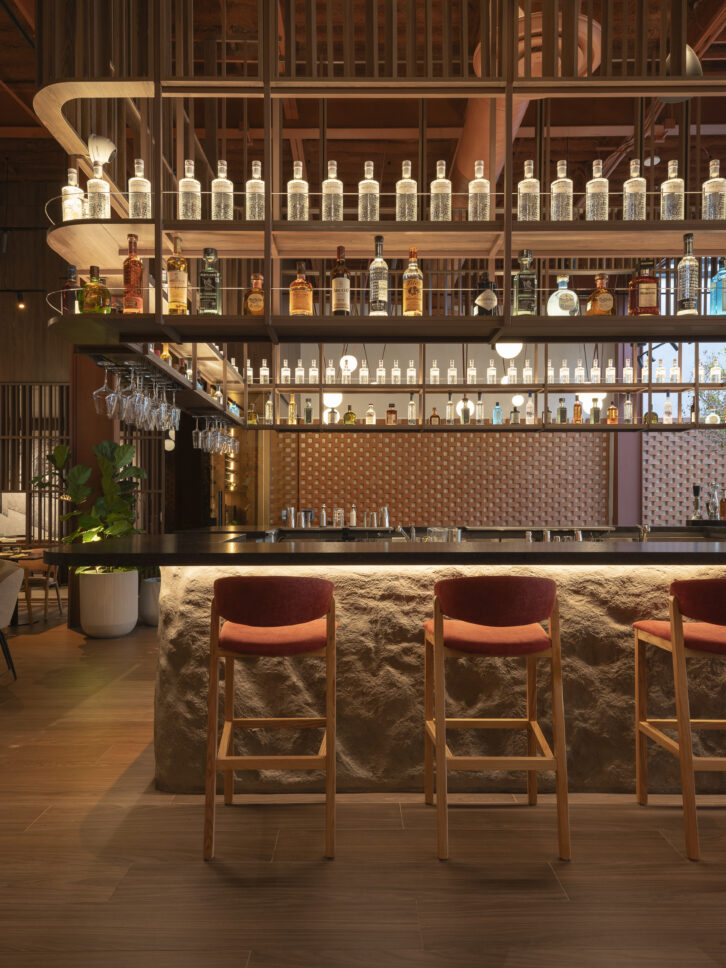
An example of this context-led approach is the ADAMA Bar and Restaurant in Panama City. Integrator Next Level Tech used Control4 preconfigured scenes to move the venue between daytime dining, private events and late-night entertainment. Staff are able to run everything from a central touchscreen, and a DJ station routes live music to selected areas. With table layouts changing under a 6m-high open ceiling, the Episode loudspeakers are arranged as a distributed system to balance coverage.
Clearly, whatever the interface, a frictionless experience depends on the infrastructure beneath it. A commercial system needs to support multiple zones and remain manageable by technical team who are often non-specialists. ADI’s Reynolds says the key is to separate the experience from the complexity underneath it. “The end user should have a simple, intuitive way to interact with a space, while the underlying system provides the reliability, security, centralised management and scalability that commercial environments require,” he says. “Good design makes complexity invisible to end users.”
Rhead feels the key is to make the technology feel simple without oversimplifying the infrastructure behind it. Users want to be able to walk up to a tablet, make a change to the music or adjust a zone and get on with their day. “Behind the scenes, though, the system still needs to be securely managed and built to run reliably day after day,” he comments.
Meanwhile, Mulpeter stresses that Crestron takes care to “bake in” reliability and security from the outset. The designs in both commercial and resi installations inform each other, he argues. “Some of our clients on the resi side need enterprise-grade security and best-in-class reliability for their home offices – their jobs demand it,” he says.
RESIDENTIAL CROSSOVER
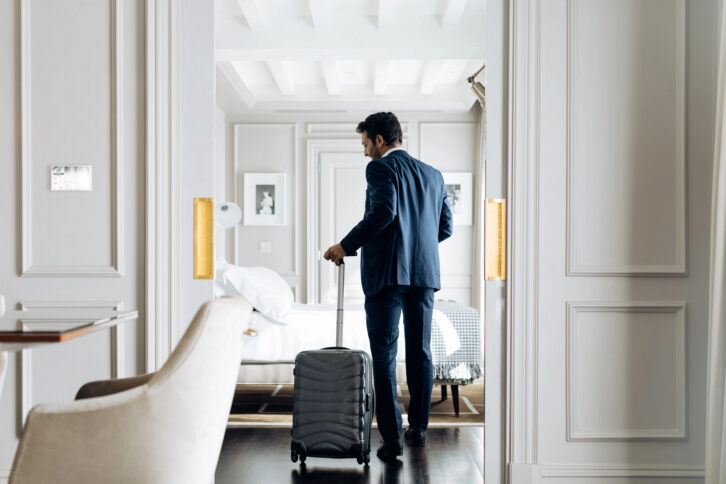
An example of the crossover between Crestron’s residential and commercial technologies, Mulpeter says, is the Cascade Hotel, a Tribute Portfolio property in Kansas City, Missouri. Crestron Home OS, which was developed for residential and multi-dwelling applications, is designed to give staff and guests a single interface for lighting, climate, shades, audio, video and one-touch scenes. “The property is a commercial hospitality experience, but they do run the Crestron Home OS as their control platform for a simple, unified approach to AV control for their staff and guests.”
A further question to consider when installing technology in resimercial spaces is how far it should anticipate users’ needs. Some systems already recognise simple triggers, such as a laptop being connected, or a room becoming occupied, so the environment adapts automatically. Mulpeter says: “Settings can be triggered simply because I plugged a laptop in, started a Teams call, or simply walked into the room. All of those things are inputs into the system, and we react to those inputs.”
Mark Reynolds actually sees anticipation as the ultimate goal. He says: “Ideally, the technology should anticipate what users need rather than requiring them to navigate through multiple menus.”
AI CONTROL
In considering how the application of technology will evolve, Sullivan-Trainor is expecting a “control revolution” to create the intelligent workspace, where AI acts as an autonomous manager monitoring and optimising configurations. “This trend basically takes control out of the hands of users and places it in the hands of trusted AI, which is activated through one touch commands,” he argues. “To get there, AI must be transparent, secure, reliable, available to human review, and conform to privacy policies. We have a way to go, but this is what the future of control looks like.”
Consumer technology is already heading towards greater automation, according to Sonos’ Rhead. The company’s Sonos 27, the latest version of the its audio operating system, is designed to add control through multiple AI assistants and agents, including outside assistants such as ChatGPT. It is a home release, but Rhead sees it as part of a wider trend also affecting commercial spaces. He adds: “We’re already seeing the impact of better software design, cloud management and AI-driven experiences; recently announced Sonos 27 reflects that wider industry trend towards more intuitive and adaptable control environments.”
When asked to look five years ahead, our contributors envisage different combinations of automation, personalisation and the role of AI, but share an emphasis on removing friction. AVIXA’s Sullivan-Trainor explains: “In the workspace, it’s definitely one touch that triggers an AI-orchestrated scenario that configures the space for the appropriate tasks. In addition to that this allows dynamic changes if for some reason tasks shift, or timelines change. Adding in remote colleagues on schedule or ad hoc should be seamless as well. And access to analytic findings for key cross-company data that drives decisions will be a major component.”
EFFORTLESS FUTURE
Mulpeter is more concerned with the outcome than the mechanism. He adds: “It’s one that continues to serve the needs of the meeting; one that when you walk into the room, you don’t think about the technology. It just does what you need it to do.”
For Rhead at Sonos, the future lies in more natural interaction. He says AI will contribute a lot, but he thinks the aim should always be to simplify rather than adding more complexity. “Developments such as Sonos 27 hint at a future where users can interact with systems more naturally, whether through software, automation or conversational interfaces. Five years from now, the strongest AV experiences will be the ones that feel effortless, even though there’s an enormous amount of technology working in the background.”
When assessing the future of resimercial AV, the goal will be to deploy sophisticated technology that supports users without drawing attention to itself. For integrators, that means prioritising experience while maintaining robust infrastructure. As automation advances, the challenge will be to preserve simplicity without sacrificing control. Ultimately, the most successful technology will be the technology users barely notice.
You can subscribe to Installation magazine for free here and the daily newsletter here.