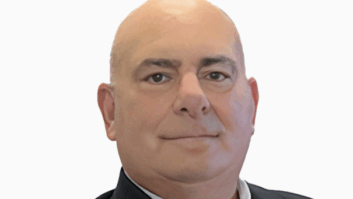
Ten years ago, Paul Cales was just another “student roadie”, troubleshooting network problems on festival stages in Brittany as an engineering undergraduate. But two years after building a final-year prototype in response to a tour manager’s challenge, he founded Naostage straight out of university in 2018.Now 32, he is CEO of an expanding tracking technology company with systems distributed in more than 20 countries and used on tours by artists including Indochine and Orelsan. “I’ve never worked for anyone else,” he says. “I got my degree and founded Naostage. It’s crazy, and it remains a major challenge because we’re still a very young company with a really young C-level team.”
As a young man, Cales had only the vaguest idea what pro AV was. Certainly it was not on his horizon as a career path. But as soon as he discovered a world that combined his two lifelong passions – music and engineering – he felt completely at home. Born in Toulouse, Cales moved with his family to Nantes, in Brittany on the wild north-western coast, when he was four. Music was always a major part of his life and, after secondary school, he played lead guitar and wrote songs for The Shamrocks, a Celtic punk band whose Irish drummer gave the group its distinctive sound. “We did well locally and I was passionate about it at the time,” he recalls. “Now I don’t have time to be in a band, but I play guitar every day.”
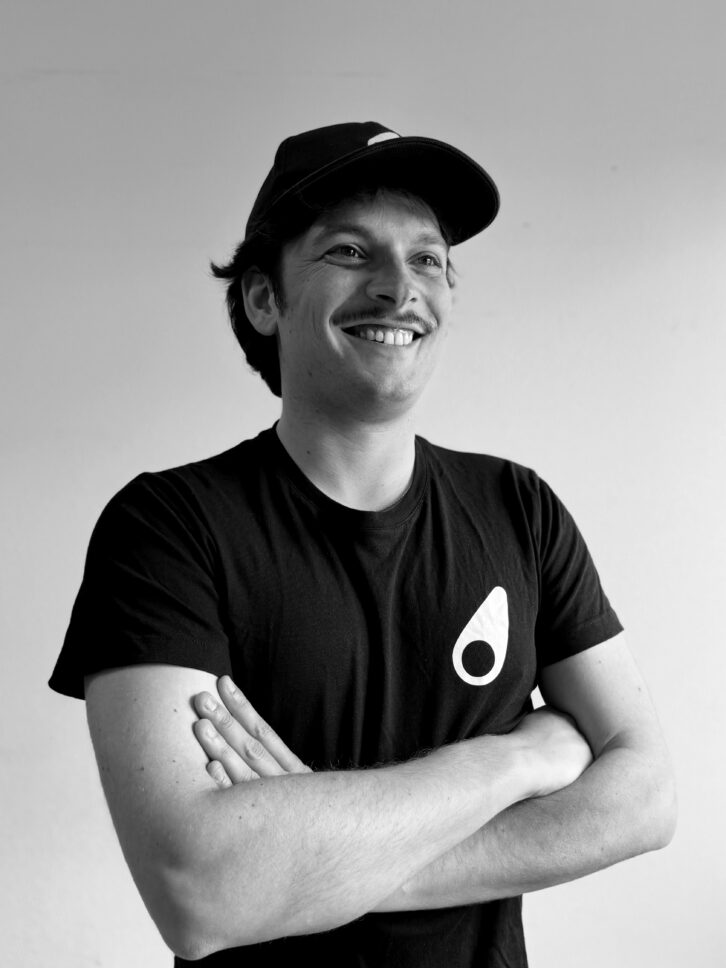 The band didn’t survive university, but his love of music never waned. He has musician friends who play with established French artists like Zaho de Sagazan and the UK’s Arctic Monkeys. Cales is still a good enough musician to join them for jamming sessions in the studio at weekends.
Cales’ introduction to pro AV came purely by chance after he enrolled to study engineering at the prestigious INSA Rennes in Brittany. Alongside his studies, he joined the team behind Rock’n Solex, France’s oldest and largest student-run festival, and soon realised it was where he belonged. “That was where I discovered the worlds of followspots [lighting systems that automatically track and illuminate performers], sound, lighting and video, along with the technicians and stage managers behind them,” Cales says. “And I instantly became completely hooked!”
Cales and future Naostage co-founders Olivier Le Doeuff and Nathan Van De Hel – fellow students at INSA – soon began working for rental companies, venues and festivals across Brittany, including Route du Rock. “We were basically student roadies! We became the ‘engineering-student troubleshooters’, because networking was only beginning to be used widely in the industry and many technicians had problems with it,” Cales explains. “We were always troubleshooting things on stage.”
For the young music lovers, working behind the scenes for international artists was exhilarating. “We became completely crazy on the technology, but also the people. It’s a unique industry united by a shared passion for technology, music, what we create and even the pressure of putting on a show.”
MODEST AMBITIONS
At the time, Cales had modest career ambitions. He hoped to become an R&D engineer at a lighting or audio manufacturer. But that changed during an international tour by the Belgian rapper Stromae, when the technical director approached him and his friends and asked them to solve a tricky engineering problem. “He said, ‘Hey you, the little engineering students. I need to develop an automated, beaconless tracking system for Stromae because I want him to interact with the lighting, video and media content. Nothing on the market can do it’,” Cales recalls. “That request was where Naostage began.”
The friends had no time to build a prototype before the tour began, but they were fascinated by the challenge and chose it as their final-year engineering project. Once they had worked out the concept, they presented it to leading figures in the French live-events industry, including the CEO of L-Acoustics. The response was highly positive, but also cautious. “Everybody told us it represented the future,” Cales says. “But they also said ‘you can try it, but it will be really complex to develop’.”
Existing systems relied on radio tags, infrared beacons or cinema-style motion capture, all requiring performers to wear devices. Naostage’s ambition was to remove the wearable entirely. A French student-entrepreneur research contract with Inria (the French National Research Institute for Digital Science and Technology) provided the support they needed to spend almost five years developing the technology.
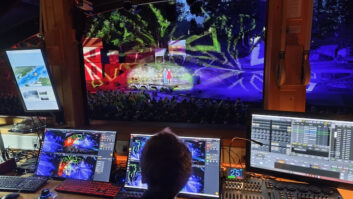
Naostage’s tracking system was first used at the Puy du Fou theme park, near Nantes, in 2021, before moving to the Les Vieilles Charrues festival, the French equivalent of Glastonbury, to control multiple followspots. It has since been deployed for the tours of several well-known French musical artists. Cales believes the company’s technology arrived just at the right time, and momentum is building despite the residual suspicion that greets new ideas.
TIPPING POINT
“In deep tech, timing is everything,” Cales explains. “We now have tag-free, AI-based tracking that works, and we’re reaching a tipping point where we can step into the big leagues of pro AV. But new technologies always take time to become part of standard workflows, and people in AV are understandably cautious. When a show or installation has to perform flawlessly, nobody wants to bet on an unproven solution. A big part of our job is overcoming this natural inertia.”
The original idea behind tracking, he explains, was to resolve the growing disconnect between live performers and the AV production surrounding them. Cales says it can sometimes feel as though you’re watching two shows at once – the human artistic performance and the AV performance. “We want to reconnect them and let the artist interact with the AV world,” he says. “If you understand a space in real time and know where the people and objects are, you can create that kind of interaction.”
LETTING GO
Having co-founded the company and watched his ‘baby’ grow, Cales couldn’t let go at first and wanted to control every aspect. But he’s learned to trust his team. “When you surround yourself with people who are better than you at their craft, and then get out of their way, the company moves at a different speed. This is an industry full of passionate and resourceful people – technicians, artists, engineers. We all share the same obsession with making the system work, no matter what. That camaraderie is part of pro AV.”
Today, Naostage employs 20 people, led by a four-person strategic board. Two of them, Le Doeuff and Van De Hel, have been there from the beginning. Le Doeuff leads software R&D and Van De Hel oversees production and hardware. Meanwhile, Alexis Reymond heads international sales, while Cales focuses on strategy, partnerships and the French market. “I’m not in day-to-day development now,” Cales says. “But I’m still the product expert – the person who knows the most about the tech and how it works. I help lead the next developments by bringing customer and market feedback to the development team.”
Artificial intelligence is everywhere in pro AV, and it is often difficult to separate real innovation from marketing hype. But that’s not the case for Naostage, as AI really has been at the heart of the K SYSTEM platform from the beginning. Remarkably, Nostage has even developed its own neural networks and training pipeline. “We worked with advanced researchers at Inria, including some of the first to publish papers on AI. We developed our own learning pipeline as everything we do has to operate in real time. This is very different from consumer-generative AI such as ChatGPT. We use real-time computer-vision intelligence. Analysing an image in real time is very different from working with large quantities of text.”
The cutting-edge nature of Naostage’s operations demands the retraining of its AI models every three months using data generated by systems deployed around the world. The company has its own very large thermal-vision dataset for detecting people. The rarity of the dataset makes it in demand. “Outside military applications, very few organisations have that kind of thermal dataset. We’ve had requests from organisations interested in using the dataset for other purposes, including medical applications, although it was created entirely from concerts and live-music environments,” Cales explains.
Though the technology promotes automation, Cales insists that it won’t remove humans from the equation. “It’s difficult for some people to understand, but you cannot completely trust a computer on its own. Can you imagine a Taylor Swift stadium show being run only by a computer? You always need a person to monitor it and make decisions.”
Where automation does change things, he argues, is in what becomes creatively possible. On one large festival production, K SYSTEM controlled around 30 fixtures to follow five performers across a stage roughly 40m wide. Achieving the same result with traditional followspots would have required between 12 and 18 operators, a number that was never realistic in the first place. “We weren’t replacing 12 people because those 12 positions would never have existed!” Cales insists. “We made a much more ambitious creative result possible. You still need people to configure, install, calibrate and monitor the system. One technician controlling a system that replaces the work of 12 followspots has more responsibility, not less. That’s our vision.”
BROAD ADOPTION
Naostage’s tracking technology was born in the live music scene, but it has since spread into a much wider range of applications, he says. Naostage now works across fixed and corporate installations, where tracking can automate followspots, PTZ cameras and triggers – muting a microphone automatically when someone leaves a stage, for instance – as well as theme parks. The company has also signed its first broadcast contract, for a major French TV show launching later this year, where its technology will automate PTZ camera capture to track people living together in a house.
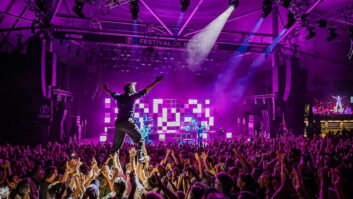
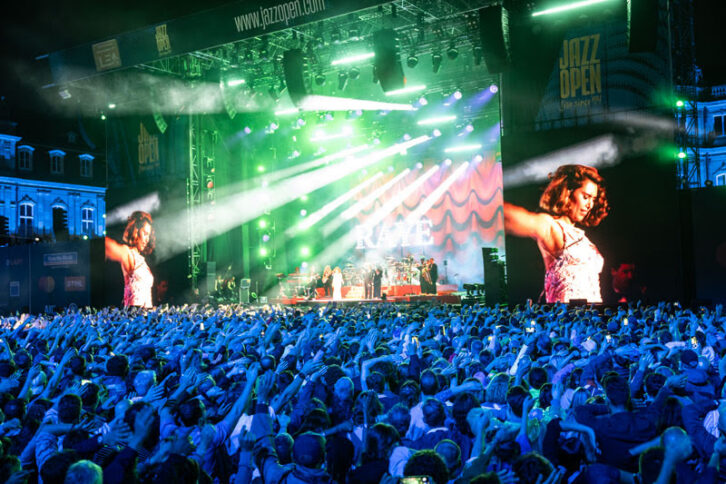
But the live work is still at the heart of Naostage’s work, including recently at the 60th anniversary of the Montreux Jazz Festival in Switzerland. Naostage’s technology handled lighting show control for a performance by English jazz singer RAYE, featuring guest appearances including Alicia Keys. “We’re now distributed in more than 20 countries across Europe, Australia and Asia,” Cales says, with the US next in line for a bigger push. “We’re growing strongly in France and Europe, and we also have projects in South-East Asia, China and Hong Kong.”
Away from techand music, Cales’ other enduring passion is rugby union. Born in Toulouse, he remains a devoted Stade Toulousain supporter and used to play scrum half himself. “There’s too much business around football. Rugby feels more like a genuine sport based on the team rather than individual performance,” he says. “The only reason I stopped playing is because it’s too violent! I don’t want to arrive at the office or a trade show with an injury or a black eye.”
The pro AV industry has not only shaped Cales’ career, but also his personal life. Around two years ago, he met his fiancée, Audrey, a lighting designer, while both were working on the Drag Race France arena tour. When he allows his mind to wander beyond the day-to-day demands of running Naostage, he always drifts off to his favourite place in the world. “It’s Réunion Island. It’s a really beautiful island with wonderful people. It’s awesome,” he says. “If Naostage is successful and I’m eventually able to retire, I’ll go and live there.”
STAYING CURIOUS
Having found success in the industry at a young age, Cales is keen to pass on what he has learned. Above all, he advises anyone considering a career in pro AV to remain curious. The best people in the industry, he says, understand a little about everything – from lighting and networking to software and computer vision – as well as the human realities of working under pressure at 2am during a show. “Pro AV is exactly where art meets engineering. The more fluently you can speak both languages, the more valuable you become,” he says.
It is advice that reflects his own journey from student roadie to tech start-up CEO. “Spend time in the field, too,” he adds. “Don’t become disconnected by remaining in the office. No speech or classroom lesson can teach you what a real venue, a real show and a real deadline demands. That’s where the learning happens.”
You can subscribe to Installation magazine for free here and the daily newsletter here.