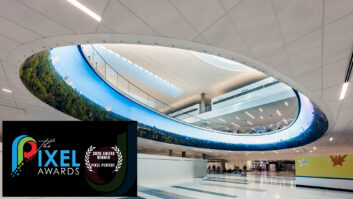
The 220ft Oculus LED installation at George Bush Intercontinental Airport in Houston has won a Digital Signage Federation (DSF) Pixel Award for its visual design and creative execution.
Created as part of the transformation of Terminal E’s International Central Processor, the installation combines more than 2,000 custom-fabricated Nanolumens Nixel Series LED modules to form a rounded, continuous display suspended at a 60-degree angle between the airport’s Arrivals and Departures levels.
The truncated elliptical structure delivers a resolution of 34,584 by 1,416 – almost 49 million pixels – with pixel pitches ranging from 1.4mm to 2mm and brightness calibrated to 800 nits for the brightly lit terminal.
 Commissioned by Houston Airports, the project brought together Nanolumens, which engineered the display configuration and manufactured the LED modules; Ford AV, which led integration and installation; Gentilhomme, responsible for on-screen content; and Smart Monkeys, which supplied its ISAAC workflow platform.
The installation was recognised in the DSF Pixel Awards’ Pixel Perfect category for Best Visual Design and Creative Execution.
“Our part was engineering a display that standard LED modules could not achieve, and seeing that work land on one continuous surface makes this award meaningful,” said Dan Rossborough, director of strategic projects at Nanolumens.
Designed to introduce arriving passengers to Houston, Oculus operates as both a large-scale media canvas and an architectural feature positioned above one of the terminal’s principal passenger circulation areas.